
Best Place For A Carbon Monoxide Detector
Alright, settle in, grab your imaginary latte, because we're about to talk about something super serious, but we're going to do it with a smile and maybe a few chuckles. We're diving into the mysterious world of carbon monoxide detectors – specifically, where on earth you should put the darn things. Because let's face it, nobody wants a visit from the "Silent Killer" (which sounds less like a gas and more like a poorly-named pro wrestler, right?).
Carbon monoxide, or CO for short, is the ultimate party crasher. It's colorless, odorless, and tasteless. It’s basically the ninja of hazardous gases, slipping into your home undetected and making you feel drowsy, headachey, and eventually… well, let's just say you might miss your favorite TV show. So, knowing where to plop its noisy little sentinel is key to not becoming a CO cautionary tale.
The Absolute #1 Spot: Near Your Sleepy Head!
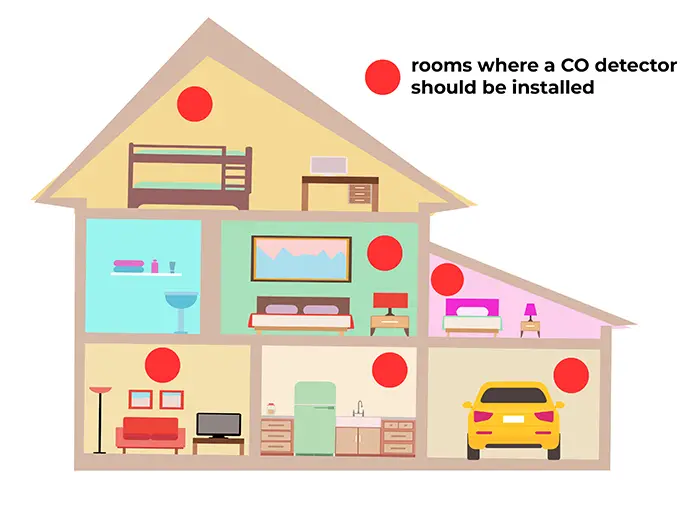
Okay, so this one isn't rocket science, but it's often overlooked. The absolute prime real estate for a CO detector is near sleeping areas. Think about it: when are you most vulnerable? When you're tucked in, dreaming about winning the lottery or arguing with a talking squirrel. Your body's natural defenses are down, and you're less likely to notice the early symptoms of CO poisoning.
Must Read
Now, do you put it inside every bedroom? The general wisdom says no. You want it in the common hallway or area outside the bedrooms. This way, if little Timmy's dream of being a superhero is interrupted by an alarm, everyone gets the memo. So, picture this: one detector for every sleeping zone. If you've got three bedrooms grouped together, one in the hall outside them is usually sufficient. But if you have a guest bedroom across the house, that's a whole new sleeping zone that needs its own guardian angel.
And yes, "above your head" when sleeping is important because CO can affect you when you are most relaxed. So, placement within a few feet of your bed, not directly above, but in the general sleeping area is crucial. We're aiming for early warning, not a rude awakening when it's too late to even yell for help.

The "Every Level" Mandate: CO Doesn't Do Stairs!
Here's a fun fact that might surprise you: CO doesn't care about gravity. It doesn't rise like hot air or sink like a lead balloon. It mixes pretty evenly with the air in your home. This means if you only have a detector upstairs, and a furnace problem starts brewing in the basement, that CO has to travel a long way to politely ask your upstairs detector for attention. And by then, you might be feeling more than just a little woozy.
So, the rule of thumb? At least one CO detector on every level of your home. Basement? Yep. Main floor? Absolutely. Upstairs? You betcha. Think of it like a neighborhood watch program, but for dangerous gases. You wouldn't just have one watchman for an entire city block, would you? Unless that watchman was Superman, and even he'd probably appreciate some backup.

Especially if you have fuel-burning appliances (furnace, water heater, gas dryer) in your basement or utility room, that basement detector is your first line of defense. Don't skip it!
The "Nosey Neighbor" Placement: Near Appliances (But Not TOO Near)
This is where things get a little nuanced. You'd think, "Aha! I'll just plunk it right next to the furnace, where the evil lives!" And while that logic is adorable, it's not entirely correct. Placing a detector too close to a fuel-burning appliance can lead to false alarms. Why? Because these appliances sometimes emit small, harmless puffs of CO during startup or shutdown. Your detector, bless its sensitive heart, might mistake these for a full-blown crisis.
So, the sweet spot? At least 5-15 feet away from any fuel-burning appliance. This includes your furnace, water heater, gas stove, and fireplace. Think of it as giving the appliance its personal space. You don't want your detector getting "too friendly" and crying wolf every time the furnace clears its throat.
And don't forget your garage! If you have an attached garage, especially if you ever start your car in there (even for a second to move it!), a CO detector is a must-have. Because car exhaust is a major source of CO, and that stuff can seep into your living space faster than you can say "oops, left the car running."
Where NOT to Put Them (Because Location, Location, Location!)
Just as important as where to put them is where not to. Avoid placing your CO detectors:

- Directly above or next to fuel-burning appliances: (As discussed, false alarms are a pain.)
- Near windows or exterior doors: Drafts can mess with readings.
- In direct sunlight: Heat can affect the sensor.
- In extremely dusty, dirty, humid, or greasy areas: Think bathrooms or kitchens. The steam, grease, and dust can clog the sensor.
- Within 15 feet of heating/cooling vents: Airflow can dilute or redirect CO, affecting detector accuracy.
Generally, look for a wall or ceiling location, at least 5 feet off the floor. CO mixes with air, so it's not like you need to put it on the floor for it to "catch" it. Mid-wall or ceiling height is just fine, making sure it's not obstructed by furniture or curtains.
The Grand Finale: Be Smart, Be Safe, Be Happy!
So there you have it! Installing carbon monoxide detectors isn't just about sticking them anywhere they fit. It's about strategic placement that makes sure these little heroes can do their job effectively. Remember: near sleeping areas, on every level, and strategically near (but not too near) appliances. Test them regularly, replace their batteries (or the units themselves after 5-7 years, depending on the model), and educate your family.
Because while we love a good mystery, the "Silent Killer" is one story we never want to be a part of. Stay safe, stay humorous, and may your home always be CO-free!