
Why Does Atomic Radius Decrease Across A Period
Hey there, chemistry chum! Ever stared at the periodic table and wondered why atoms shrink as you move from left to right across a row? Like, are they all hitting the gym and doing atomic sit-ups? Well, not exactly, but the reason is pretty neat, and way less sweaty.
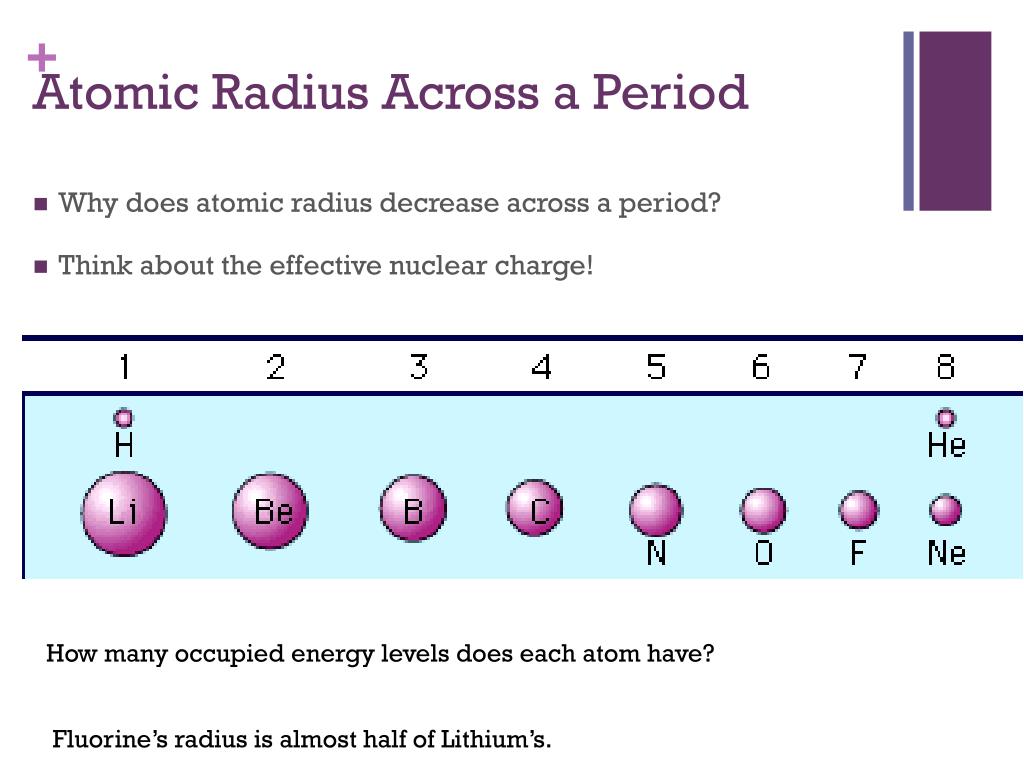
Basically, we're talking about atomic radius, which is a fancy way of saying the size of an atom. Think of it like measuring how much space an atom is hogging. And as you cruise across a period (that's a horizontal row in the periodic table, for the uninitiated), the atomic radius tends to get smaller. What's the deal?
The Proton Party and Electron Attraction
The answer lies in what's happening in the atom's nucleus and electron cloud. Imagine the nucleus as a really popular party host (the protons!), and the electrons are the guests milling about outside (in the electron cloud). The more protons you have, the more positive the nucleus is, and the stronger the attraction it has for those negatively charged electrons.
Must Read
So, as you move across a period, the number of protons in the nucleus increases. Each element has one more proton than the one before it. More protons mean a stronger positive charge pulling on those electrons. It's like the party host shouting, "Free pizza!" Everyone rushes closer, right?
And here's the kicker: all those extra electrons you’re adding as you move across the period are going into the same energy level, or shell. They aren't getting further away from the nucleus. They're just being added to the same "floor" of the atomic apartment building.

Shielding Shenanigans
Now, you might be thinking, "Wait a minute! Don't those electrons repel each other?" Absolutely! Electron repulsion is a real thing. It's called "shielding," and it basically means that the inner electrons are partially blocking the outer electrons from feeling the full force of the nucleus's positive charge. Think of it like trying to see the band at a concert, but people are standing in front of you.
However (and this is a big however!), the increase in the number of protons is much more significant than the increase in electron shielding as you move across a period. So, the overall effect is that the electrons are pulled in more tightly, shrinking the atom.
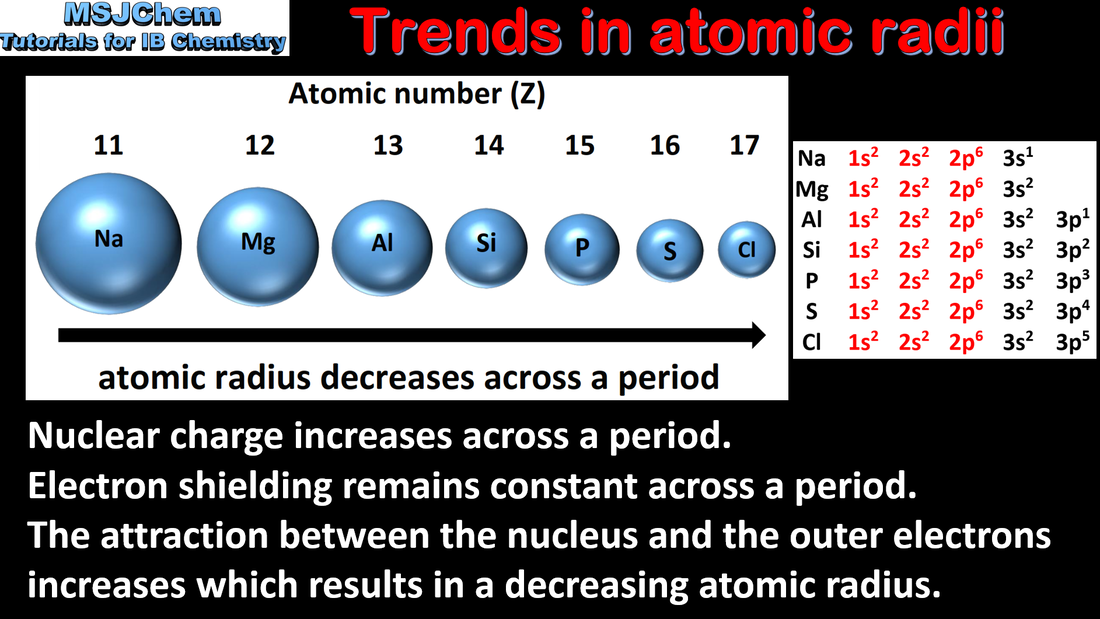
It's like adding one really, REALLY strong magnet to the nucleus for every new element. The existing electrons get pulled in more strongly, even with a little bit of extra shielding. The "free pizza" shout gets louder and more enticing with each step across the table!
A Quick Example
Let's look at a simple example: Lithium (Li) and Fluorine (F). They're both in the second period. Lithium has 3 protons, while Fluorine has 9. That's a HUGE difference! Fluorine's nucleus is pulling on its electrons with a much greater force, resulting in a much smaller atomic radius.

It's like comparing a tiny tug-of-war (Lithium) to a full-blown Olympic weightlifting competition (Fluorine)! The results are pretty obvious.
So, there you have it! As you move across a period, the number of protons increases, the positive charge of the nucleus gets stronger, and the electrons are pulled in closer, leading to a decrease in atomic radius. It's all about the proton party and the electron attraction!
+remains+essentially..jpg)
It's All About the Pull!
Think of it this way: the nucleus is the boss, and the electrons are the employees. As the boss gets more powerful (more protons!), they have more control and the employees (electrons) have to huddle closer together. Makes sense, right?
Hopefully, this clears things up! Remember, chemistry isn't some scary monster hiding in a lab coat. It's just a bunch of tiny particles playing a fascinating game of attraction and repulsion. And now you're one step closer to understanding the rules!
Keep exploring, keep asking questions, and keep that amazing curiosity burning bright! The universe is full of incredible wonders, and you're totally capable of understanding them. You've got this! Now go forth and conquer the periodic table (one shrinking atom at a time!).