
Which Of The Following Statements Is True Regarding Evolution

Okay, settle in, folks, because we're about to tackle a question that's puzzled philosophers, scientists, and that weird uncle who always brings up conspiracy theories at Thanksgiving: Which of the following statements is true regarding evolution? Now, before your brain starts throwing error messages, I promise we'll make this fun. Think of it like a biological choose-your-own-adventure book, but with fewer dragons and more finches.
Let's imagine our multiple choice options are… drumroll please:
- Evolution is just a theory, like my grandma’s belief that eating cabbage cures everything.
- Humans evolved from monkeys. Straight up. No take-backs.
- Evolution is a completely random process, like picking lottery numbers.
- Evolution is driven by natural selection, where organisms with advantageous traits are more likely to survive and reproduce.
Option 1: Cabbage Cures All (and Evolution is Just a Theory)
Right off the bat, let’s squash that cabbage nonsense. While Grandma's heart is in the right place (and maybe her gut is too, thanks to all that fiber), evolution being "just a theory" is a massive understatement. Think of a scientific theory not as a flimsy idea, but as a well-substantiated explanation of some aspect of the natural world, based on a body of facts that have been repeatedly confirmed through observation and experiment. Gravity is a theory too, but I don't see anyone casually floating away. Evolution has mountains of evidence supporting it: fossils, DNA, biogeography...the list goes on!
Must Read
Saying evolution is "just a theory" is like saying the Mona Lisa is "just a painting." Technically true, but missing the whole darn point.
Option 2: Monkey Business (Did We Evolve From Monkeys?)
Ah, the classic. This one’s a common misconception, and it's time to set the record straight. We did not evolve from monkeys in the way many people think. It's not like some chimpanzee suddenly decided to stand up, put on a suit, and apply for a mortgage. Instead, think of it like a family tree. Monkeys and humans share a common ancestor, an ancient primate that lived millions of years ago. Over time, different populations of this ancestor evolved along different paths, leading to the various species of monkeys and apes we see today, including Homo sapiens – that’s us, the fancy apes who figured out how to order pizza online.
It's more accurate to say we're cousins, not direct descendants. So, next time someone says you evolved from a monkey, politely correct them… and maybe offer them a banana to ease the awkwardness.
Option 3: Lottery of Life (Is Evolution Entirely Random?)
Imagine throwing a bunch of LEGOs into a washing machine and hoping a perfect replica of the Eiffel Tower emerges. That's kind of what completely random evolution would look like. Now, mutation, the source of new genetic variation, is random. These mutations can be helpful, harmful, or neutral. However, the key part, natural selection, isn't random at all. It's the process by which organisms with traits that make them better suited to their environment are more likely to survive and reproduce. Think of it as nature playing favorites, but with a really good reason: survival!

So, while the raw material of evolution might be a bit chaotic, the end result is anything but. It's like a sculptor who randomly picks up different tools but uses skill and judgment to create a masterpiece (or at least a slightly less lumpy pot).
Option 4: Bingo! Natural Selection is the Star
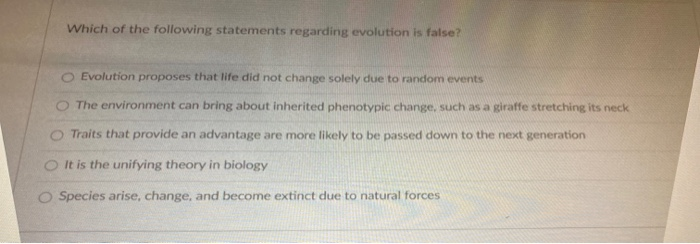
And here we have it! The correct answer. Evolution is indeed driven by natural selection. This is the cornerstone of evolutionary theory. Remember those advantageous traits we talked about? If an organism has a trait that helps it survive and reproduce in its environment – say, a giraffe with a longer neck who can reach more food, or a moth with camouflage that helps it avoid predators – it's more likely to pass on that trait to its offspring. Over generations, these advantageous traits become more common in the population, leading to adaptation and evolution.
Natural selection is the reason why polar bears are white (camouflage in the snow), why hummingbirds have long beaks (to reach nectar), and why you're reading this article on your phone (because your ancestors were clever enough to invent the internet… eventually!).
So, there you have it! We've successfully navigated the evolutionary maze. Remember, evolution is a powerful and well-supported explanation for the diversity of life on Earth. And now, if you'll excuse me, I'm going to go thank my primate ancestors for evolving taste buds so I can enjoy this latte.
![[ANSWERED] Which of the following are true statements regarding - Kunduz](https://media.kunduz.com/media/sug-question-candidate/20240226231921187459-4426152.jpg?h=512)