
When Did 174 High Index Lenses Become Available
Okay, picture this: You're squinting at the world, right? Glasses are perched precariously on your nose, and they're about as thick as a brick. Not exactly the coolest look, huh?
But what if I told you there was a way to ditch those coke-bottle lenses for something sleek, light, and way more stylish? Enter high-index lenses! Specifically, the elusive 1.74 high-index lenses. But when did these magical vision-correctors actually appear on the scene?
That's the question that's been buzzing in my head lately. Let's dive in, shall we?
Must Read
The Quest for Thinner Lenses: A Little Background
Before we pinpoint the 1.74's arrival, let's quickly understand why we even need high-index lenses. Think of it like this: regular lenses bend light a certain amount. But for those of us with stronger prescriptions, that bend needs to be, well, bendier! To achieve this with traditional materials, you end up with thicker, heavier lenses. Not fun.
High-index lenses use special materials with a higher refractive index. This means they can bend light more efficiently, allowing for thinner lenses, even with stronger prescriptions. It’s like trading in a gas-guzzling SUV for a fuel-efficient sports car - same job, way more streamlined!

So, the higher the index, the thinner the lens…generally speaking. Makes sense, right?
So, When Did 1.74 High-Index Lenses Show Up?
Now for the million-dollar question! Pinpointing the exact date is a bit tricky. It's not like there was a global announcement with fireworks and confetti (though, maybe there should have been!). However, the general consensus points to the late 1990s and early 2000s.
Think about it: The '90s were a time of technological leaps, from the internet boom to increasingly sophisticated plastics. It's reasonable to assume that material scientists were hard at work developing polymers capable of achieving that coveted 1.74 refractive index around that time.
It's like trying to track down the first time someone made the perfect cup of coffee. You can get close, but pinpointing the exact moment is a near-impossible task.
Why Is 1.74 So Special?
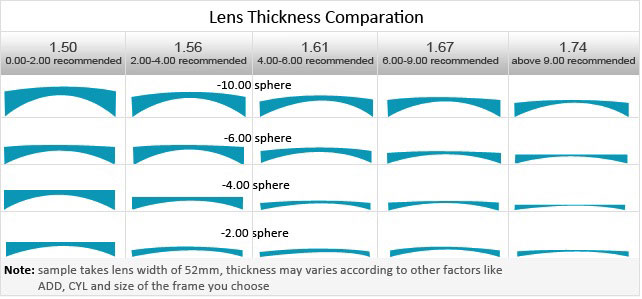
Okay, so why all the fuss about this specific number? Well, 1.74 high-index lenses represent a significant leap in thinness. They are, generally speaking, the thinnest plastic lenses available. For people with strong prescriptions – especially those dealing with significant myopia (nearsightedness) – 1.74 lenses can make a huge difference in both aesthetics and comfort.
Imagine the weight difference between carrying around a dictionary versus a paperback novel. That's the kind of difference we're talking about here!

They are significantly thinner than standard plastic or even other high-index options like 1.60 or 1.67. This translates to less distortion around the edges of the lenses, a lighter feel on your nose, and a more flattering appearance. Who wouldn't want that?
The Impact of 1.74 Lenses: A Game Changer
The arrival of 1.74 high-index lenses was a real game-changer for many. Suddenly, people who had previously felt self-conscious about their thick glasses had options. It opened the door to a wider range of frame styles too. You could finally rock those stylish, delicate frames without the lenses bulging out!
Think of it like this: before 1.74, choosing glasses with a strong prescription often meant sacrificing style for function. But with these ultra-thin lenses, you could finally have both! That’s pretty cool.
Are 1.74 Lenses Right for You?
While 1.74 lenses offer fantastic benefits, they aren't always the best choice for everyone. They can be a bit pricier than other options, and depending on your specific prescription and frame choice, other high-index lenses might offer a better balance of cost and performance.
As always, it's best to chat with your eye doctor or optician to determine the best lens material and design for your individual needs. They can assess your prescription, consider your lifestyle, and help you find the perfect pair of glasses to help you see the world clearly and comfortably.
So, the next time you see someone rocking a pair of super-slim glasses, take a moment to appreciate the technology that made it possible. Who knew lens technology could be so fascinating? Now you do!