
What's Inside Of A Fire Extinguisher

Hey there, fire safety superstar! Ever looked at that trusty red (or sometimes silver) cylinder hanging on the wall and thought, "What on earth is brewing inside that thing?" You're not alone! Most of us just know it's there for a 'break glass in case of emergency' moment, but the inner workings are a bit of a mystery. Well, pull up a comfy chair, because we're about to demystify the humble fire extinguisher, and it's actually pretty cool!
Think of a fire extinguisher as a miniature superhero, ready to leap into action at a moment's notice. But instead of capes and superpowers, it relies on some clever science and a few key ingredients. No magic spells here, just good old physics and chemistry!
The Outer Shell: More Than Just a Pretty Face
First up, we have the cylinder itself. This isn't just any old can; it's a super sturdy, pressure-resistant container designed to hold its contents under high pressure. You wouldn't want it to burst prematurely, would you? That would make for a very messy surprise, and probably wouldn't put out any fires effectively!
Must Read
The "Oomph": Pressurized Gas
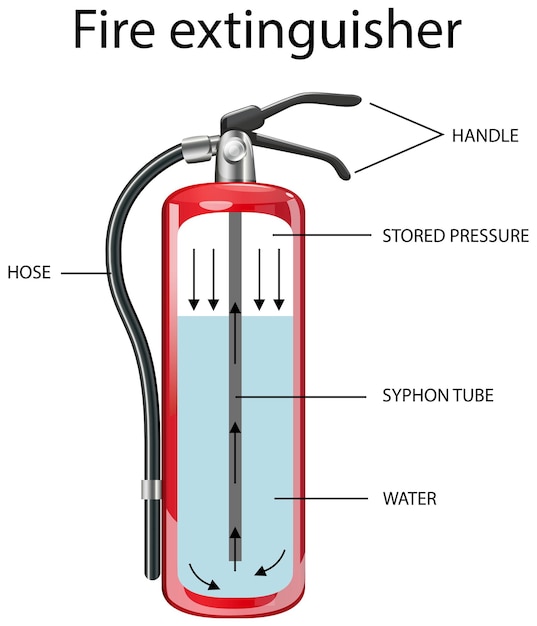
Now, how does all that fire-fighting goodness get out of the cylinder and onto the flames? That's where the propellant comes in. Inside most extinguishers, there's a canister of highly compressed gas – often nitrogen, but sometimes carbon dioxide (which can also double as the extinguishing agent!). This gas is like the strong friend who gives you a boost; it provides the force to push the fire-fighting agent out when you squeeze the handle. It's the "oomph" that turns a simple container into a flame-stopping cannon!
The Main Event: The Extinguishing Agent
Alright, this is the star of the show! The extinguishing agent is the actual stuff that battles the blaze. And just like different types of villains need different superhero powers, different types of fires need different extinguishing agents. Let's meet the most common ones:
1. Water (Class A)
Yup, good old H₂O! Some extinguishers are just glorified, super-pressurized water guns. They're fantastic for common combustible materials like wood, paper, and textiles – what we call Class A fires. They cool the fire down below its ignition point. But remember: never, ever use water on electrical fires or flammable liquids. That's a recipe for disaster (and a bigger fire!).
2. Dry Chemical (ABC or BC)
This is probably the most common type you'll find in homes and offices. It's usually a fine powder, often made of monoammonium phosphate or sodium bicarbonate. When you blast it out, it forms a powdery cloud that interrupts the chemical reaction of the fire. It’s like telling the fire, "Hey, you two, stop fighting!" It works on Class A (solids), Class B (flammable liquids), and Class C (electrical) fires. Talk about an all-rounder!
3. Carbon Dioxide (CO₂) (BC)
These cool cats dispense a plume of super cold CO₂ gas. How does it work? It essentially suffocates the fire by displacing the oxygen around it. No oxygen, no fire! Plus, because it’s a gas, it leaves behind no messy residue, making it perfect for sensitive equipment like computers or electrical panels (Class B and C fires). Just be careful – it’s really cold and can cause frostbite if you're not careful!
4. Foam (AB)
Imagine a really thick, smothering blanket. That's what foam does! It creates a barrier between the fire and the oxygen, cooling it down and preventing reignition. Great for Class A and B fires, especially those involving flammable liquids. It’s like putting a really big, wet duvet on a campfire.

The Inner Workings: Tubes and Gauges
Beyond the main agents, there are a few other clever bits:
- Siphon Tube: This tube runs from the valve at the top all the way down to the bottom of the extinguisher, making sure every last drop (or puff) of agent can be used. It’s like the straw in your milkshake, but for fighting fires!
- Valve Assembly and Nozzle: This is the part you hold and squeeze. It has a spring-loaded valve that, when opened, releases the pressurized agent through the nozzle. The nozzle is shaped to direct the flow effectively – a focused stream or a wide spray, depending on the agent.
- Pressure Gauge: That little dial on the side? It’s super important! It tells you if the extinguisher is properly charged and ready for action. If the needle isn't in the green, it means your superhero needs a recharge or a replacement.
Ready for Anything!
So, the next time you spot a fire extinguisher, you'll know it's not just a fancy red can. It’s a carefully engineered piece of safety equipment, packed with clever components and powerful agents, all designed to protect you and your loved ones from the unexpected. It's a silent guardian, patiently waiting to spring into action and turn a scary situation into a manageable one.
Remember to always know where your extinguishers are, and make sure they're serviced regularly. Stay safe, stay smart, and give that trusty extinguisher a little nod of appreciation. You're now officially in the know, and that's a pretty powerful feeling!
