
What Wattage Is A Standard Light Bulb

Ever stood in the light bulb aisle, squinting at all the numbers and labels, and thought, "Wait, what wattage is a standard light bulb these days?" If so, you're definitely not alone! It's one of those everyday mysteries that most of us just shrug at, but it's actually a pretty cool story about how technology evolves.
For decades, asking about a "standard light bulb" would immediately conjure up images of that classic, glowing 60-watt incandescent bulb. You know the one – it hummed a little, got super hot, and had that warm, slightly yellowish glow. It was the undisputed champ of household illumination for what felt like forever.
What did that "60-watt" even mean back then? Well, in simple terms, wattage is a measure of power consumption. Think of it like this: if your light bulb were a tiny car, the wattage would be how much fuel it needs to run. A 60-watt bulb needed 60 watts of electrical power to do its job. It wasn't directly a measure of how bright it was, but rather how much energy it slurped up from your wall socket.
Must Read
And for a long time, the more watts, the brighter the bulb. So, a 100-watt bulb was brighter than a 60-watt, which was brighter than a 40-watt. Simple, right? We just kind of knew what to expect from each number. A 60-watt bulb was usually perfect for a regular room, offering a decent, cozy light.
The Big Flip: When Wattage Stopped Being the Boss
Then came the energy revolution! Suddenly, those beloved incandescent bulbs, with all their heat and energy consumption, started looking a bit old-fashioned. Enter the Compact Fluorescent Lamps (CFLs) and, more significantly, the incredible Light Emitting Diodes (LEDs). These newcomers changed everything.

The game-changer? These new bulbs could produce the same amount of light using a fraction of the power. This is where the old "wattage equals brightness" rule went out the window, and things got a little confusing for consumers. You might pick up a bulb that said "9W" but then see "60W equivalent" in big letters. What gives?
This is where a new hero stepped onto the scene: lumens. Lumens are now the true king when it comes to measuring how bright a light bulb actually is. Think of lumens as the actual "light output," whereas wattage is still just the "power input."

So, if a classic 60-watt incandescent bulb typically put out around 800 lumens of light, a modern LED bulb can achieve that very same 800 lumens using only about 8 to 10 watts of electricity. That's a huge difference! Imagine your car suddenly needing 80% less fuel to drive the same distance – pretty cool, right?
So, What's "Standard" Now?
Today, when you're looking for a "standard" light bulb for your living room lamp or ceiling fixture, you're most likely looking for an LED bulb that gives you the equivalent brightness of those old incandescents.

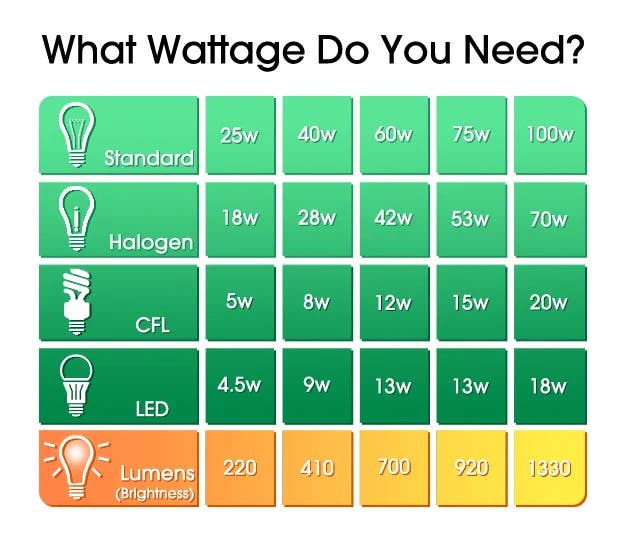
Here's a quick cheat sheet for what most people consider "standard" LED equivalents:
- For a soft, ambient light (like an old 40W bulb): Look for an LED around 4-6 watts (delivering about 450 lumens).
- For everyday room lighting (the classic 60W equivalent): You'll want an LED that uses about 8-10 watts (for around 800 lumens). This is probably the most common "standard" you'll find today.
- For brighter rooms or reading lamps (like an old 75W bulb): Grab an LED in the 11-14 watt range (giving you about 1100 lumens).
- For really bright areas (the old 100W powerhouse): An LED of about 15-18 watts will do the trick (for roughly 1600 lumens).
Isn't that wild? What used to be a 60-watt gulp of energy is now just an 8-watt sip! It's like going from a gas-guzzling SUV to a sleek, super-efficient electric car – both get you where you need to go, but one does it with much less fuss and expense.
Why Does This Matter?
This shift in what "wattage" means for light bulbs is more than just a techy tidbit. It has real-world impacts that are pretty amazing:
- Saves you money: Lower wattage means lower electricity bills. Those savings add up over time!
- Better for the planet: Less energy consumption means less demand on power plants, reducing carbon emissions. Good for Mother Earth!
- Bulbs last forever (almost): LEDs have incredibly long lifespans, often 15-25 times longer than incandescents. No more constantly climbing ladders to change bulbs!
- Cooler rooms: Remember how hot those old bulbs got? LEDs produce very little heat, which is a nice bonus in warmer climates or small spaces.
So, the next time you're browsing for a light bulb, don't get too hung up on the wattage number alone. Instead, look for the lumens to tell you how bright it will be, and then smile at the incredibly low wattage number that tells you how little energy it's going to use.
It’s a fantastic example of how innovation can take something as simple and everyday as a light bulb and make it dramatically more efficient and beneficial for all of us. The "standard" light bulb wattage has changed, and that's a brilliant thing!