
What Is The Square Root Of 24
Alright, gather 'round, folks! Let's talk about something truly wild, something that's plagued mathematicians for centuries (or at least felt like it): the square root of 24. Now, before you start picturing little green squares sprouting roots, let me assure you, it's not that kind of root. We're talking numbers here, baby!
Imagine you're a pizza chef. A particularly square pizza chef. You've got a pizza with an area of 24 square inches. Your boss, who’s clearly been hitting the oregano a little too hard, wants to know exactly how long each side of this perfectly square pizza is. That, my friends, is where the square root of 24 comes in!
So, What Is the Square Root of 24, Anyway?
In simple terms, the square root of a number is the number that, when multiplied by itself, gives you that original number. Think of it like this: What times itself equals 24? Well, not 5 (that's 25, darn close!), and definitely not 4 (that's only 16, way off!).
Must Read
Turns out, the square root of 24 isn't a nice, neat, whole number. It's a bit of a rebel. It's one of those irrational numbers, which basically means its decimal representation goes on forever without repeating. It’s like that one friend who never knows when to stop talking at a party. Forever!
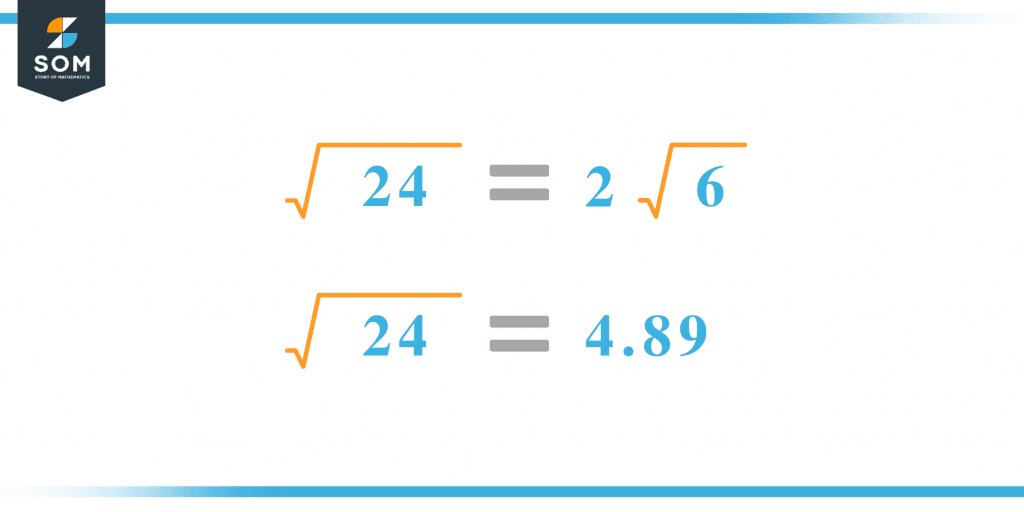
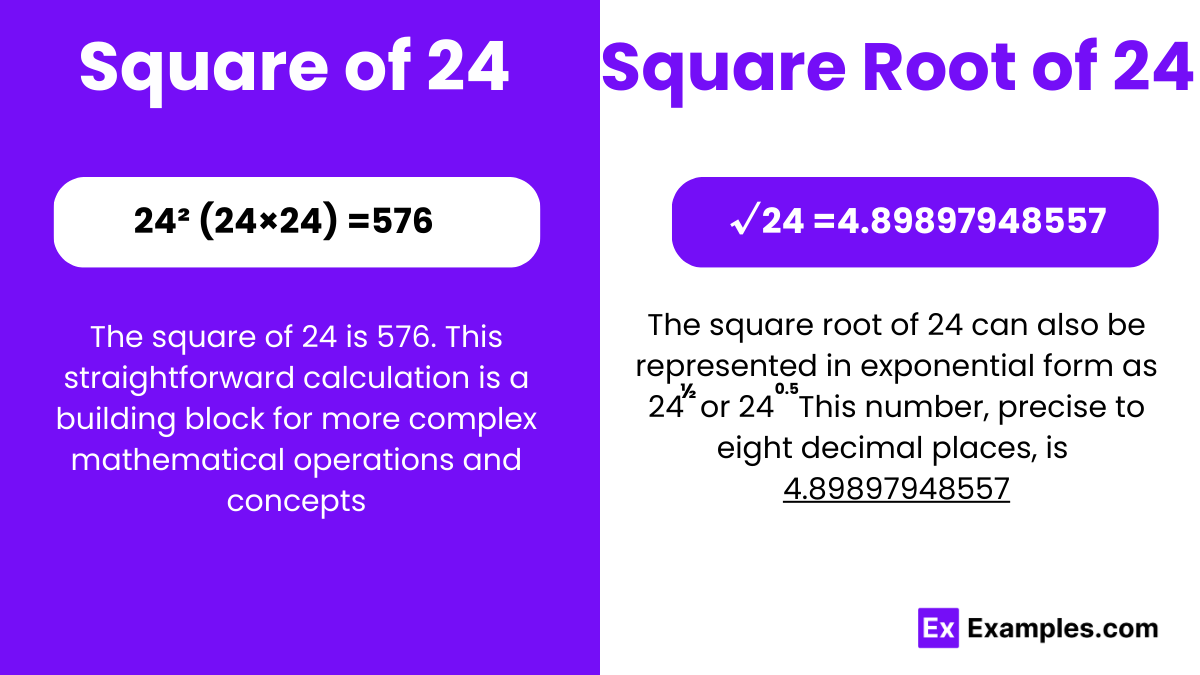
Don’t worry, you don't have to memorize the entire infinite decimal. Close enough is usually good enough! We can say the square root of 24 is approximately 4.898979485...and then it just keeps going. Your pizza chef probably just wants something like "around 4.9 inches" anyway. Unless, of course, he’s also a mathematical purist. Then you’re in trouble.
Breaking Down the Beast: Simplifying the Square Root of 24
Now, if you’re feeling fancy (and who isn’t, deep down?), you can simplify the square root of 24. This is where math gets a little bit like detective work.
The key is to find the largest perfect square that divides evenly into 24. A perfect square is a number you get by squaring a whole number: 1 (1x1), 4 (2x2), 9 (3x3), 16 (4x4), and so on. Let’s see…24 is divisible by 4! And 4 is a perfect square (2x2). Eureka!

So we can rewrite the square root of 24 as the square root of (4 x 6). And here's where the magic happens: the square root of (a x b) is the same as the square root of a * times * the square root of b. Therefore:
√24 = √(4 x 6) = √4 x √6 = 2√6
Ta-da! We've simplified it! Instead of saying the square root of 24, you can now say "two times the square root of six." Sounds much more sophisticated, doesn't it? Impress your friends at your next cocktail party. They'll think you're a genius (or just really, really weird).

Why Should I Care About the Square Root of 24?
Okay, okay, fair question. Aside from being a great conversation starter (trust me, it totally is!), square roots pop up all over the place in real life. Architecture, engineering, physics... you name it! Building a bridge? Gotta know your square roots. Designing a rollercoaster? Square roots are your friend. Trying to figure out how many pepperoni slices will fit diagonally on your pizza? You guessed it: square roots!
Think of it this way: understanding square roots is like having a secret superpower. You might not use it every day, but when you do, you'll be ready to save the day (or at least calculate the hypotenuse of a right triangle).

Plus, knowing a little bit about math makes you a more well-rounded human being. You can appreciate the beauty and elegance of numbers, the way they fit together, and the patterns they create. It’s like unlocking a whole new level of understanding of the universe! Or, you know, just being able to figure out how much wallpaper you need.
So there you have it: the square root of 24, demystified! It’s not as scary as it looks. It’s just a number that, when multiplied by itself, equals 24. And if that number happens to be an infinite, non-repeating decimal… well, that just makes it more interesting, doesn't it?
Now go forth and conquer the world…or at least your next math problem! And remember, when in doubt, just ask your friendly neighborhood pizza chef. He's probably got a calculator handy.