
What Is The Lcm For 8 And 10

Okay, so you're at brunch, mimosa in hand, and suddenly the conversation veers towards...math? Don't panic! This isn't some pop quiz designed to ruin your Sunday. Instead, let's gently glide into a simple concept: the LCM. Specifically, the LCM for 8 and 10.
LCM, my friend, stands for Least Common Multiple. It's basically the smallest positive number that both 8 and 10 can divide into evenly. Think of it as the perfect meeting point for these two numbers. Like that perfect avocado toast recipe that satisfies both your savory and healthy cravings.
Finding the LCM: It's Easier Than You Think
There are a few ways to find this magical number. Let's explore a couple, keeping things chill and understandable.
Must Read
Method 1: The Listing Game
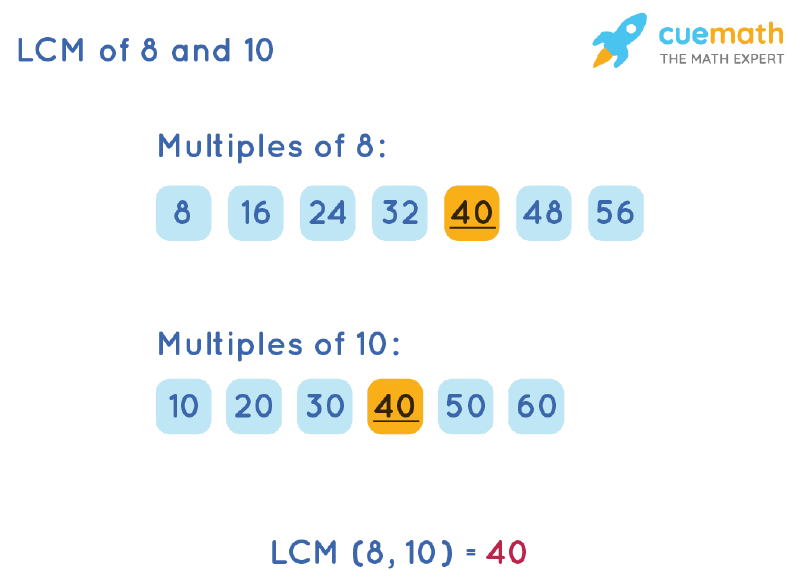
This is the most straightforward, perfect for a casual approach. We simply list out the multiples of each number until we find a common one.
- Multiples of 8: 8, 16, 24, 32, 40, 48...
- Multiples of 10: 10, 20, 30, 40, 50...
Eureka! We see that 40 appears in both lists. So, the LCM of 8 and 10 is 40. See? Not so scary!
Method 2: Prime Factorization Fun
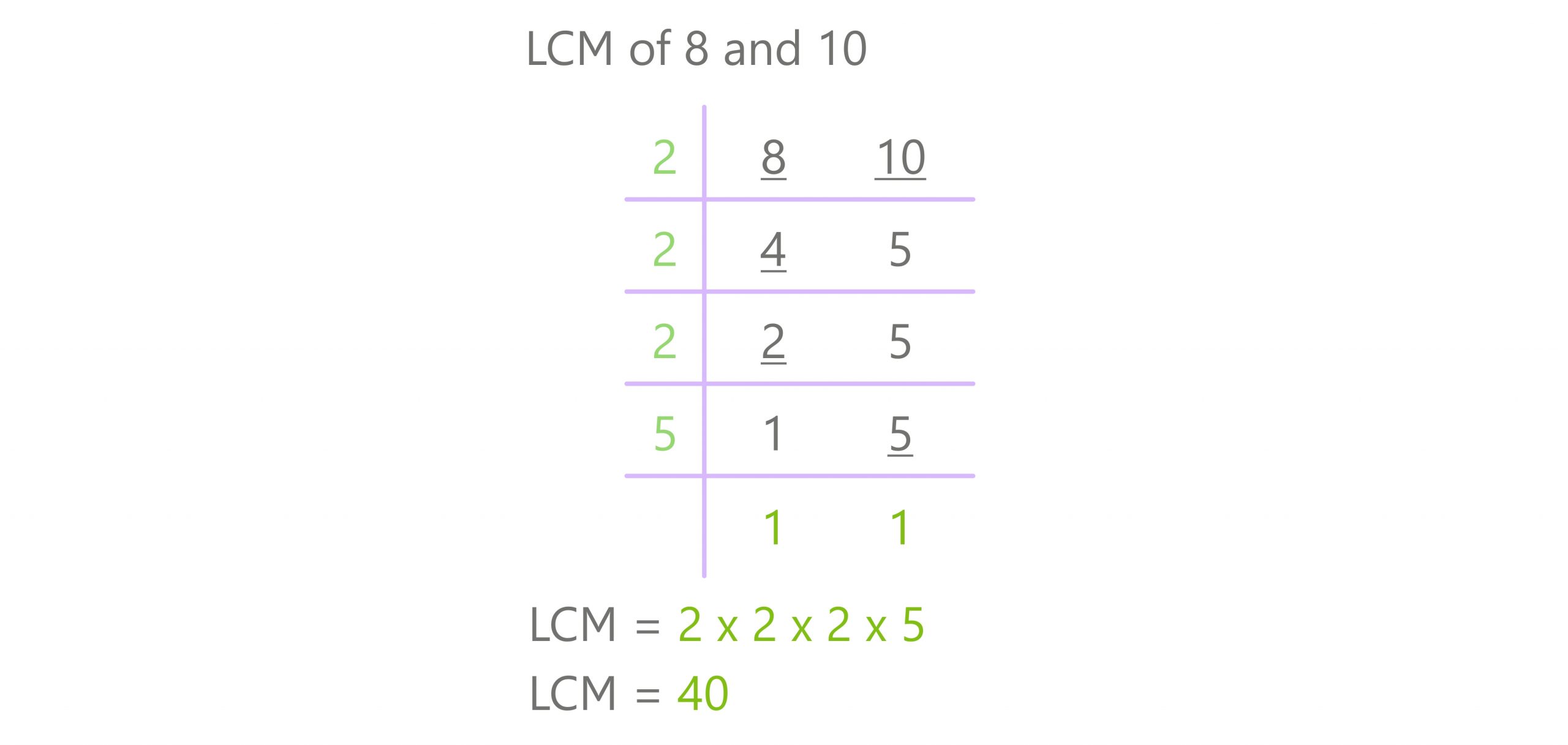
This method is a bit more "grown-up," but still totally manageable. We break down each number into its prime factors. Think of it as dissecting the avocado to appreciate its creamy goodness on a molecular level (metaphorically speaking, of course!).
- Prime factorization of 8: 2 x 2 x 2 (or 23)
- Prime factorization of 10: 2 x 5
Now, we take the highest power of each prime factor that appears in either factorization.

- The highest power of 2 is 23 (from the factorization of 8)
- The highest power of 5 is 51 (from the factorization of 10)
Multiply these together: 23 x 5 = 8 x 5 = 40. Again, we arrive at 40! Think of this like understanding the fundamental ingredients needed to create the perfect dish.
Why Does This Even Matter?
Okay, valid question. Why should you care about the LCM of 8 and 10 outside of a random brunch conversation? Well, the LCM pops up in various real-world scenarios, though you might not always realize it.
For example, imagine you're planning a party. You want to buy hot dogs and buns. Hot dogs come in packs of 8, and buns come in packs of 10. To avoid leftovers (or worse, running out of either!), you need to buy enough packs so that you have the same number of hot dogs and buns. The LCM (40) tells you that you need to buy 5 packs of hot dogs (5 x 8 = 40) and 4 packs of buns (4 x 10 = 40).
Another example: Music! Imagine two melodies playing simultaneously. One repeats every 8 beats, the other every 10 beats. The LCM tells you that the melodies will align again every 40 beats. Think of it like a harmonious collaboration where everything lines up perfectly.
Cultural Connection: Finding Common Ground
The concept of the LCM isn't just about numbers; it's also about finding common ground. Just like the LCM helps us find the smallest number divisible by two others, understanding different perspectives helps us find common ground with others. It's about recognizing shared values and building bridges instead of walls. Kinda profound for a math concept, right?
Quick Tip: There are many online LCM calculators available. If you're ever in doubt, a quick Google search can save the day. But knowing the concepts behind it makes it even cooler!

Remember that movie Arrival, where the protagonist used mathematics as a universal language to communicate with aliens? Well, the LCM might not be quite that epic, but it does represent a universal principle of finding harmony and commonality.
A Little Reflection for Daily Life
The LCM reminds us that even seemingly disparate things can find common ground. It's a useful tool in math, but also a metaphor for collaboration and understanding. So, the next time you're faced with a challenge, remember the LCM: Look for the smallest, most efficient way to find a common solution. It might just be the key to unlocking a smoother, more harmonious outcome. And maybe, just maybe, it'll even impress your friends at brunch.
Embrace the beauty of numbers, and the even greater beauty of finding connections.