What Is The Lcm For 4 And 10
Ever find yourself dividing up pizzas or sharing snacks and wishing there was a simpler way to make sure everyone gets a fair piece? Or perhaps you're trying to coordinate multiple events that happen on different schedules? That's where the magic of the Least Common Multiple (LCM) comes in! It might sound like a mouthful, but trust me, understanding the LCM can be surprisingly useful and even… dare I say… fun! Let's dive into figuring out the LCM for the numbers 4 and 10.
So, what exactly is the LCM? Simply put, it's the smallest positive number that is perfectly divisible by two or more numbers. Think of it as the common ground where multiples meet. In our case, we want to find the smallest number that both 4 and 10 can divide into without leaving a remainder.
Why bother learning about the LCM? Well, it has practical applications in various everyday situations. Imagine you have two friends: one visits every 4 days and the other every 10 days. Knowing the LCM of 4 and 10 tells you when they'll both be visiting on the same day! This is just one example. The LCM is also crucial when working with fractions, particularly when adding or subtracting them with different denominators. Finding the LCM of the denominators allows you to find a common denominator, making the calculation a whole lot easier.
Must Read
Okay, let's get down to business and find the LCM of 4 and 10. There are a couple of ways to do this. One method is listing multiples. We'll list the multiples of each number until we find a common one:
- Multiples of 4: 4, 8, 12, 16, 20, 24, 28, 32…
- Multiples of 10: 10, 20, 30, 40, 50…
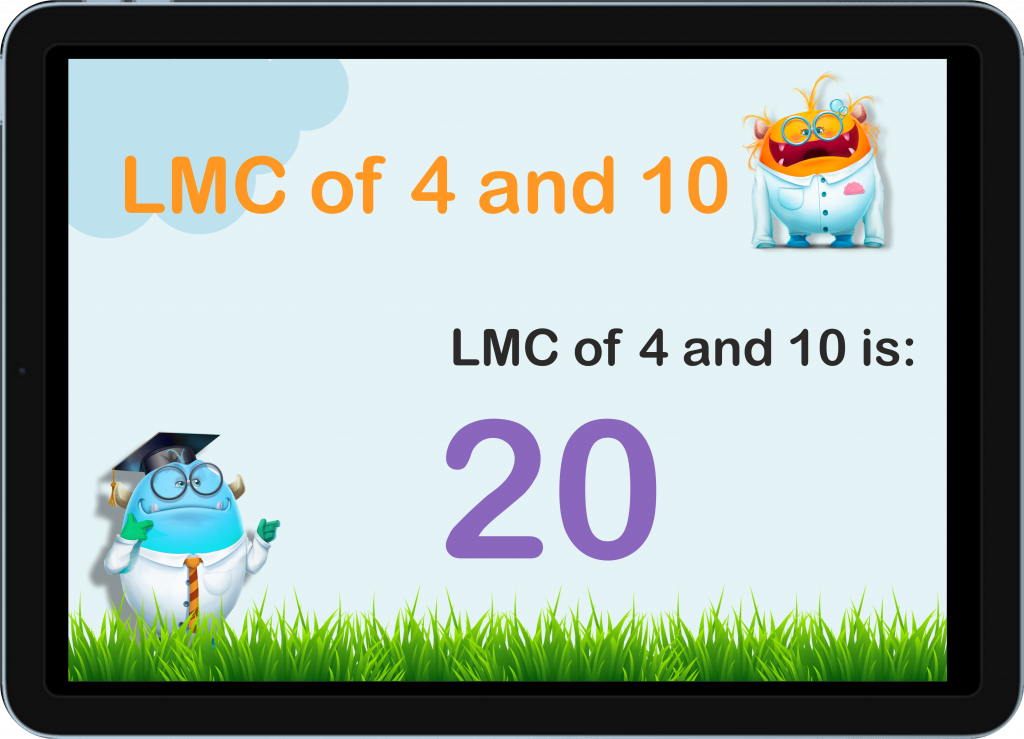
Aha! We see that 20 appears in both lists. Is it the smallest? Yes! Therefore, the LCM of 4 and 10 is 20.
Another method involves prime factorization. This is a handy technique, especially when dealing with larger numbers. First, we break down each number into its prime factors:
- 4 = 2 x 2 = 2²
- 10 = 2 x 5
Next, we identify all the unique prime factors involved (in this case, 2 and 5). For each prime factor, we take the highest power that appears in either factorization:

- 2 appears as 2² in the factorization of 4 and as 2¹ in the factorization of 10. We take 2².
- 5 appears as 5¹ in the factorization of 10.
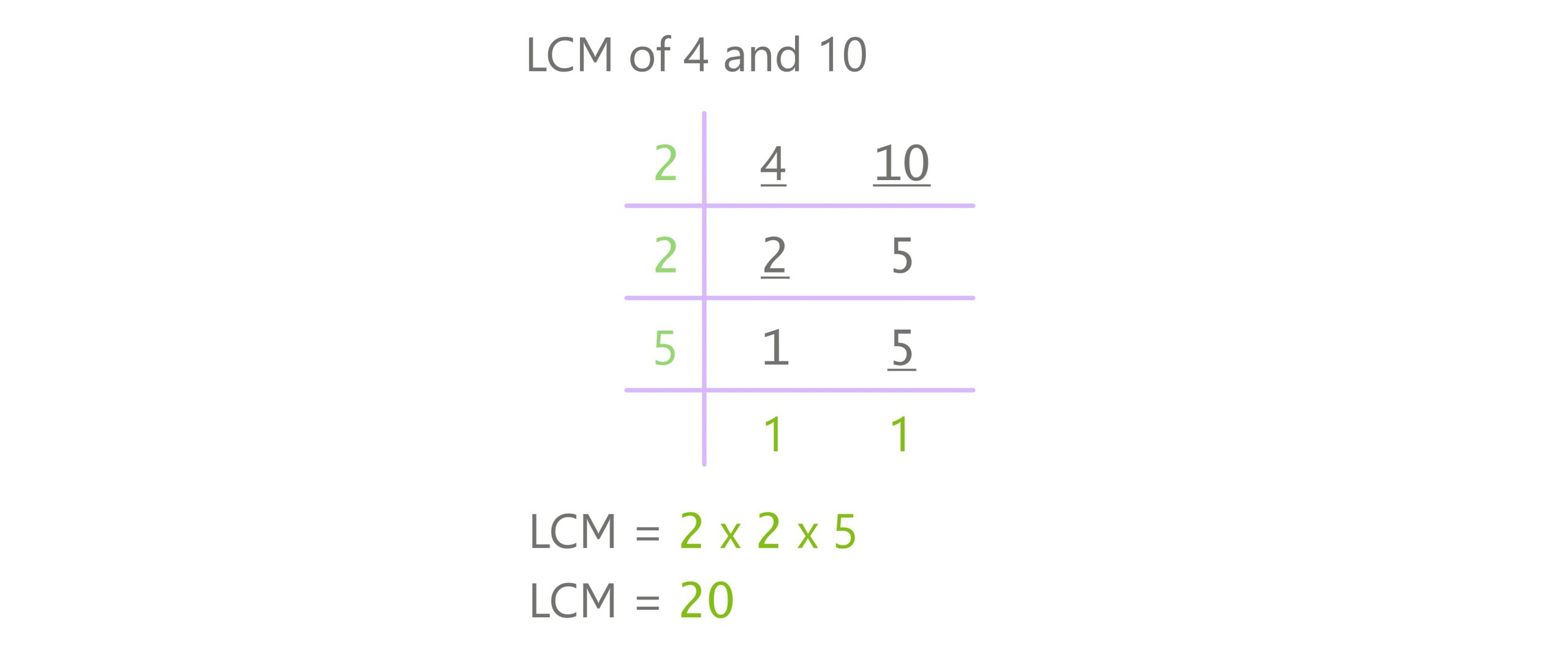
Finally, we multiply these highest powers together: 2² x 5 = 4 x 5 = 20. Again, we arrive at the same answer: the LCM of 4 and 10 is 20!
So, there you have it! You've successfully calculated the LCM of 4 and 10. Whether you prefer listing multiples or using prime factorization, understanding the concept opens up a world of possibilities – from efficiently dividing snacks to simplifying complex fraction problems. Keep practicing, and you'll be an LCM master in no time! You might even impress your friends with your newfound mathematical prowess. Remember, even seemingly simple concepts like the LCM can have a powerful impact on your problem-solving abilities.