
What Is Prime Factorization Of 90

Alright, let's talk about 90. Ninety! A number we see everywhere – the speed limit on some roads (eek!), the minutes in a soccer game (intense!), maybe even your grandma’s age (shhh!). But have you ever stopped to think about what 90 is really made of?
I'm not talking about sugar, spice, and everything nice. I'm talking about prime factorization. Don’t run away screaming! It sounds complicated, I know, but trust me, it’s like a mathematical scavenger hunt, and the prize is… enlightenment! (Okay, maybe not enlightenment, but definitely a cool party trick).
The Detective Work Begins
Imagine 90 is a delicious cake. Prime factorization is like figuring out the recipe – what are the simplest, most basic ingredients that make up this cake? These simple ingredients are called prime numbers. Prime numbers are like the introverts of the number world. They only like to be divided by 1 and themselves. Think 2, 3, 5, 7, 11...they're independent souls!
Must Read
So, let's get cracking. We need to break down 90 into these prime little introverts. We can start by asking: what’s the smallest prime number that divides evenly into 90?
Well, 2 is the smallest prime number. And guess what? 90 is even! So, 90 divided by 2 is 45. Okay, we’ve got a 2 in our recipe! We can write that down: 90 = 2 x 45.

Now, let’s look at 45. Can 2 divide into 45 evenly? Nope. Next prime number up: 3! Does 3 divide into 45? Why yes, it does! 45 divided by 3 is 15. So now our recipe looks like this: 90 = 2 x 3 x 15.
We're not done yet! 15 isn't a prime number either. Can 3 divide into 15? Absolutely! 15 divided by 3 is 5. Our recipe is starting to get exciting: 90 = 2 x 3 x 3 x 5.

Aha! 5! 5 is a prime number! Finally! We’ve reached the end of our scavenger hunt. We can’t break down 5 any further. It’s a prime introvert, happy to just hang out with 1 and itself.
The Grand Finale: The Prime Factorization of 90 Revealed!
So, what's the prime factorization of 90? Drumroll, please…
90 = 2 x 3 x 3 x 5
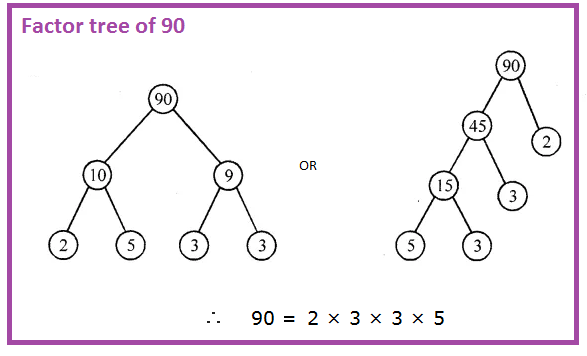
Or, if you're feeling fancy, you can write it as 90 = 2 x 32 x 5. That little 2 means 3 is multiplied by itself. Math shortcuts are so cool, right?
Why Should You Care? (Besides the Party Trick)
Okay, you might be thinking: "This is all well and good, but why should I care about the prime factorization of 90? I have bills to pay, a show to binge-watch, and a nap to take!"

Well, prime factorization is actually super useful in all sorts of situations! It helps you simplify fractions, find common denominators, and even understand cryptography (the secret codes that keep your online information safe!). It’s like knowing a secret language that unlocks the mysteries of mathematics.
"Mathematics is the language with which God has written the universe." – Galileo Galilei (Okay, maybe not about prime factorization specifically, but it fits the mood!).
But more importantly, it's just plain fun! It's like solving a puzzle, and who doesn't love a good puzzle? It trains your brain to think logically and creatively. Plus, you can impress your friends and family with your newfound mathematical prowess. Just imagine casually dropping the prime factorization of 90 into a conversation at your next dinner party. "Oh, you're serving cake? Did you know the prime factorization of 90, which is the age my grandma wishes she was, is 2 x 3 x 3 x 5?" They'll be amazed! (Or maybe slightly confused, but definitely amazed!).
So, the next time you see the number 90, don't just see a number. See a collection of prime numbers working together to create something bigger and more complex. See a story. See…cake! And remember, even the most seemingly ordinary things can be broken down into their simplest, most essential parts. It’s a beautiful thought, really. Now go forth and factorize!