
What Is A Tertiary Consumer In A Food Chain

Hey there, friend! Ever wonder what happens after the burger you're about to devour used to munch on some grass? We're diving deep (well, maybe ankle-deep) into the wild world of food chains, and today's star of the show is the oh-so-important tertiary consumer. Buckle up; it's gonna be a tasty ride!
What in the World is a Food Chain?
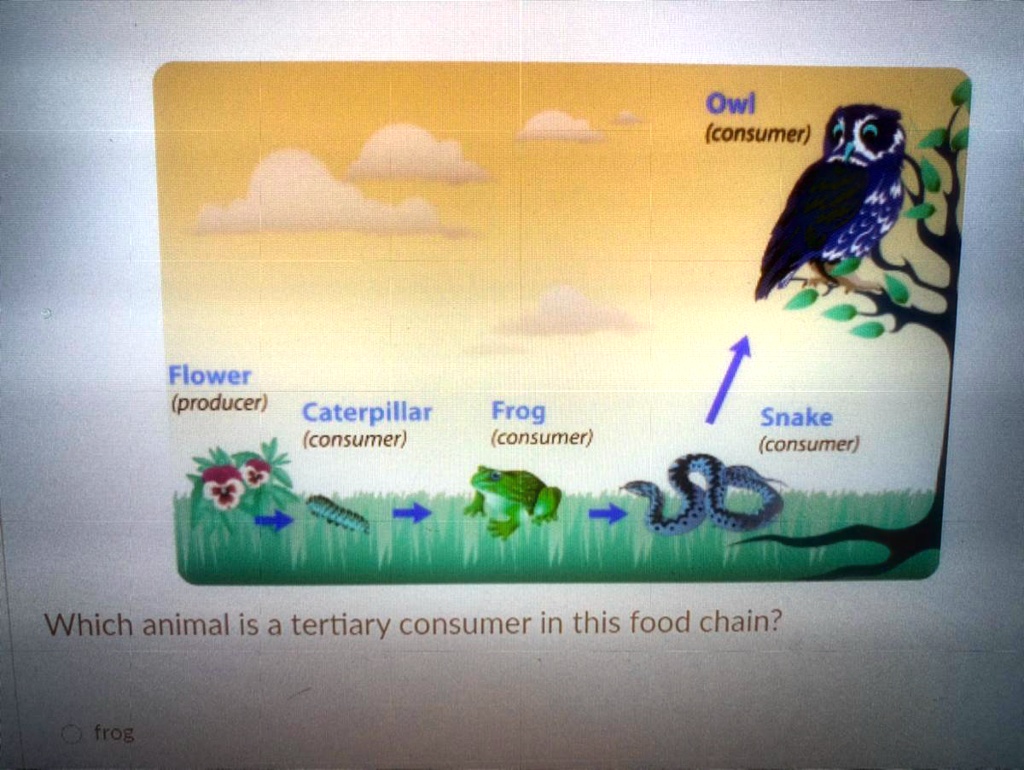
First things first: picture a chain. No, not the kind you use to lock your bike (though that's a good analogy for security!). Think of a chain of who-eats-who. Plants, basking in the sun, kick things off. They're the producers, the rockstars of the food world, creating their own food using photosynthesis. Pretty impressive, right?
Next come the primary consumers, the herbivores. Think grasshoppers munching on grass, or cows happily chewing their cud. They are like the first level of customers in the food court of life.
Must Read
Then we have the secondary consumers, the carnivores who eat the herbivores. Think of a snake that eats a mouse. It's like, "Hey, thanks for all the hard work eating that grass, mouse! Now you're dinner!" (Circle of life, folks, circle of life!).
Enter the Tertiary Consumer! Ta-da!
Okay, drumroll, please! The tertiary consumer is an animal that eats the secondary consumer. Basically, they're at the top (or near the top) of the food chain in their specific ecosystem. They're the apex predators...or at least, close to being apex predators. Sometimes, it gets a little complicated, but let's keep it simple for now.
Think of a hawk swooping down and snatching that snake that ate the mouse. That hawk? That's our tertiary consumer! Or an Orca eating a seal, who previously snacked on some delicious squid. Boom! Tertiary consumer in action.
They are usually carnivores, but sometimes they can be omnivores as well, eating both meat and plants. Life's all about options, even for apex predators!
Why are Tertiary Consumers Important? (Besides Being Totally Awesome)
So, why should we care about these top-tier eaters? Well, they play a crucial role in maintaining the balance of their ecosystem. Without them, the populations of the animals they prey on could explode, leading to all sorts of problems. Imagine too many snakes! No thanks!
Think of it like this: They're the quality control department of the animal kingdom. They keep populations in check and ensure that no single species dominates too much. Nature's way of saying, "Hey, everyone, chill out!"
Important Note: Sometimes, there are even quaternary consumers! These are animals that eat tertiary consumers. Think of a super-apex predator, like a polar bear sometimes preying on an arctic fox who previously ate a seabird. But let's not get too ahead of ourselves. Tertiary consumers are already pretty darn cool.

Examples of Tertiary Consumers in Action!
Let's bring this home with some examples, shall we? Imagine a grassland ecosystem. Here's how the food chain might look:
- Grass (Producer) -> Grasshopper (Primary Consumer) -> Frog (Secondary Consumer) -> Snake (Tertiary Consumer)
See how that works? Or what about in a forest? Something like this:
- Berries (Producer) -> Mouse (Primary Consumer) -> Owl (Secondary Consumer) -> Wolf (Tertiary Consumer)
Pretty neat, huh? Nature's a complex web, and these tertiary consumers are vital threads keeping it all together.
Final Thoughts: You're Now a Food Chain Expert!
So, there you have it! You've officially learned about tertiary consumers and their important role in the food chain. You can now impress all your friends and family with your newfound knowledge (or at least avoid awkward silences at dinner parties!).
Remember, every creature, big or small, plays a part in the grand scheme of things. From the tiniest plant to the mightiest tertiary consumer, we're all connected. It's a beautiful, sometimes brutal, but ultimately fascinating system. And you, my friend, are now one step closer to understanding it! Go forth and explore the wonders of the natural world! And maybe think twice before judging that hawk for eating that snake... it's just doing its job!