What Is A Prime Factorization Of 56

Ever heard the number 56 whispered in hushed tones by mathematicians, artists, and even... bakers? Okay, maybe not bakers directly, but the magic behind 56, specifically its prime factorization, touches more lives than you might think! It's not just a mathematical curiosity; it's a foundational building block that can unlock new creative possibilities. We're talking about the prime factorization of 56 – breaking it down to its simplest, irreducible ingredients.
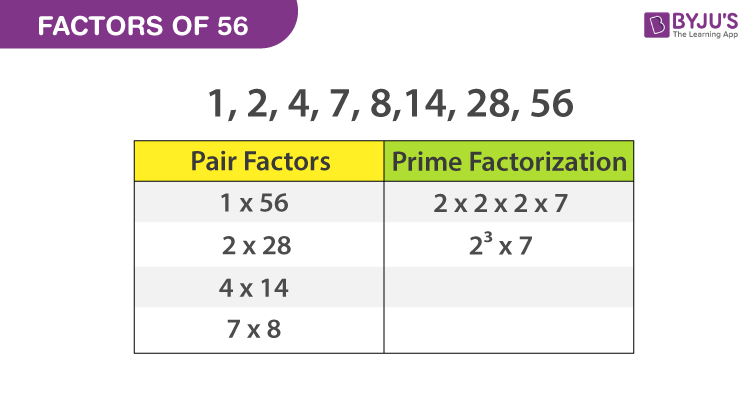
So, what's the big deal? Well, understanding prime factorization is like having a secret key. For artists, knowing that 56 = 2 x 2 x 2 x 7 (or 23 x 7) can inspire pattern creation. Imagine designing a mosaic with repeating motifs. Using the factors of 56 – 1, 2, 4, 7, 8, 14, 28, and 56 – gives you a range of options for size and symmetry. Hobbyists building models or crafting projects can use prime factorization to optimize dimensions and ensure structural integrity. Thinking about organizing your stamp collection? Knowing the factors of the number of stamps allows you to neatly arrange them into rows and columns. And for the casual learner, it’s simply a fantastic exercise in logical thinking and problem-solving.
Let's get more concrete. Consider an abstract painter. They might choose to divide a canvas into sections based on the factors of 56. One large area representing 28, with two smaller areas representing 14 each, and then four even smaller areas representing 7 each. The possibilities are endless! Or, imagine a textile artist creating a repeating pattern. They could use 2 shades of blue and 7 of green, for a harmonious palette derived from the primes that make up 56. Musically, someone might experiment with a composition based on intervals dictated by the factors: a melody in 2/4 time combined with a bassline in 7/8 time. Think of the intriguing polyrhythms!
Must Read
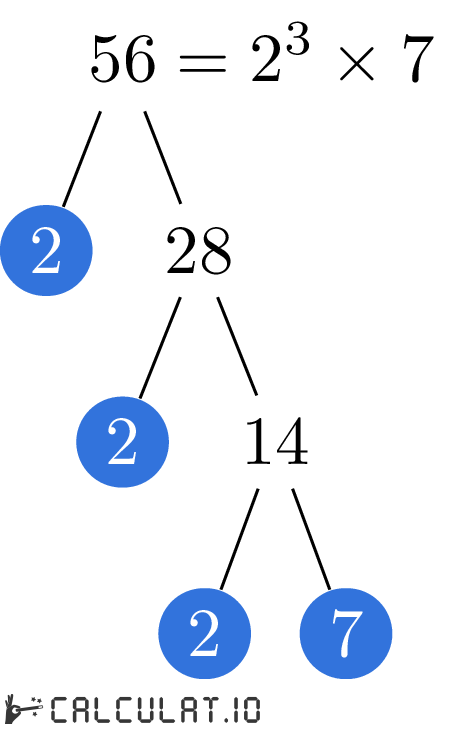
Want to give it a go yourself? It's easier than you think! Start by choosing a number (anything you want!). Try dividing it by the smallest prime number, 2. If it divides evenly, keep dividing by 2 until it doesn't. Then, move on to the next prime number, 3, and repeat. Continue with 5, 7, 11, and so on, until you're left with only prime numbers. For 56, you can start with 56 / 2 = 28. Then, 28 / 2 = 14. And finally, 14 / 2 = 7. Since 7 is a prime number, you're done! The prime factorization of 56 is 2 x 2 x 2 x 7. Grab a notepad, pick a number, and start experimenting! Don't be afraid to make mistakes; that's where the real learning happens.
Ultimately, exploring prime factorization isn't just about crunching numbers. It's about discovering the underlying order and structure of the world around us. It’s a playful journey into the heart of mathematics, revealing hidden connections and sparking new ideas. It’s fun because it allows you to see numbers not as static entities, but as dynamic compositions waiting to be deconstructed and reimagined. So, embrace the power of prime numbers, unlock your creative potential, and enjoy the process of discovery!