
What Determines The Size Of An Atom
Hey there, science curious pals! Ever wondered about something super fundamental? Like, really fundamental? Let's talk atoms! Specifically, what on Earth determines the size of these teeny-tiny building blocks of, well, everything?
Now, I know what you might be thinking: atoms are, like, ridiculously small. Thinking about their size feels a bit like trying to imagine infinity, right? But trust me, getting a handle on atomic size is actually pretty cool. It helps us understand why things behave the way they do, from the stiffness of a diamond to the stretchiness of rubber.
So, what's the secret sauce? What dictates how much space an atom hogs?
Must Read
The Fuzzy Electron Cloud: Size Matters
Forget the image of atoms as neat little solar systems with electrons orbiting a central nucleus in perfect circles. That's a charming, old-fashioned picture, but reality is way fuzzier. Think of it more like a swarm of bees buzzing around a hive. Those bees? Those are your electrons, and the hive is the nucleus. And this "swarm" is called an electron cloud. The size of this cloud is what largely determines the size of the atom.
But why a cloud? Well, electrons don't have a definite location at any given moment. Instead, they exist in probability distributions – areas where they're likely to be found. Imagine trying to define the edge of a cloud – tricky, right? It’s similar with an atom's electron cloud. We can only say that, with a certain probability (often 90% or 99%), the electron will be found within a certain distance from the nucleus. This distance effectively defines the atom's "size".
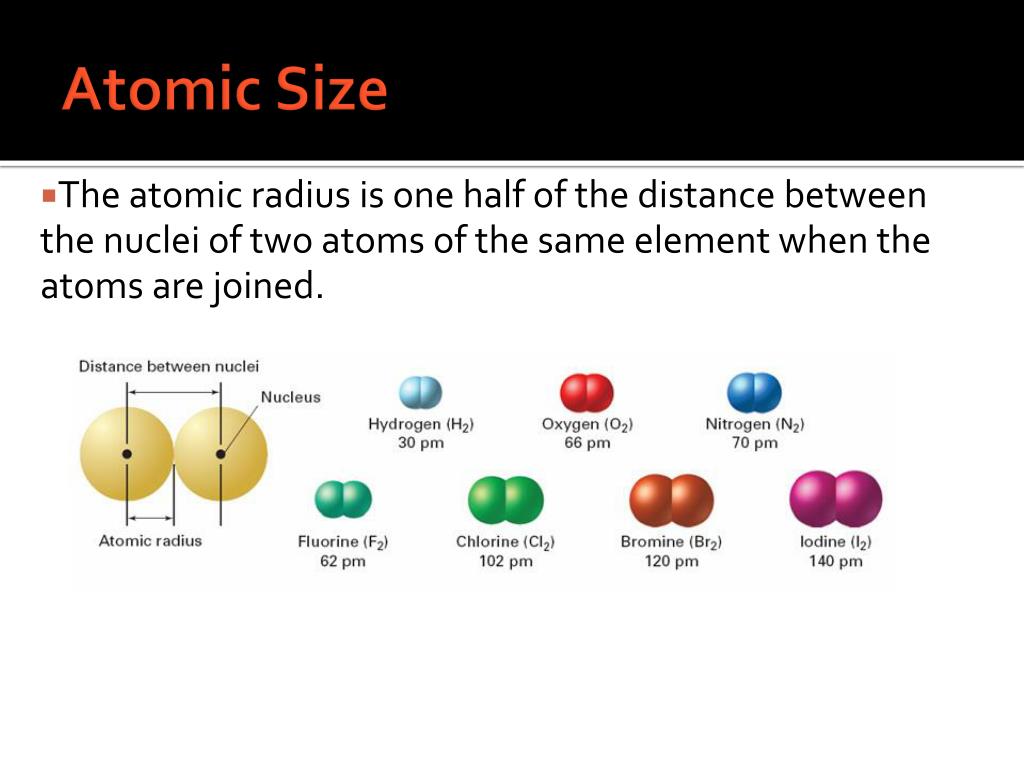
But hold on, aren't all electrons the same? And shouldn't all atoms therefore be roughly the same size? Nope! This is where things get interesting. The number of protons in the nucleus (which defines what element an atom is – like hydrogen versus gold) and the number of electrons orbiting (or rather, clouding) that nucleus play a huge role.
Nuclear Attraction: Pulling Things In
The nucleus, with its positively charged protons, exerts an attraction on the negatively charged electrons. This is like a tiny gravitational pull, but instead of mass, it's charge doing the work. The more protons in the nucleus, the stronger the pull. Think of it like this: A little magnet can only hold a few paperclips, but a big, powerful magnet can hold a whole bunch!
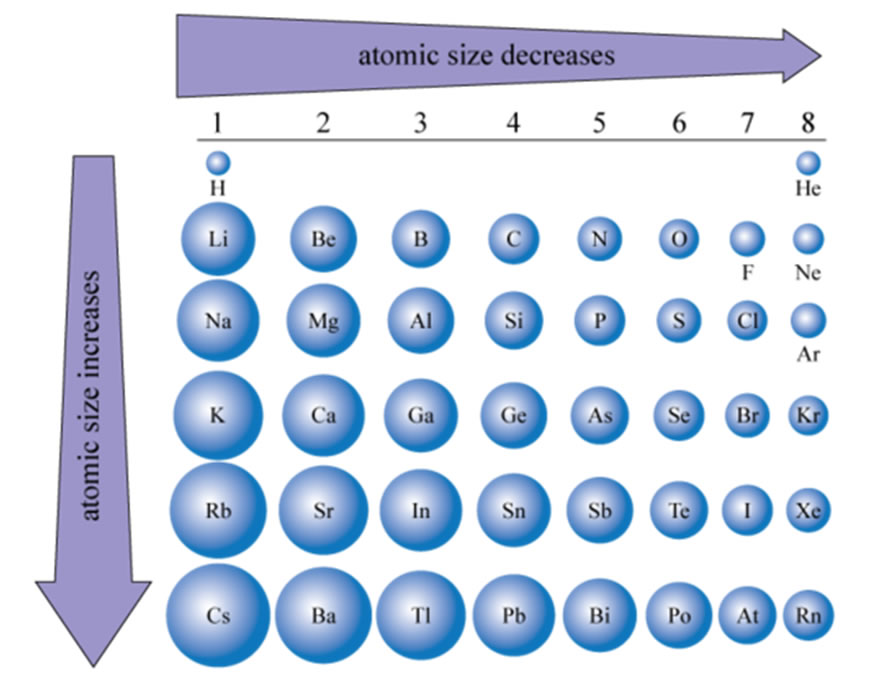
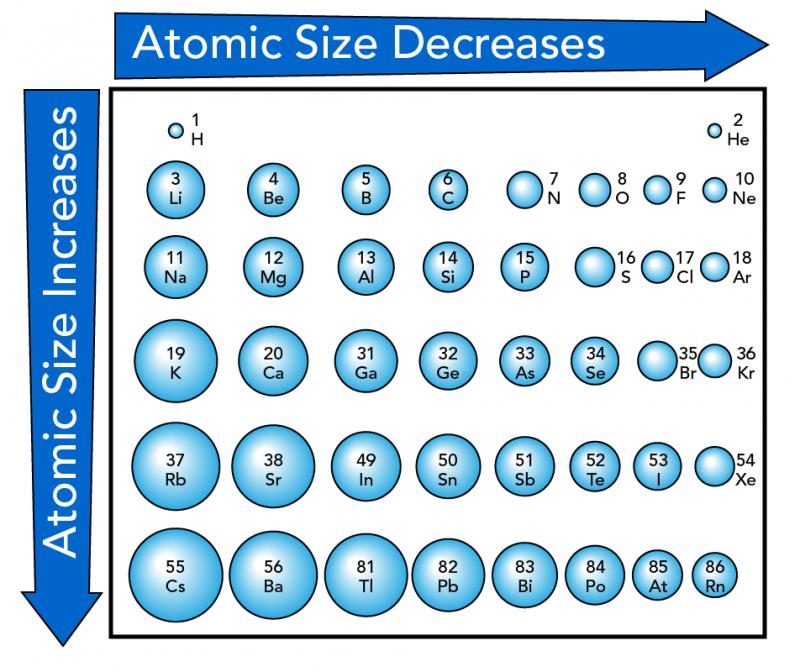
So, as you add more protons to the nucleus, the electrons are pulled in closer. This makes the electron cloud shrink, and therefore, the atom gets smaller. This is why, generally, atoms tend to get smaller as you move from left to right across the periodic table. The increased nuclear charge sucks the electrons in tighter. Cool, huh?
Electron Shielding: A Layered Defense
However, it's not quite that simple. Electrons don't just hang out willy-nilly. They arrange themselves into different energy levels, or "shells," around the nucleus. Think of it like layers of an onion. The innermost layer is closest to the nucleus, and the outer layers are farther away.
The inner electrons act as a sort of shield, partially blocking the pull of the nucleus from reaching the outer electrons. This is called "electron shielding." The more inner electrons you have, the more shielding there is, and the less tightly the outer electrons are held.
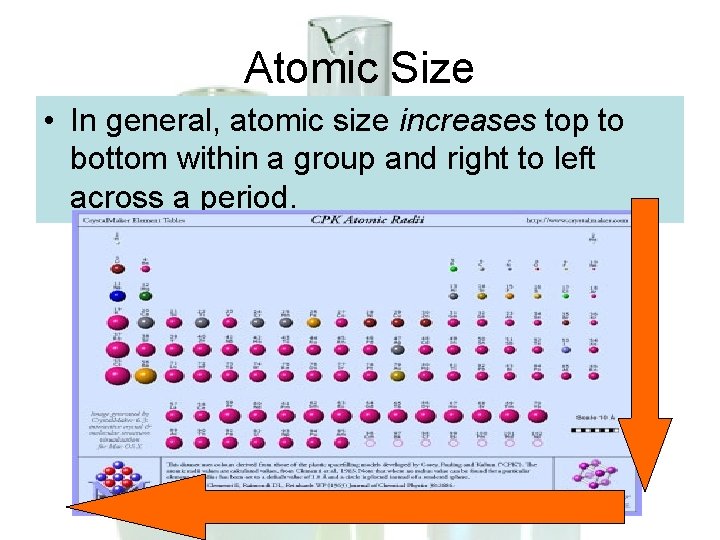
Because of shielding, as you move down the periodic table (adding more electron shells), the atomic size generally increases. Even though the nuclear charge is also increasing, the effect of the added electron shells outweighs the nuclear charge effect. Those outer electrons are further from the nucleus and less strongly attracted.
Van Der Waals Radius: The Bumping Zone
Now, there's another subtle factor. When we talk about atomic size, we often refer to something called the Van der Waals radius. This is essentially the distance at which two atoms will start to repel each other. Even if they're not chemically bonded, there's still a repulsive force that kicks in when their electron clouds get too close. Think of it like two magnets with the same poles facing each other – they push apart, right?
The Van der Waals radius is often considered a more practical measure of atomic size, because it tells us how closely atoms can pack together in a solid or liquid.

So, to recap, the size of an atom is determined by a complex interplay of factors:
- The number of protons in the nucleus (nuclear charge): More protons, stronger pull, smaller atom (generally, across the periodic table).
- The number of electron shells: More shells, more shielding, larger atom (generally, down the periodic table).
- The Van der Waals radius: The distance at which atoms start to repel each other.
It's a fascinating balancing act, isn't it? The interplay of these factors is what gives each element its unique size and, ultimately, dictates how it interacts with other atoms to form the molecules that make up our world. Pretty neat, huh?
So next time you're marveling at the strength of steel or the flexibility of plastic, remember that it all boils down to the size of the atoms and how those atoms interact! And that's something worth pondering.