Volume Of Parallelepiped Calculator

Okay, so picture this: I'm helping my friend move (because, you know, that's what good friends do). We're trying to Tetris-fit all his earthly possessions into a moving van, and there's this awkwardly shaped box. He swears it's "mostly rectangular," but it's got a definite lean to it. "How much space does this beast actually take up?" I mutter, already feeling the aches of manual labor setting in. That's when it hit me: This is basically a real-life parallelepiped problem!
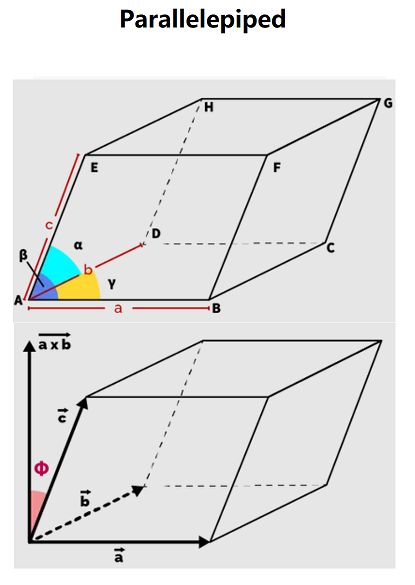
Yeah, I know, parallelepiped sounds like something Dr. Evil would use to destroy the world. But trust me, it's way less sinister and way more… useful. It's just a 3D shape with six faces, where each face is a parallelogram. Think of a slightly squished rectangular box. Or, you know, that awkwardly shaped box from my friend's move.
So, how do you figure out the volume of one of these guys? Well, you could try to calculate it by hand. You’d need to know the lengths of three adjacent edges and the angles between them. Sounds like a recipe for geometric frustration, right? (Don’t worry, I wouldn’t wish that on my worst enemy...unless they’re blocking my parking spot.)
Must Read
Enter the Parallelepiped Volume Calculator!
Thankfully, we live in an age of technological marvels, and one of those marvels is the online parallelepiped volume calculator. This little tool is a lifesaver when you need to quickly and accurately determine the volume of, well, a parallelepiped. No more struggling with complex formulas or needing to remember obscure trigonometric functions.
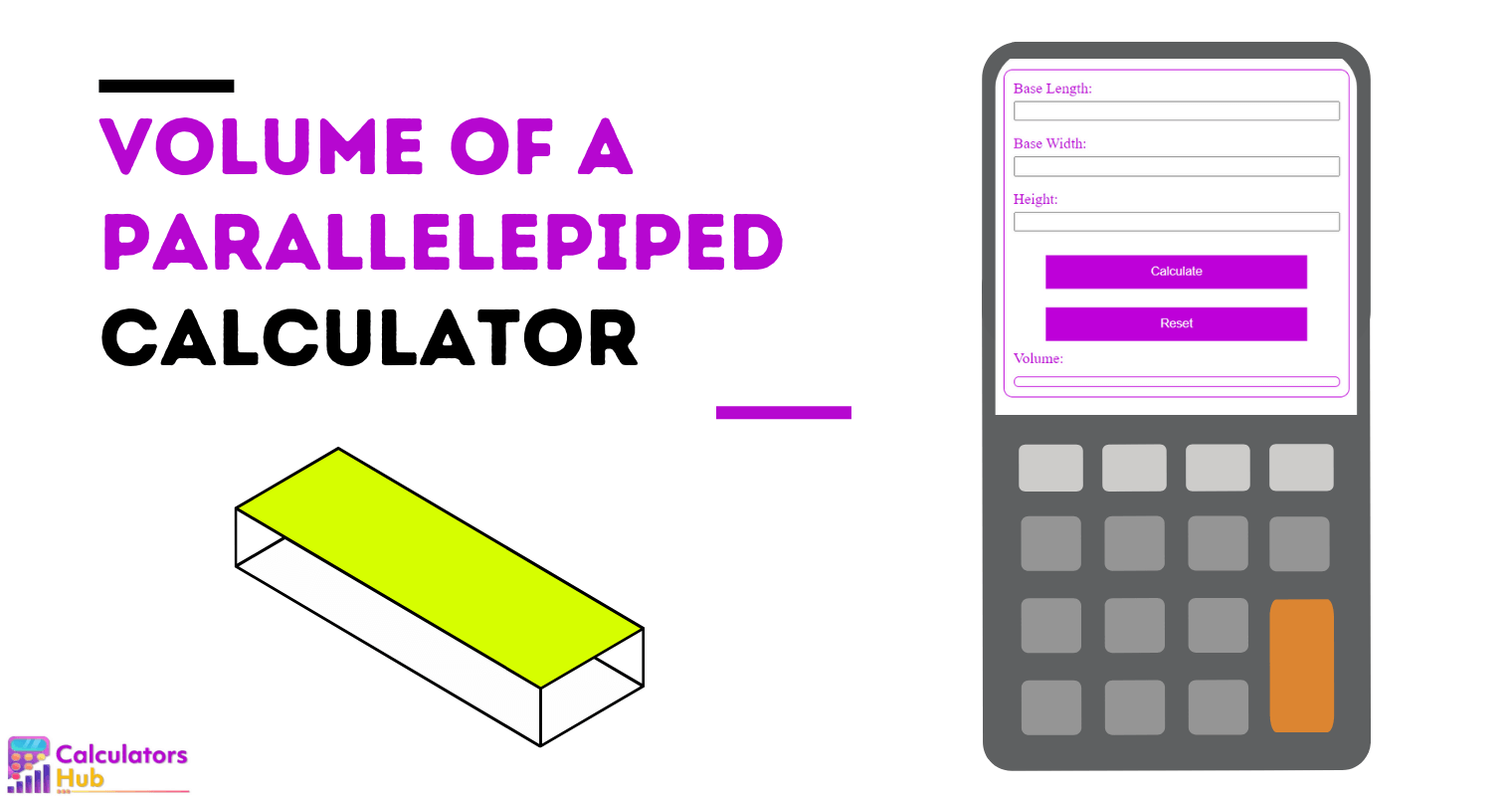
How does it work? Simple! You just need to input the relevant information. Usually, calculators require you to enter either the lengths of three adjacent edges and the angles between them, or the coordinates of three vectors that define the parallelepiped. The specific input method varies depending on the calculator.
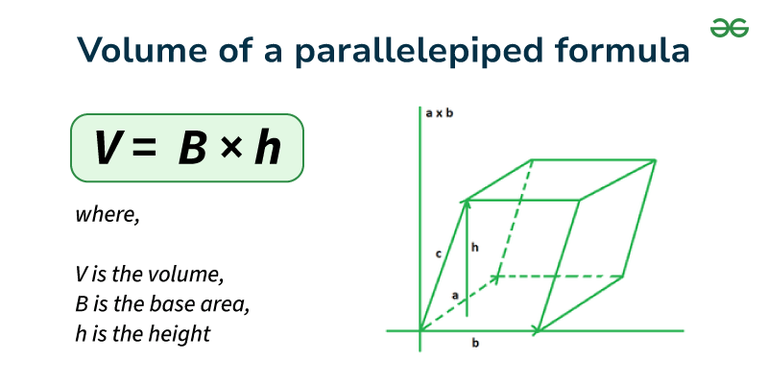
Most of these calculators use the following formula, in one form or another:
Volume = |(a · (b x c))|
Where 'a', 'b', and 'c' are the three vectors that define the edges of the parallelepiped. The '·' represents the dot product, 'x' represents the cross product, and '| |' denotes the absolute value (because volume can't be negative!). But honestly, you don't really need to understand the formula to use the calculator – that's the beauty of it!
Why is this even useful? Beyond preventing moving-day meltdowns (like the one I almost had), knowing the volume of a parallelepiped has tons of practical applications:

- Construction: Calculating the amount of concrete needed for oddly shaped foundations.
- Engineering: Determining the flow rate of fluids through irregular ducts.
- 3D Graphics: Calculating the bounding volume of objects in a virtual environment.
- Physics: Modeling crystals and other complex structures.
See? Way more versatile than you initially thought! (And definitely more exciting than folding laundry, which I should probably be doing right now…)
What to look for in a good calculator:
- Clear input fields: Make sure it's easy to understand what information you need to provide.
- Accurate results: Obviously! Check that the calculator is giving you reasonable values.
- Units conversion: A good calculator will let you specify the units of measurement (e.g., cm, m, inches, feet).
- Step-by-step solution (optional): Some calculators show you the calculations involved, which can be helpful for understanding the process.
So, next time you encounter a parallelepiped in the wild (or, you know, just a leaning box), don't panic! Just whip out your handy dandy calculator and impress everyone with your geometric prowess. You’ll be a volume-calculating virtuoso in no time! And maybe, just maybe, you'll even avoid a moving-day crisis of your own. Good luck!