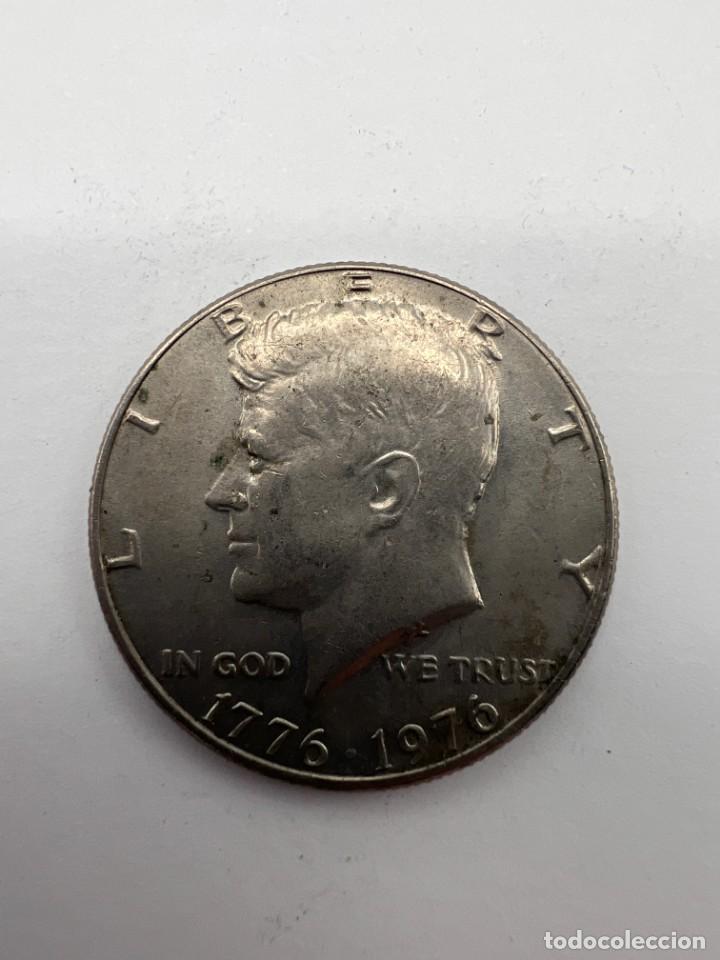
Valor De Moneda De Medio Dolar 1776 A 1976

Alright, gather 'round, folks! Let's talk about something near and dear to my heart, and hopefully, soon to be near and dear to yours: the 1776-1976 Bicentennial Half Dollar. Now, I know what you're thinking: "A coin? Really? That sounds about as exciting as watching paint dry." But trust me on this one. This little piece of metal has a story to tell, and it’s way more interesting than your average, everyday pocket change.
First things first, let's clear something up. When we say "1776-1976," we're not talking about a half dollar minted for 200 years straight. Imagine the stockpiles! The mint would have needed a warehouse the size of Texas! No, these were specially minted to celebrate the 200th anniversary of the United States. Think of it as a birthday party for America, and this coin was the party favor… a slightly metallic, legal-tender party favor.
So, what makes this coin so special? Well, besides the whole Bicentennial thing (which is pretty darn special on its own), it’s got a pretty nifty design. On one side, you've got good ol' JFK looking stoic and presidential, just like he always did. But flip that bad boy over, and BAM! Instead of the usual eagle clutching arrows and an olive branch (which, let’s be honest, is a little cliché), you get the Liberty Bell superimposed on the moon. Yes, you read that right. The MOON. It’s like NASA and the Founding Fathers had a baby. Pretty wild, huh?
Must Read
The Three Flavors of Freedom (and Metal Composition)
Now, these Bicentennial half dollars came in a few different flavors. Not like chocolate and vanilla, but more like "regular," "slightly fancier," and "whoa, that's shiny!"
First up, the workhorse: The clad version. This is the one you’re most likely to find rattling around in your grandma's coin jar. It’s made of a copper-nickel clad alloy, which basically means it’s mostly copper with a thin layer of nickel on the outside. Think of it like a cheap suit – functional, but not exactly turning heads.

Next, we have the uncirculated version: These were a little bit nicer, often sold in special packaging. They were still clad, but they were struck with more care and never made it into general circulation. So they are cleaner and better looking than the 'grandma's coin jar' one. They were the equivalent of a new, unwrinkled shirt fresh from the store.
And finally, the gold standard: (Well, silver standard, technically.) The 40% silver version! These were the fancy pants of the Bicentennial half dollar world. They were made with 40% silver and sold at a premium. If the clad version is a cheap suit, the silver one is a tailored tuxedo. Much more appealing to a collector. Owning one of these is like telling the world, “Yes, I appreciate both American history AND shiny things!”
So, What's It Worth? Time for the Fun Part!
Okay, let’s get down to brass tacks (or should I say, copper and nickel tacks?). The value of your 1776-1976 half dollar depends on a few things: its condition, its metal composition, and, frankly, how badly someone wants it.

The clad versions, the ones you find in your change, are generally worth… well, about 50 cents. Sorry to burst your bubble. You might get a dollar or two for one in pristine condition, but don’t expect to retire early based on your Bicentennial half dollar fortune. The clad uncirculated versions aren’t much pricier, averaging a couple of dollars.
Now, the silver versions… that’s where things get a little more interesting. Because they contain silver, their value is tied to the fluctuating price of silver. Generally, you can expect to get a few dollars for a silver Bicentennial half dollar, but prices can vary. Think of it like a tiny silver bar with a cool design stamped on it. The better the condition, the more someone is likely to pay.

The biggest factor of value? Condition, Condition, Condition! If your coin looks like it’s been through a war (ironically), it's not going to be worth much. But if it's sparkling and pristine, collectors might be willing to shell out a little more.
Ultimately, the 1776-1976 Bicentennial Half Dollar is more than just a coin. It’s a piece of American history, a celebration of our nation's 200th birthday, and a reminder that even something as seemingly ordinary as pocket change can have a fascinating story to tell. So, next time you stumble across one of these bad boys, take a moment to appreciate its place in history... and then maybe check eBay to see if you can retire on it. (Spoiler alert: You probably can't, but it's fun to dream!)
So, go forth and hunt for these little treasures! You might not get rich, but you’ll definitely have a cooler conversation starter than your neighbor's prize-winning petunias.