
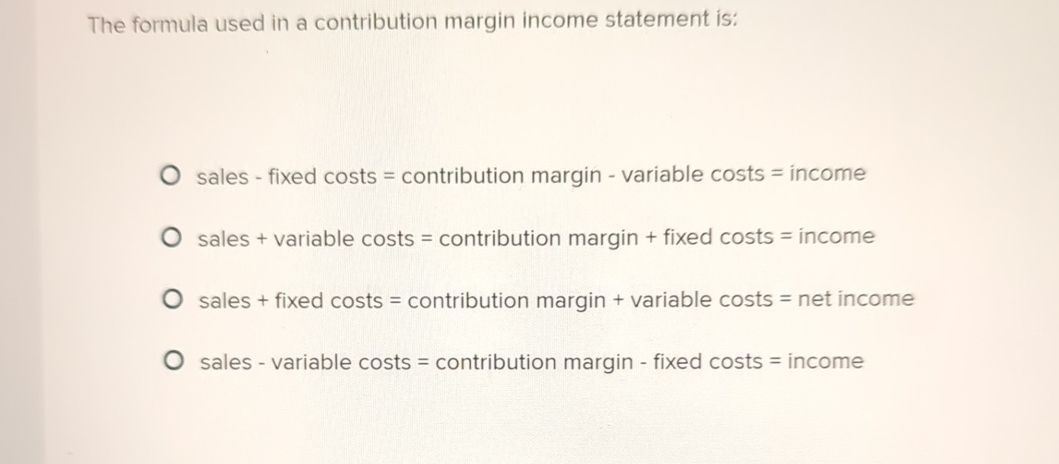
The Formula Used In A Contribution Margin Income Statement Is:
Alright, let's talk money, honey! But don't worry, we're not diving into complicated tax returns or deciphering the Federal Reserve. Instead, we're going to unravel something super practical and surprisingly easy to understand: the contribution margin income statement formula. Think of it as your secret weapon for making smart business decisions, whether you're running a lemonade stand or a multi-million dollar empire.
So, what is this magical formula? Buckle up, because here it comes:
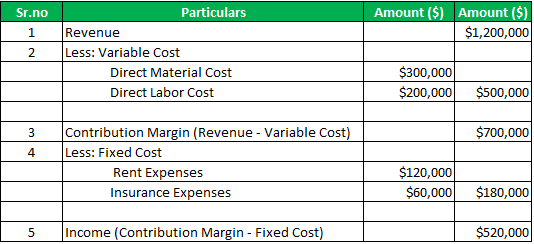
Sales Revenue - Variable Costs = Contribution Margin
Must Read
Boom! That's it. Simple, right? But trust me, the power of this little equation is immense.
Breaking it Down: Like Your Favorite Playlist
Let's dissect each element, just like you'd analyze the perfect summer playlist. First, we have Sales Revenue. This is the total amount of money you bring in from selling your products or services. Think of it as the main melody – the foundation of your income.
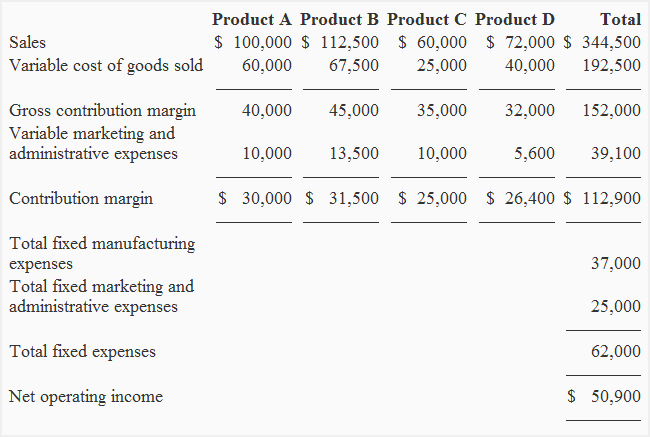
Next up: Variable Costs. These are the costs that change depending on how much you produce or sell. More sales? Higher variable costs. Less sales? Lower variable costs. Imagine these as the bassline – they fluctuate with the rhythm of your business. Examples include raw materials, direct labor, and sales commissions. Basically, anything that's directly tied to making and selling your stuff.
And finally, the star of the show: the Contribution Margin. This is the amount of revenue that's left over after you've covered your variable costs. It "contributes" towards covering your fixed costs (like rent, salaries, and insurance) and, hopefully, generating a profit! Think of it as the soulful vocals – the part that really gives your financial performance its character.
Why Should You Care? (Besides Making More Money!)
Okay, so you know the formula. But why should you even bother with it? Here’s the deal: the contribution margin gives you insights that a traditional income statement simply can't. For instance, it allows you to:
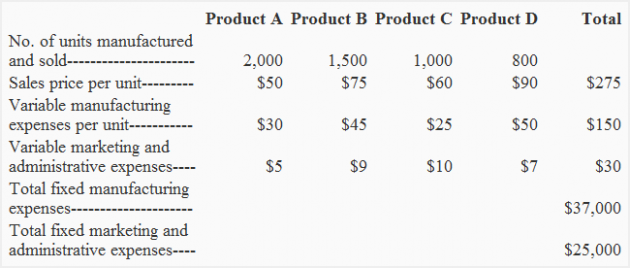
- Determine Profitability: See how profitable each product or service is. Maybe your gourmet dog biscuits are raking it in, while your catnip toys are just...meh.
- Make Pricing Decisions: Figure out how much you need to charge to cover your variable costs and make a decent profit. Are you undercharging? Overcharging? Time to find that sweet spot!
- Analyze Breakeven Points: Calculate how many units you need to sell to cover all your costs, both fixed and variable. Knowing your breakeven point is like knowing where the finish line is in a marathon – it keeps you motivated!
- Evaluate Sales Strategies: Decide which products or services to promote more aggressively. Double down on what's working, and ditch what's not.
Practical Tip: Use a spreadsheet! Seriously, fire up Google Sheets or Excel and start tracking your sales and variable costs. It's a game-changer.
A Real-World Example: The Local Coffee Shop
Let's say your favorite local coffee shop sells a latte for $5. The variable costs (coffee beans, milk, cup) are $2. Using our formula:
$5 (Sales Revenue) - $2 (Variable Costs) = $3 (Contribution Margin)
That means each latte contributes $3 towards covering the coffee shop's fixed costs (rent, salaries, etc.) and, hopefully, making a profit. If rent is high, they need to sell a lot of lattes! This is why they might push those loyalty cards and offer afternoon discounts - all to boost volume and maximize that contribution margin.
Fun Fact: Did you know that the concept of contribution margin is rooted in early 20th-century management accounting? It's been helping businesses make smarter decisions for over a century!
Beyond the Numbers: Connecting to Your Life
The beauty of the contribution margin isn't just about business. It's a mindset. Think about your personal finances. You can apply the same principle to your own income and expenses.
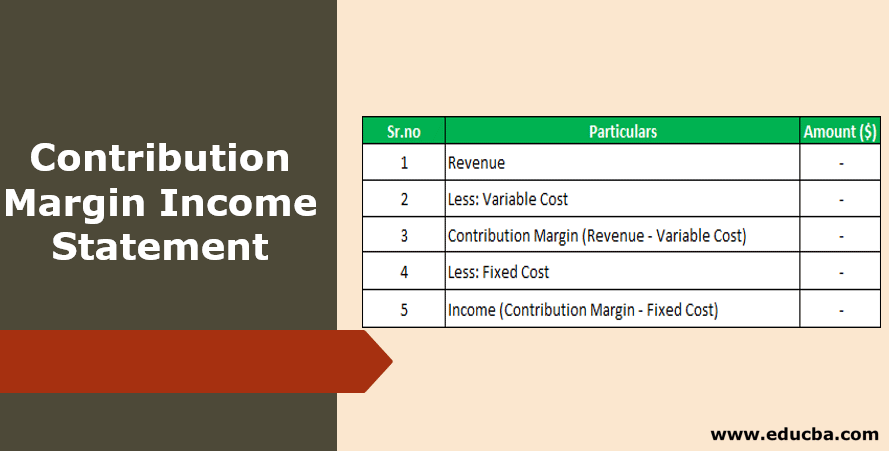
Imagine your salary is your sales revenue. Your variable expenses are things like groceries, transportation, and entertainment – costs that fluctuate with your lifestyle. The money left over is your "contribution margin" – the amount you have available to cover your fixed expenses (rent/mortgage, utilities, loan payments) and, ideally, save for the future.
Understanding this simple concept can help you make better decisions about your spending, identify areas where you can cut back, and ultimately achieve your financial goals. It’s about being mindful of where your money is going and making sure you’re maximizing the “contribution” each dollar makes to your overall well-being.
So, the next time you're pondering a big purchase or making a business decision, remember the contribution margin formula. It's a powerful tool that can help you navigate the world of finance with confidence and clarity.