The Combining Form For Liver Is

Ever wonder how doctors and scientists string together those complicated medical terms? It’s like building with LEGOs, but instead of colorful bricks, they use combining forms! And one particularly fascinating (and vital!) organ gets its own special linguistic LEGO brick: the liver. Why bother learning this? Well, understanding combining forms unlocks the secrets behind a whole vocabulary of medical jargon, making it easier to understand health information, medical reports, and even impress your doctor with your knowledge!
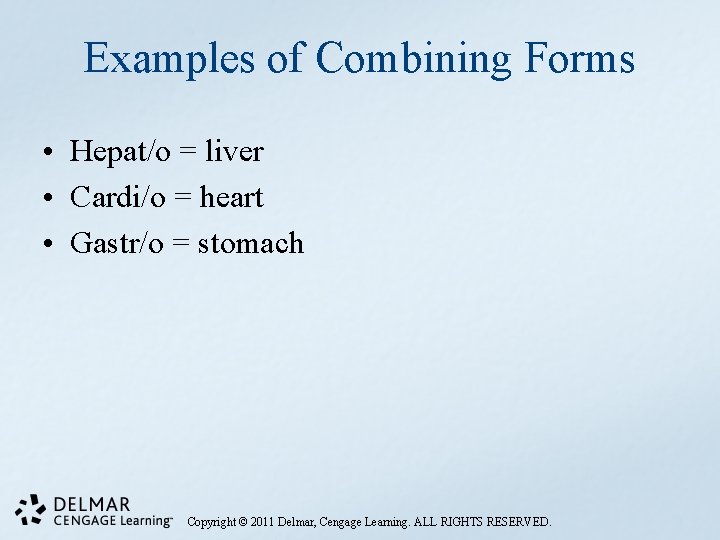
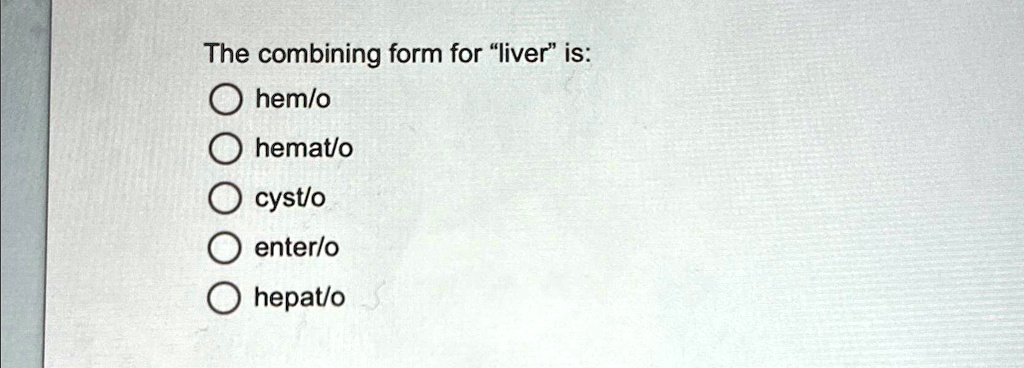
So, what is the combining form for liver? Drumroll, please… it's hepat/o. This little chunk of a word acts as a prefix, connecting to other elements to describe conditions, treatments, or anything related to the liver. Think of it as a linguistic shortcut, a way to efficiently communicate complex ideas about this crucial organ.
The purpose of using combining forms like hepat/o is two-fold: precision and efficiency. Instead of using a long, descriptive phrase, you can use a single, concise word. Imagine having to say "inflammation of the liver" every time instead of simply saying "hepatitis"! That's the power of combining forms. This system helps medical professionals communicate quickly and accurately, minimizing ambiguity and ensuring clear understanding, which is, of course, incredibly important when dealing with health issues.
Must Read
Where might you encounter hepat/o in real life or in educational settings? Everywhere! In biology class, you might learn about "hepatocytes," which are the main cells of the liver. A medical student will study "hepatomegaly," referring to an enlarged liver. Even in the news, you might hear about "hepatitis," an inflammation of the liver caused by various factors, including viruses. Another common example is “hepatic,” as in hepatic artery or hepatic vein, describing structures directly related to the liver. The combining form pops up everywhere once you start looking for it.
Let's consider some more examples. Hepat/o combined with "-oma" (a tumor or growth) creates "hepatoma," a liver tumor. Combined with "-toxic" (poisonous), we get "hepatotoxic," meaning damaging to the liver. See how simple and effective it is? You only need to understand the combining form and the suffix to understand the whole word!

Want to explore this further? Try this simple exercise: grab a medical dictionary or even just search online for medical terms containing "hepat." Make a list and try to break down each word into its components. What does each part mean? How does it relate to the liver? Another fun exercise is to create your own imaginary liver-related conditions using hepat/o and different suffixes. For instance, "hepatophobia" - fear of the liver (maybe a picky eater's ailment!).
By understanding combining forms like hepat/o, you gain a valuable tool for navigating the world of medicine and health. It transforms confusing jargon into understandable concepts, empowering you to take charge of your own health and understand the world around you a little bit better. So, embrace the linguistic LEGOs and start building your medical vocabulary today! You might be surprised at how quickly you start to understand those previously daunting medical terms.
.jpg)