
Surface Area Of A Solid Of Revolution
Hey! So, remember that time we were talking about calculus (because, you know, we do that), and I mentioned solids of revolution? Well, let’s dive a little deeper. Don’t worry, it's not as scary as it sounds!
We're talking about taking a curve – any curve, really! – and spinning it around an axis. Think potter's wheel. Or maybe a really elaborate lathe. The shape you get? That's a solid of revolution. Cool, right?
So, What's the Surface Area?
Okay, so we know what a solid of revolution is. But what if we want to find out how much wrapping paper we need to cover it? I mean, hypothetically. Because who wraps weird calculus-shaped things? (Okay, maybe you do… no judgment!).
Must Read
That's where surface area comes in! We're talking about the total area of the outer surface of our spunky shape. Not the volume inside, just the skin, the shell, the… surface!
Important question: Are we talking about revolving around the x-axis or the y-axis? Because that changes things a little.
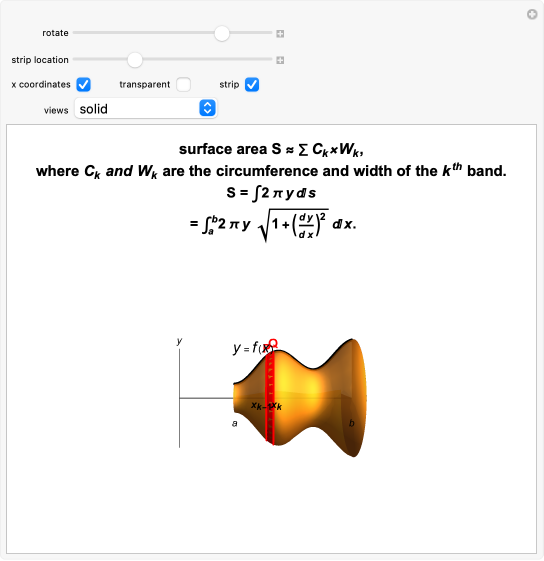
Let’s start with revolving around the x-axis. Imagine your curve is described by the equation y = f(x), and we're spinning it from x = a to x = b. Think of slicing up our surface into a bunch of tiny bands, like super-thin ribbons. Each ribbon is almost a frustum of a cone (that's just a fancy word for a cone with the pointy top chopped off, btw!).
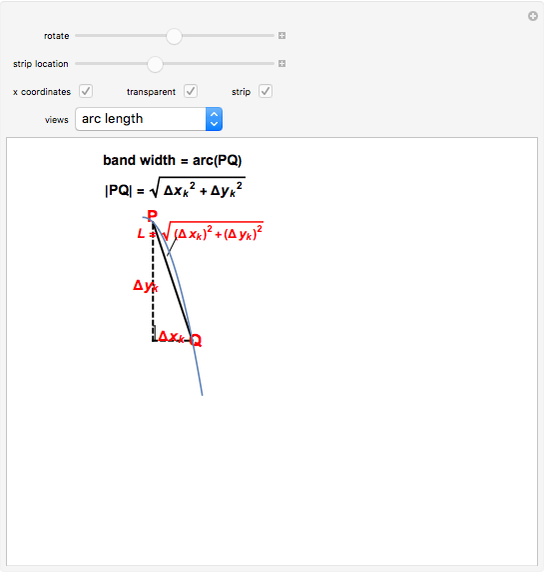
The area of each of these tiny ribbons is approximately 2πy * ds, where 'y' is the radius (the distance from the curve to the x-axis), and 'ds' is the arc length of the curve. Arc length? Oh yeah, remember that little gem from calculus? Don't worry, we'll bring it back.
Arc Length Alert! ds = √(1 + (dy/dx)²) dx. Yep, derivatives are back too. Are you really surprised though?
So, putting it all together for the x-axis: Surface Area = ∫[from a to b] 2πy √(1 + (dy/dx)²) dx.

There! Not so bad, right? I mean, it looks a bit intimidating, but it’s just a matter of plugging and chugging (after you’ve done the derivative, of course!)
What About the Y-Axis?
Ah, a twist! Revolve around the y-axis, you say? No problem! Just a slight adjustment is needed.
Now, our curve is described as x = g(y), and we're spinning it from y = c to y = d. The radius of each ribbon is now 'x' (the distance from the curve to the y-axis).
And the arc length? Well, it’s similar, but we’re now working with dy instead of dx: ds = √(1 + (dx/dy)²) dy.

So, for the y-axis: Surface Area = ∫[from c to d] 2πx √(1 + (dx/dy)²) dy.
See the pattern? It’s all about what variable you’re integrating with respect to, and what your radius is!
Important Tidbits & Fun Facts (Okay, Maybe Not Fun…)
Remember: Always, always, ALWAYS check your limits of integration (a, b, c, d, whatever!). Getting those wrong is a classic calculus blunder!

Sometimes, finding the derivative (dy/dx or dx/dy) can be… challenging. Embrace the power of simplification. Seriously, simplify everything you can before you start integrating. Your future self will thank you.
And sometimes, you might have to use a little trig substitution. Or maybe even partial fractions. (Don’t worry, those are just words… mostly harmless words…)
Final Thought: Don't be afraid to draw pictures! Visualizing the problem is half the battle. Draw the curve, draw the axis of rotation, draw the little ribbons! It really helps. I swear!
So, there you have it! Surface area of a solid of revolution, demystified (maybe!). Now go forth and calculate! Or, you know, grab another coffee. Your call.