
Stainless Steel Plate Gauge Thickness Chart

Hey there, fellow curious minds! Ever wondered about the secret language spoken by sheets of stainless steel? You know, those shiny, durable surfaces we see everywhere from kitchen sinks to skyscrapers? Well, grab a cup of coffee (or tea, no judgment!), because we're diving into the surprisingly fascinating world of stainless steel plate gauge thickness charts.
Now, I know what you might be thinking: "A chart? About thickness? Sounds…riveting." (Pun intended! 😉) But trust me, this isn't just some dry technical document. It's a key to understanding the strength, flexibility, and overall performance of this amazing material. It's like knowing the recipe behind your favorite dish – once you understand the ingredients (in this case, the thickness!), you appreciate it so much more.
So, What Exactly Is a Gauge?
Think of gauge as a slightly quirky way to measure the thickness of sheet metal. It's a bit backwards, actually. A higher gauge number actually means a thinner sheet! Confusing, right? It's like golf – the lower the score, the better you're doing. Think of it that way and it'll stick.
Must Read
Imagine you're looking at two pieces of stainless steel. One is like a delicate piece of paper (okay, maybe not that delicate, but you get the idea), and the other is like a sturdy metal door. The "paper" would have a higher gauge number, while the "door" would have a lower one.
Why this backwards system? Well, that's a bit of history (involving wire drawing, believe it or not!), and we won't bore you with all the details here. Just remember: bigger number = thinner metal.

Why Does Thickness Even Matter?
Great question! The thickness of the stainless steel sheet directly impacts its properties and applications. It's the difference between a flimsy soup can and a robust bridge support. Seriously!
Think about it: If you need something to withstand heavy loads, like a support beam in a building, you'll want a thicker gauge (lower gauge number) for maximum strength and durability. On the other hand, if you need something flexible and lightweight, like a decorative panel, a thinner gauge (higher gauge number) might be perfect.
It's all about finding the right balance. Too thin, and it might bend or break. Too thick, and it might be unnecessarily heavy and expensive. That's where the stainless steel plate gauge thickness chart comes to the rescue!

Decoding the Chart: Your Secret Weapon
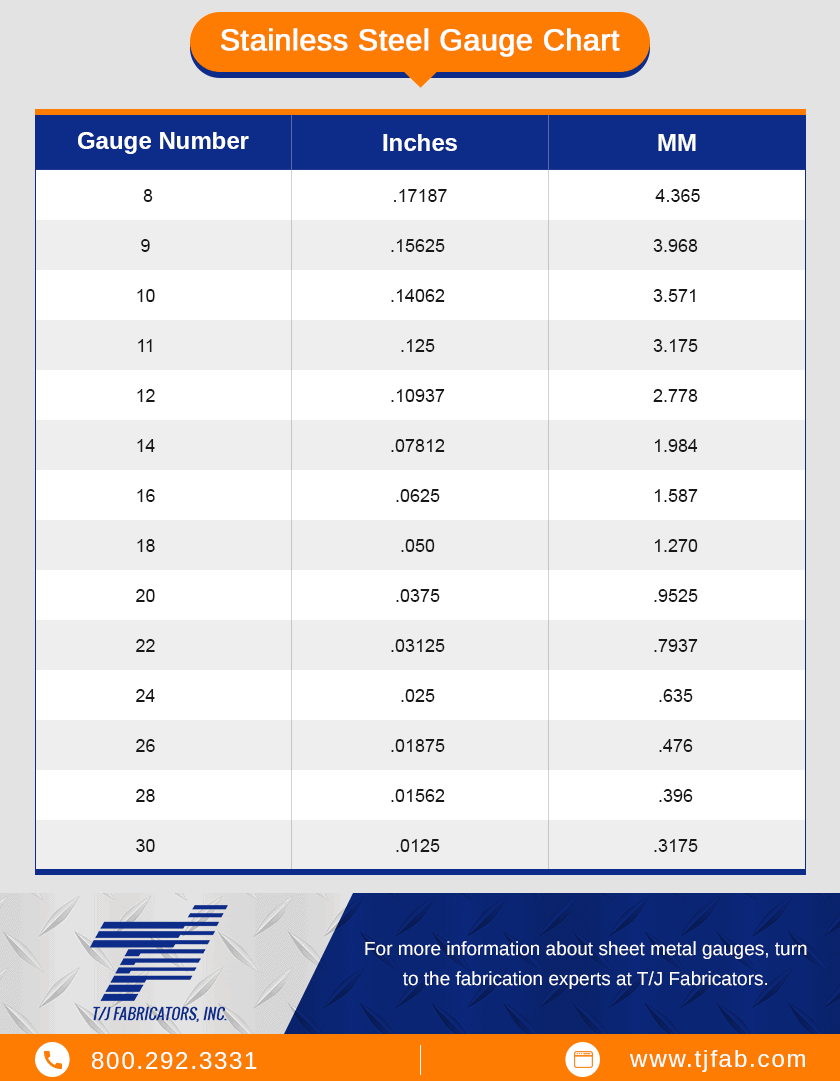
Okay, so what is this magical chart we keep talking about? It's essentially a table that lists the gauge number and its corresponding thickness in inches (or millimeters). It's your go-to guide for understanding the relationship between those numbers and the actual metal thickness.
You can usually find these charts online with a quick search. They'll show you that, for example, 16 gauge stainless steel is approximately 0.0625 inches (1.59 mm) thick, while 10 gauge is around 0.1345 inches (3.42 mm). See how the thickness increases as the gauge number decreases?
Think of it as a translation tool. It translates the cryptic "gauge" language into something we can all understand: actual measurable thickness.

Cool Applications: Where Gauge Really Shines
So, where does knowing this stuff come in handy? Everywhere! Seriously, the possibilities are endless.
- Kitchens: From sinks (typically 18-20 gauge) to refrigerators, the gauge of the stainless steel determines its durability and resistance to dents and scratches.
- Construction: Thicker gauges (10 gauge and below) are used for structural components like beams, columns, and cladding.
- Automotive: Stainless steel is used in exhaust systems, trim, and even body panels, with different gauges chosen for different applications.
- Medical: Surgical instruments and implants often use stainless steel, and precise gauge control is crucial for their performance.
- Art and Design: Artists and designers use stainless steel for sculptures, installations, and decorative elements, taking advantage of its unique properties and aesthetic appeal.
Imagine a sleek, modern kitchen. The gleaming stainless steel appliances aren't just for show; their gauge thickness is carefully chosen to withstand daily use and abuse. Or think about a massive bridge, its robust steel structure relying on precise gauge control for its stability.
More Than Just Numbers: It's About Performance
Ultimately, understanding the stainless steel plate gauge thickness chart is about understanding the performance of the material. It's about knowing what you can expect from a sheet of stainless steel based on its thickness. Will it bend? Will it break? Will it rust? The gauge plays a crucial role in answering these questions.
It's also about making informed decisions. Whether you're building a skyscraper or just choosing a new kitchen sink, knowing the gauge of the stainless steel can help you select the right material for the job and ensure its long-term performance. It's about investing wisely and getting the most out of your materials.
So, the next time you see a sheet of stainless steel, take a moment to appreciate its hidden complexity. Remember the gauge, the thickness, and the amazing properties that make this material so versatile and indispensable. And maybe, just maybe, you'll even find yourself reaching for that stainless steel plate gauge thickness chart. Happy building!
And remember, even the seemingly smallest details, like the thickness of a piece of metal, can make a huge difference. Isn't that kind of cool?