
Remove Element From Vector C++

Vectors in C++! We all love them, right? Big, dynamic, ready to hold anything. Until you need to get rid of something. Then the real fun begins.
The Great Vector Purge
Removing an element from a vector? It sounds simple. Like taking a candy from a baby. But, let's be honest. It can feel more like defusing a bomb. With duct tape.
You see, vectors aren't just bags of stuff. They're ordered bags of stuff. That order matters. Even though sometimes, I question why.
Must Read
The `erase()` Method: A Classic Choice
Ah, `erase()`. The old faithful. Point it to where you want the item to vanish. Poof! Gone. Except not really.
Because the vector has to shift everything else over. Like rearranging deck chairs on the Titanic. Tedious. And potentially slow if your vector is huge. Unpopular opinion: Should vectors be that huge anyway?
Think of it as a really, really long line at the grocery store. And someone decides to leave. Everyone behind them has to shuffle forward. Annoying, right?
The `remove()` and `erase()` Combo: Double Trouble?
Then there's the remove-erase idiom. Fancy, isn't it? Sounds like a magician's trick. It is, in a way, making elements disappear.
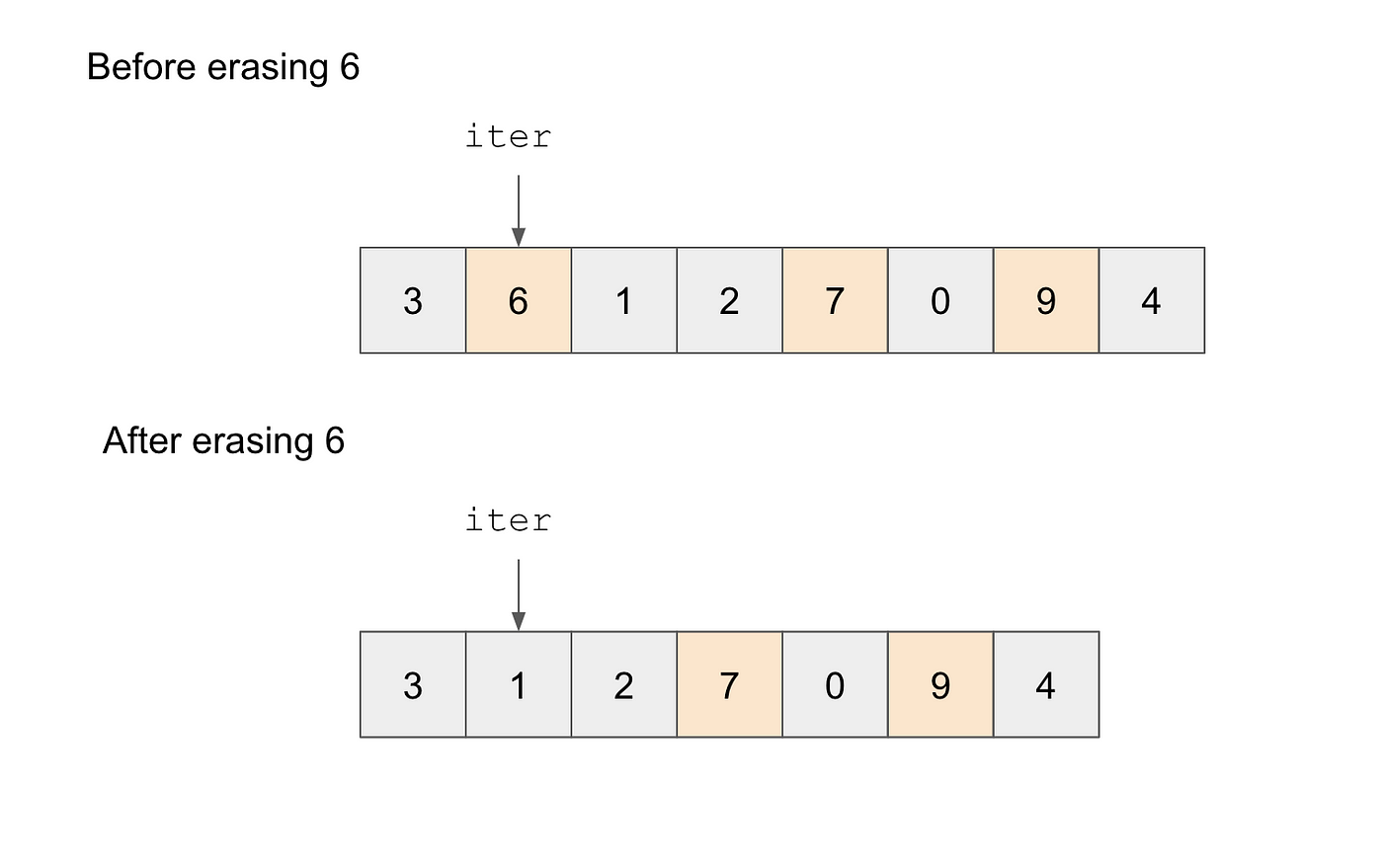
You call `remove()`. It moves all the elements you don't want to remove to the front. Like sorting laundry. Then `erase()` chops off the unwanted bits at the end.
It feels like you're doing the work twice. Moving stuff around just to move it again. Unpopular opinion: Sometimes I suspect the inventors of C++ were just trying to mess with us.
Swapping and Popping: The Backdoor Bandit
Here’s a sneaky trick. If you don’t care about the order of elements (and sometimes, honestly, who does?), you can swap the element you want to remove with the last element.
Then just `pop_back()`. The element you wanted to delete is gone. No shifting. No fuss. Just BAM! Outta there.
It's like a magician making something disappear with a flick of the wrist. Quick and clean. Unpopular opinion: This method is vastly underrated.
Dealing with Duplicates: The Multi-Eraser
Got multiple elements you want to evict? Say you have a vector of annoying numbers. And you want them GONE.
The `remove-erase` idiom shines here. It's like a vacuum cleaner for unwanted data. Sucking them all away in one fell swoop.
Just be careful. You could accidentally vacuum up your socks too. Double-check your conditions before unleashing the `remove()` monster.
When Order Matters (But Does It Really?)
Okay, okay. Sometimes order does matter. Like when you're storing the order of players in a game. Or a list of steps in a recipe. (Though I often skip steps. Unpopular opinion: Recipes are just guidelines.)
In these cases, `erase()` might be your only option. But think hard. Can you restructure your data? Can you use a different data structure?
Maybe a `std::list`? It's slower for random access. But removing elements is a breeze. Unpopular opinion: `std::list` gets a bad rap. It's like the nerdy kid who grows up to be a billionaire.
The "Mark and Sweep" Technique: A Delayed Execution
This isn't a built-in method, but a cool idea. Create a separate "to remove" list. Mark the elements you don't want anymore.
Then, later, iterate through the vector and actually remove them. Like putting off chores until the last minute. (Unpopular opinion: Procrastination is a valid strategy.)
This can be useful if you're doing a lot of removals. And you don't want to keep shifting elements every time. Deferring the cleanup can sometimes be more efficient.
Embrace the Inefficiency? (Gasp!)
Let’s be real. Removing elements from a vector isn't always going to be super-efficient. Especially if you're doing it a lot. Or with big vectors.

Sometimes, the performance hit is negligible. And the code is simpler. And you have more time to drink coffee. Unpopular opinion: Premature optimization is the root of all evil. (Or at least, the root of many headaches.)
So, before you go down the rabbit hole of micro-optimizations, ask yourself: Is it really that slow? Or am I just being a perfectionist?
The Vector's Dirty Little Secret
Vectors are amazing. But they aren't perfect. They're optimized for adding to the end. And for random access. Removing elements from the middle? Not so much.
Knowing this is key. Choose the right tool for the job. Maybe a vector isn't the best choice. Maybe you need a different data structure.
Unpopular opinion: It's okay to admit that vectors aren't always the answer. C++ has other toys in the box. Go play with them!