
Properties Of Metals Metalloids And Nonmetals
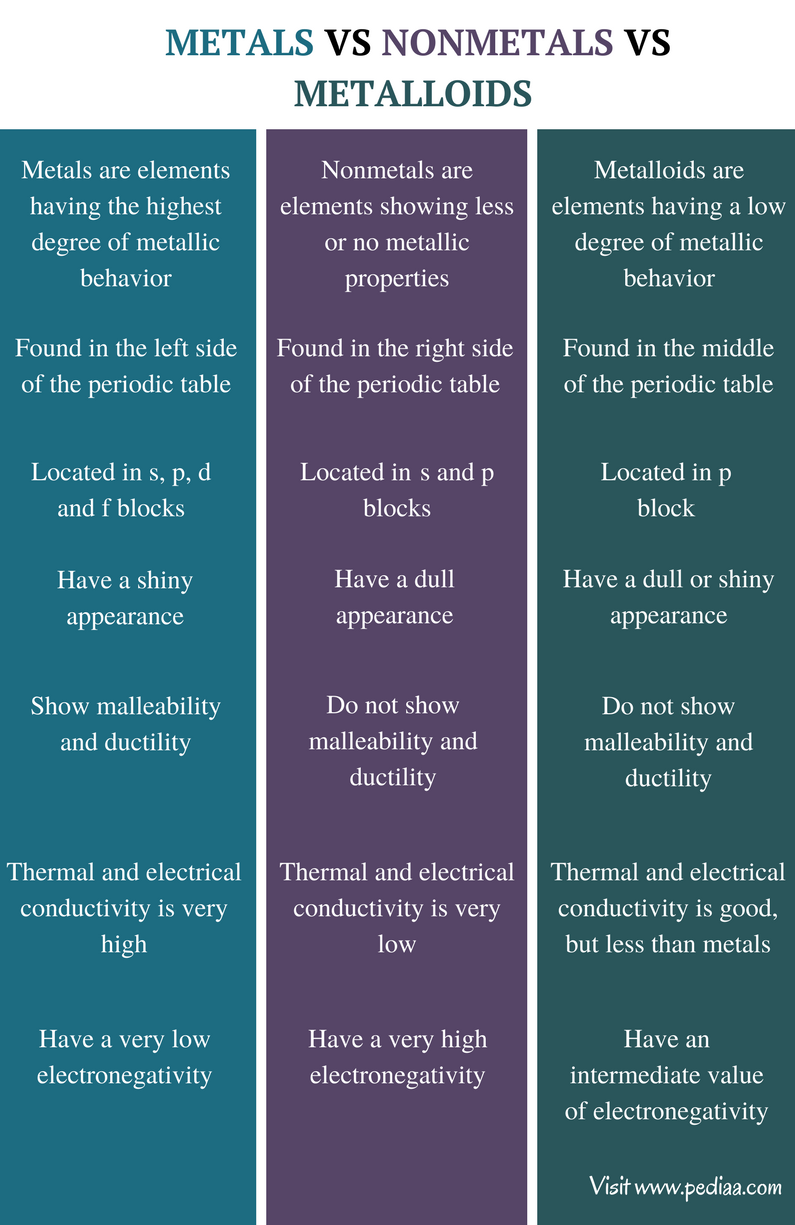
Hey there, curious minds! Ever wonder why your spoon gets hot when you stir soup, or why your phone screen shines? It's all down to the amazing world of elements and how they're grouped based on what they do. We're talking about metals, nonmetals, and those quirky intermediates, the metalloids.
Let's Talk Metals: The Shiny, Strong, and Conductive Crew
Okay, metals. What's the first thing that pops into your head? Probably something shiny, right? Think gold, silver, copper – they all have that distinct metallic luster. But it’s so much more than just looks!
Conductivity is key. Ever noticed how quickly a metal pot heats up on the stove? That's because metals are fantastic at conducting heat and electricity. Imagine them like superhighways for electrons, zipping them around with ease. This is why we use copper wires in our homes – they get the job done efficiently!
Must Read
They’re also generally strong and malleable. What does that even mean? Malleable means you can hammer them into thin sheets. Think aluminum foil! And ductile means you can stretch them into wires. Gold is super ductile - a tiny bit of gold can be stretched into an incredibly long thread. Pretty cool, huh?
Think about it: bridges are made of steel (an alloy, or mixture, of metals!), cars have metal parts, and even your jewelry is (usually) metal. Where would we be without them?
Nonmetals: The Diverse and Varied Bunch
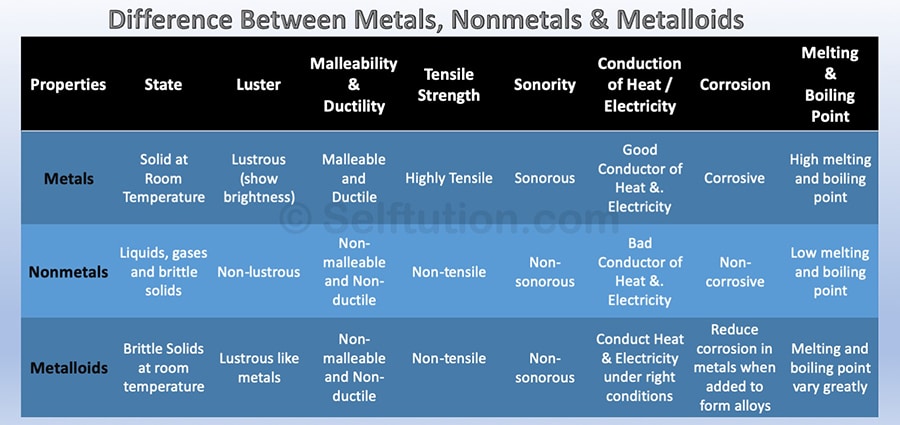
Now let's swing to the opposite side of the elemental spectrum: nonmetals. Unlike their shiny, conductive cousins, nonmetals are a much more diverse and, dare I say, unpredictable bunch.
Poor conductors are their signature move. While metals are electron superhighways, nonmetals are more like… well, dirt roads. They don't conduct heat or electricity very well. This is why the handles of your pots and pans are often made of wood or plastic - which are mostly made of nonmetals.
Nonmetals can be solids, liquids, or gases at room temperature. Think of oxygen (a gas), sulfur (a solid), and bromine (a liquid). Each behaves so differently! They also lack that signature metallic shine. Instead, they might be dull and brittle if solid.

But don’t underestimate them! Nonmetals are essential for life. Carbon is the backbone of all organic molecules. Oxygen is what we breathe. Nitrogen is a key component of DNA. Without nonmetals, there would be no you, no me, no anything living!
Metalloids: The In-Betweeners
And finally, we arrive at the metalloids – the elements that can't quite make up their minds. They live on the staircase of the periodic table, exhibiting properties of both metals and nonmetals. Are they rebels? Maybe. Are they fascinating? Definitely!
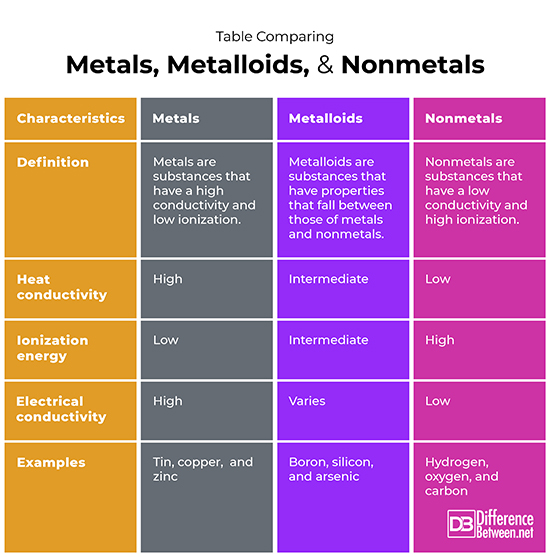
Semiconductors are their superpower. The key characteristic of metalloids is their ability to conduct electricity under certain conditions. They're not as conductive as metals, but they're also not as insulating as nonmetals. This makes them incredibly useful in electronics.
Think silicon. It's a metalloid, and it's the star player in computer chips and solar panels. The ability to control how well silicon conducts electricity makes modern electronics possible. Isn't that amazing? We can essentially tell electrons when to "go" and when to "stop!"
Metalloids are like the ultimate multi-tool of the elements. They’re not always the flashiest, but they’re undeniably important.
So, Why Should We Care?
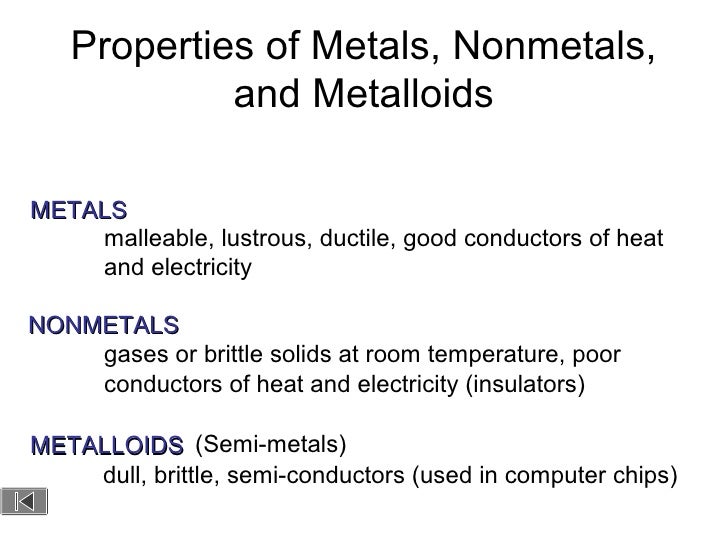
Okay, you might be thinking, "This is all interesting, but why does it matter?" Well, understanding the properties of metals, nonmetals, and metalloids helps us understand the world around us. It helps us design better materials, create more efficient technologies, and even understand the chemistry of life itself.
From the gleaming metal of a skyscraper to the air you breathe, these elements and their properties are fundamental to everything we know. So, the next time you pick up a fork, use your phone, or even just take a breath, remember the amazing world of metals, nonmetals, and metalloids working together to make it all possible! Pretty cool, right?
Keep exploring, keep questioning, and keep being curious!