
Predict The Molecular Shape Of The Sulfite Ion.
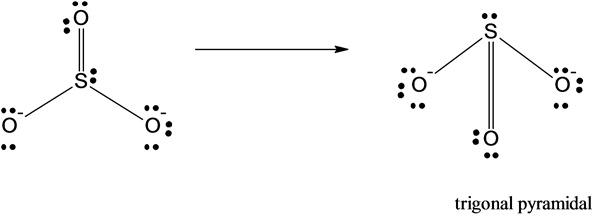
Imagine you're at a molecular masquerade ball. All these tiny particles are dressed up in different shapes, trying to impress. And wouldn't you know it, the sulfite ion, that little charmer (chemical formula SO32-), is trying to decide on their perfect outfit. What shape will this group of atoms choose? Let's play "Guess the Shape!"
First, let's meet the players. We've got one sulfur atom – let's call him Sully. Sully's the central character, kind of like the host of the party. Then we have three oxygen atoms – let's name them Oxy, Oxi, and Oxo – swirling around Sully, eager to connect. And a plot twist! There are two extra electrons hanging around, giving the whole group a slightly negative vibe (that's where the 2- comes from). Think of them as the party crashers who Sully has to accommodate.
Now, molecules don't just pick shapes randomly. They follow a set of unspoken rules, a kind of atomic etiquette. The main rule? Atoms and electron pairs try to get as far away from each other as possible. They're like shy teenagers at a dance – personal space is key!
Must Read
If Sully were surrounded by only two oxygen atoms, they'd probably line up on opposite sides, making a straight line. Picture a molecular tug-of-war, perfectly balanced. But Sully has three Oxy-friends, plus those two extra electron pairs (the party crashers!). This changes the game entirely.
Possible Shapes and Why They Don't Quite Work
Okay, let's explore some fashion faux pas. Could the sulfite ion be flat, like a pancake? Imagine Sully in the middle, with Oxy, Oxi, and Oxo spread evenly around like pepperoni slices. This arrangement, called trigonal planar, would be nice and symmetrical, but those extra electron pairs would cause problems. They'd be crammed too close to the oxygen atoms, creating a molecular mosh pit. Not ideal for anyone’s comfort!

Another option: could they arrange themselves in a pyramid shape, technically a tetrahedral arrangement? The sulfite ion would try to be an ideal tetrahedron, with all four 'faces' (formed by the Oxygen atoms and the electron pair) perfectly symmetrical. Here’s the problem: remember our two extra electrons that are crashers and need to take space also? It becomes a bit too forced, like trying to fit too many guests into a small car.
The Winning Shape: A Molecular Pyramid!
The sulfite ion solves its overcrowding problem by adopting a shape known as trigonal pyramidal. Imagine a tripod with the Oxy-gang forming the base. Sully sits atop, holding the whole structure together. But instead of another atom pointing upwards, there’s just a lone pair of electrons! This pair of electrons pushes down on the oxygen atoms, squishing the pyramid slightly and making the angle between the atoms less than 109.5 degrees.
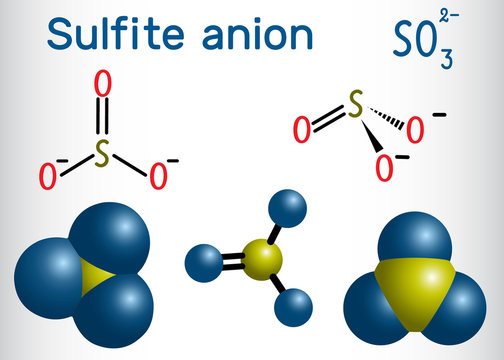
Think of it like this: Sully is a little kid under a blanket. He's holding up the blanket with his arms (the bonds to the oxygen atoms). The blanket is being pushed down from above by an invisible force (the lone pair of electrons), creating a slightly lopsided, but very stable, tent.
So, the sulfite ion's molecular shape is a pyramid with a triangular base. It's not flat, it's not perfectly symmetrical, but it’s perfectly happy! Those extra electrons have found their space, and the oxygen atoms are comfortably arranged around Sully. It's a quirky shape, perhaps, but it's their shape, and they're rocking it.
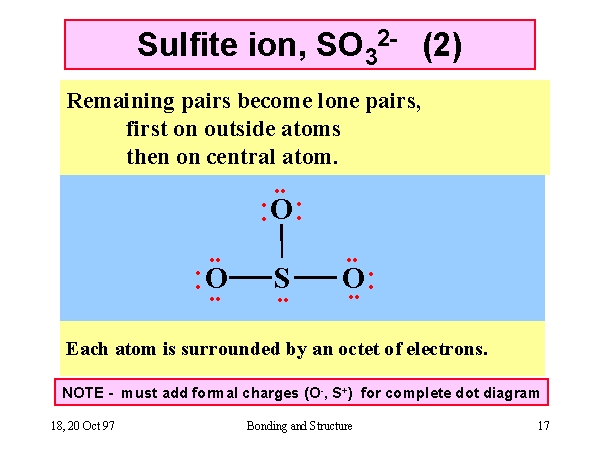
Next time you encounter the sulfite ion (maybe in food preservatives or industrial processes), remember its little molecular pyramid. It's a tiny reminder that even in the world of atoms and molecules, shapes are determined by balancing acts, compromise, and the need for a little bit of personal space.
