
Orbital Filling Diagram Sulfur

Okay, so you've heard about atoms, right? Little tiny things that make up everything, even that weird stain on your favorite shirt you can't quite get out. Well, atoms aren't just a random jumble of stuff. They're actually pretty organized, like a super-efficiently messy desk – there's a system, even if you can't see it right away. And that's where orbital filling diagrams come in. Think of them as the instruction manuals for how atoms arrange their electrons, like little tenants, in their tiny atomic "apartments."
Let's talk about sulfur! You know, that stuff that smells like rotten eggs? Yeah, that's the one. Sulfur is element number 16 on the periodic table, meaning it's got 16 protons and, if it's neutral, 16 electrons buzzing around. Now, where do these 16 electrons go?
The Apartment Complex: Energy Levels
Imagine the atom as a massive apartment complex. The closer you are to the manager's office (the nucleus, in this case), the cheaper the rent and the lower the energy. These "floors" are called energy levels. Electrons, being naturally lazy (like most of us on a Sunday morning), prefer to live in the lowest energy levels available first.
Must Read
The first energy level (floor 1) is tiny; it can only hold two electrons max. Think of it as a studio apartment. The second energy level (floor 2) is bigger and can hold up to eight electrons. That's more like a one-bedroom situation. And the third energy level (floor 3)...well, it's like a sprawling penthouse that eventually can hold 18 electrons. But hold on, we're not quite there yet!
Sublevels: The Specific Rooms
Now, inside each energy level are sublevels. These are like different rooms within the apartment. We label them as s, p, d, and f. Let's stick with s and p for sulfur.
The s sublevel is like a cozy single-person room. It can only hold two electrons, regardless of which floor it's on. The p sublevel, on the other hand, is a bit more social; it can hold up to six electrons. Think of it as a slightly cramped triple-bunked dorm room.
So, how does this all work out for sulfur?
Filling 'Em Up: Sulfur's Electron Configuration
Okay, time to get down to brass tacks. Remember, sulfur has 16 electrons. We need to assign them to their appropriate apartments (energy levels and sublevels). We follow a specific order, kinda like standing in line for concert tickets.

1. The 1s orbital: First, we fill the lowest energy level, the 1s sublevel. It can hold two electrons, so we fill it up: 1s2. Two down, fourteen to go!
2. The 2s orbital: Next, the 2s sublevel. Another single-person room! We fill it with two electrons: 2s2. Four down, twelve to go!

3. The 2p orbital: Time for the second energy level's p sublevel. This can hold six electrons. So, we pack 'em in: 2p6. Ten down, six to go!
4. The 3s orbital: Back to the s sublevel on the third energy level: 3s2. Twelve down, four to go!
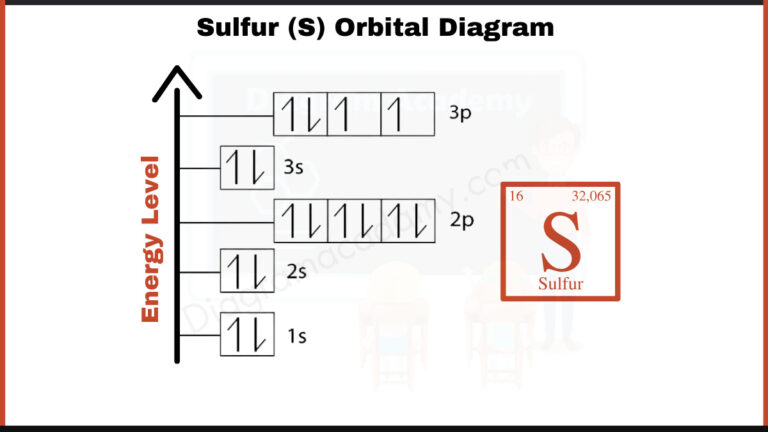
5. The 3p orbital: Finally, we reach the 3p sublevel. This could hold six electrons, but we only have four left to assign. So, we give them each a little space: 3p4.

The Full Picture: Sulfur's Orbital Diagram
Putting it all together, the electron configuration of sulfur is 1s2 2s2 2p6 3s2 3p4. That's its address label! It's like knowing exactly where all the furniture (electrons) are located inside the atomic house.
An orbital diagram is just a visual representation of this. Instead of writing it all out, we use boxes or lines to represent each orbital, and arrows (pointing up and down) to represent the electrons. Think of it as drawing a tiny floor plan of each sublevel.
So, while you might not think about sulfur's electron configuration every day, understanding how atoms arrange their electrons is fundamental to understanding everything around us. From the way molecules bond together to the color of your clothes, it all boils down to these tiny electrons following the rules of their atomic apartment complex. And that, my friend, is pretty cool.