
Molar Mass Of Sodium Acetate
Okay, folks, let's talk about something that might sound intimidating: molar mass. But trust me, it's not as scary as it sounds! We're going to tackle the molar mass of a specific chemical compound: sodium acetate. Think of it like figuring out the perfect recipe, but instead of cookies, we're working with molecules! Why should you care? Well, understanding molar mass is surprisingly useful, even in everyday life. So, buckle up, let's dive in!
First things first, what exactly is molar mass? Simply put, it's the mass of one mole of a substance. And a mole? It's just a really, really big number – 6.022 x 10²³, to be precise (also known as Avogadro's number). Think of it like a baker's dozen, but for atoms and molecules. Instead of 13 donuts, you've got that many particles! Molar mass is measured in grams per mole (g/mol). So, if you have a mole of something, its molar mass tells you how many grams it weighs.
Sodium Acetate: What Is It, Anyway?
Now, onto our star of the show: sodium acetate. You might not recognize the name, but you've probably encountered it before. It's a sodium salt of acetic acid. Still drawing a blank? Think vinegar! Acetic acid is what gives vinegar its sour taste. Sodium acetate is used in all sorts of things, from food preservatives to heating pads. That’s right, the thing keeping your hands warm might just owe its existence to… well, molar mass!
Must Read
One of the most common uses is in hot ice, a super-cool (pun intended!) science experiment you can even do at home. When a saturated solution of sodium acetate trihydrate is cooled, it can be induced to rapidly crystallize, creating a warm, ice-like structure. Understanding the molar mass helps scientists precisely control the concentration of the solution, which is key to making this experiment work. Imagine trying to bake a cake without knowing how much flour to use!
Calculating the Molar Mass of Sodium Acetate (It's Easier Than You Think!)
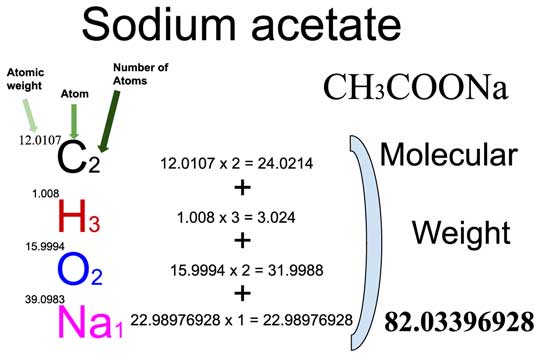
Okay, time for a little math, but don't worry, it's super straightforward. The chemical formula for sodium acetate is CH3COONa. To find its molar mass, we simply add up the atomic masses of each element in the formula. These atomic masses can be found on the periodic table.
Let's break it down:
- Carbon (C): We have two carbon atoms, each with an atomic mass of approximately 12.01 g/mol. So, 2 * 12.01 = 24.02 g/mol
- Hydrogen (H): We have three hydrogen atoms, each with an atomic mass of approximately 1.01 g/mol. So, 3 * 1.01 = 3.03 g/mol
- Oxygen (O): We have two oxygen atoms, each with an atomic mass of approximately 16.00 g/mol. So, 2 * 16.00 = 32.00 g/mol
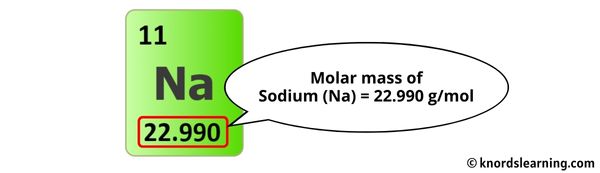
- Sodium (Na): We have one sodium atom with an atomic mass of approximately 22.99 g/mol.
Now, we just add all those values together: 24.02 + 3.03 + 32.00 + 22.99 = 82.04 g/mol.

Therefore, the molar mass of sodium acetate is approximately 82.04 g/mol. See? Not so scary after all!
Why Bother Knowing This? Real-World Applications!
So, why did we go through all that? What's the point? Well, knowing the molar mass of sodium acetate (or any compound, for that matter) is crucial in many different fields:

- Chemistry: Obviously! It's fundamental for calculating the amount of reactants needed in a chemical reaction, ensuring reactions go as planned.
- Medicine: In formulating drugs, scientists need to know the molar mass of each ingredient to ensure the correct dosage. Too much or too little of a substance can have serious consequences.
- Food Science: As we mentioned before, sodium acetate is a food preservative. Understanding its molar mass allows food scientists to determine the proper amount to add to prevent spoilage without affecting the taste or safety of the food.
- Manufacturing: Many industrial processes rely on chemical reactions. Knowing the molar mass of the substances involved is essential for optimizing production and minimizing waste.
Think about it like this: you wouldn't randomly toss ingredients into a cake batter, right? You follow the recipe to ensure the perfect outcome. Similarly, scientists and engineers use molar mass to "follow the recipe" in the chemical world.
So, the next time you're using a heating pad, eating a snack with preservatives, or just thinking about science, remember the mighty molar mass of sodium acetate. It's a small concept with a big impact on the world around us!
Understanding molar mass helps us appreciate the precision and care that goes into creating many of the things we use every day. It’s more than just a number; it's a key to understanding the world at a molecular level! And that, my friends, is pretty cool.
