
Molar Mass Of Copper Sulfate
Alright, gather 'round, folks! Let's talk about something thrilling. Something electrifying. Something... that involves a lot of numbers and could potentially impress your friends at parties. I'm talking about the molar mass of copper sulfate! (Cue dramatic music... or maybe just the sound of crickets. It's all good.)
Now, before you run screaming for the exits, hear me out. Calculating molar mass isn't as scary as it sounds. It's like baking a cake, but instead of flour and sugar, you're using elements and a dash of stoichiometry. And instead of eating the cake (sadly), you get to… uh… feel smart! That's the real reward, right?
So, what is molar mass anyway? Imagine you have a whole bunch of something – like, a mole of something. No, not the furry critter digging up your garden! In chemistry, a mole is a specific number: 6.022 x 10²³. That's Avogadro's number, and it's so big, it's practically unimaginable. If you had a mole of donuts, you could give every person on Earth (and probably every alien within a light-year) a donut every second for, like, forever. That’s a LOT of donuts.
Must Read
Molar mass is simply the mass of one mole of a substance, usually expressed in grams per mole (g/mol). It's like the "price per dozen" for atoms and molecules.
Okay, let's dive into the main event: copper sulfate (CuSO4). If you've ever seen those cool blue crystals in a science kit, that's probably copper sulfate. It's used for everything from electroplating to killing algae in your swimming pool (though I don’t recommend licking it).
Breaking Down the Blues
To find the molar mass of copper sulfate, we need to know what it's made of. Fortunately, the formula tells us everything. CuSO4 means one copper (Cu) atom, one sulfur (S) atom, and four oxygen (O) atoms are bonded together to form one molecule of copper sulfate. Simple enough, right?
Now comes the fun part: looking up the atomic masses of each element on the periodic table! Think of the periodic table as a giant, organized list of all the known elements, each with its own weight listed (its atomic mass). It's like a chemical grocery store, but instead of buying apples and bananas, you're "buying" atoms!
Here's what we find:
- Copper (Cu): Approximately 63.55 g/mol
- Sulfur (S): Approximately 32.07 g/mol
- Oxygen (O): Approximately 16.00 g/mol
See? No need to panic! These numbers are usually listed on the periodic table with plenty of decimal places, but we can round them for simplicity. Unless you're building a spaceship, these approximations are perfectly fine. (And even if you are building a spaceship, I'd recommend getting a professional involved at some point.)
The Grand Calculation
Now we just add them up, taking into account how many of each atom we have in the copper sulfate molecule:
Molar mass of CuSO4 = (1 x atomic mass of Cu) + (1 x atomic mass of S) + (4 x atomic mass of O)

Plugging in the numbers:
Molar mass of CuSO4 = (1 x 63.55 g/mol) + (1 x 32.07 g/mol) + (4 x 16.00 g/mol)
Molar mass of CuSO4 = 63.55 g/mol + 32.07 g/mol + 64.00 g/mol
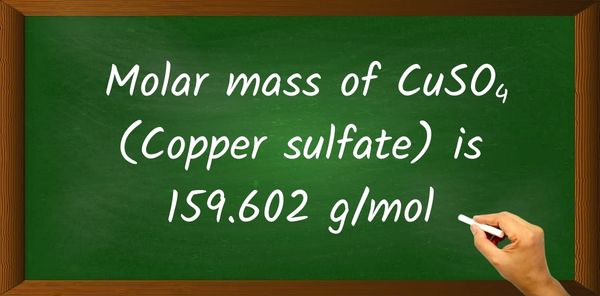
Molar mass of CuSO4 = 159.62 g/mol

Boom! We did it! The molar mass of copper sulfate (CuSO4) is approximately 159.62 grams per mole. You can now confidently tell your friends that, and watch their jaws drop in awe (or, more likely, confusion).
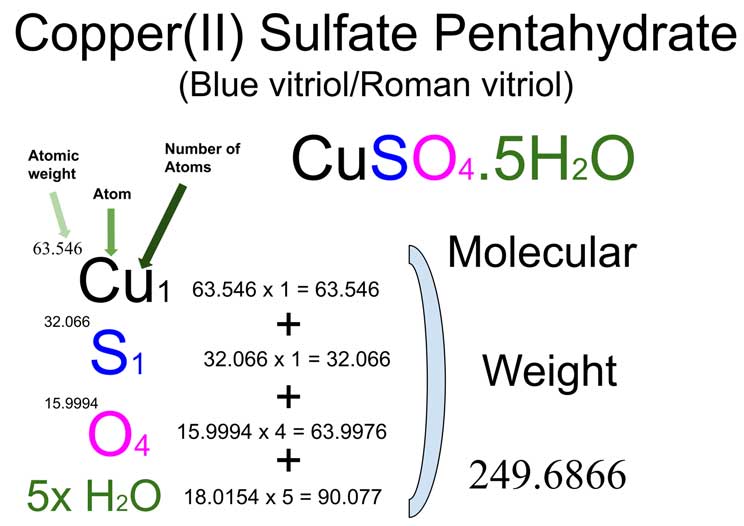
But wait, there's more! Often, copper sulfate exists as a hydrate, meaning it's associated with water molecules. The most common form is copper(II) sulfate pentahydrate, CuSO4 · 5H2O. Those five water molecules tag along for the ride, adding even more to the molar mass calculation!
To find the molar mass of the pentahydrate, we need to add the mass of five water molecules (5H2O) to the molar mass of anhydrous copper sulfate we already calculated. The molar mass of water (H2O) is approximately 18.02 g/mol (2 x 1.01 g/mol for hydrogen + 16.00 g/mol for oxygen).
So, 5 x 18.02 g/mol = 90.10 g/mol
Therefore, the molar mass of CuSO4 · 5H2O = 159.62 g/mol + 90.10 g/mol = 249.72 g/mol
That's the mass you'd typically find if you buy copper sulfate from a chemical supplier. Sneaky, isn't it? Those water molecules are like uninvited guests crashing the molar mass party.
In Conclusion (and After-Party Snacks)
So, there you have it. We've conquered the molar mass of copper sulfate, with and without its watery entourage. You've learned a bit about moles, atomic masses, and hydrates. Now go forth and impress the world with your newfound chemical prowess!
And remember, chemistry is fun... mostly. Especially when there's cake involved. Maybe not copper sulfate cake, though. Stick to vanilla.