
Is The Square Root Of 5 A Rational Number

Hey there, math enthusiasts (or even just math-curious folks)! Ever stop to wonder about the deeper secrets hidden inside everyday numbers? Today, let's dive into a fascinating little question: Is the square root of 5 a rational number?
Now, before your eyes glaze over at the mere mention of “square root” and “rational,” stick with me! It’s actually pretty neat, and we'll break it down in a way that’s easier than figuring out what to binge-watch next.
What Exactly Is a Rational Number Anyway?
Okay, so what is a rational number? Think of it this way: a rational number is simply any number that you can express as a fraction. I mean, a fraction where the top and bottom are whole numbers (integers).
Must Read
For example, 1/2, 3/4, 7/1, even -5/2 – all rational. Think of a pizza. You can cut it into slices, right? Rational numbers are like those slices - quantifiable, expressible as a ratio. Seems straightforward, right?
But wait! There’s a twist! 0.5 is rational too. Because it's 1/2. And 0.3333... (repeating forever) is rational. It's 1/3. See, even those decimals that go on forever can sometimes be neatly packaged up as a fraction.
But what about numbers that can't be written as a simple fraction? That's where the fun begins!

The Square Root of 5: A Different Beast?
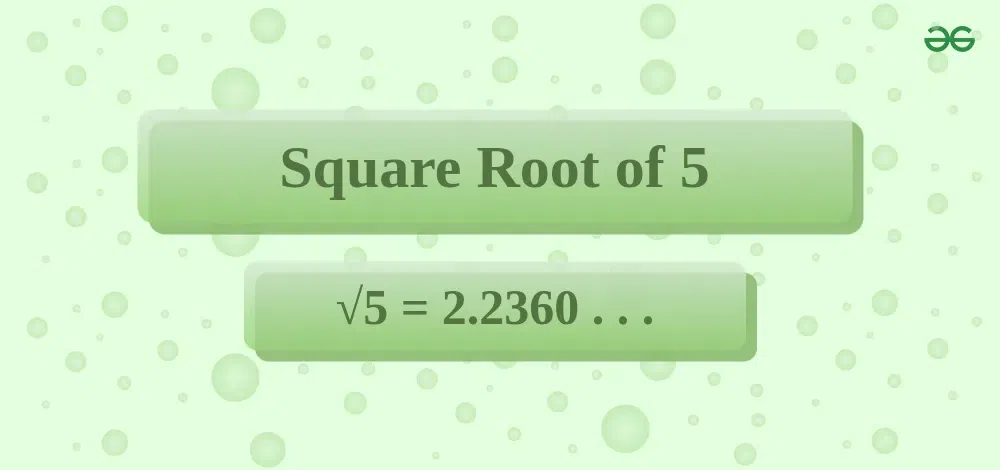
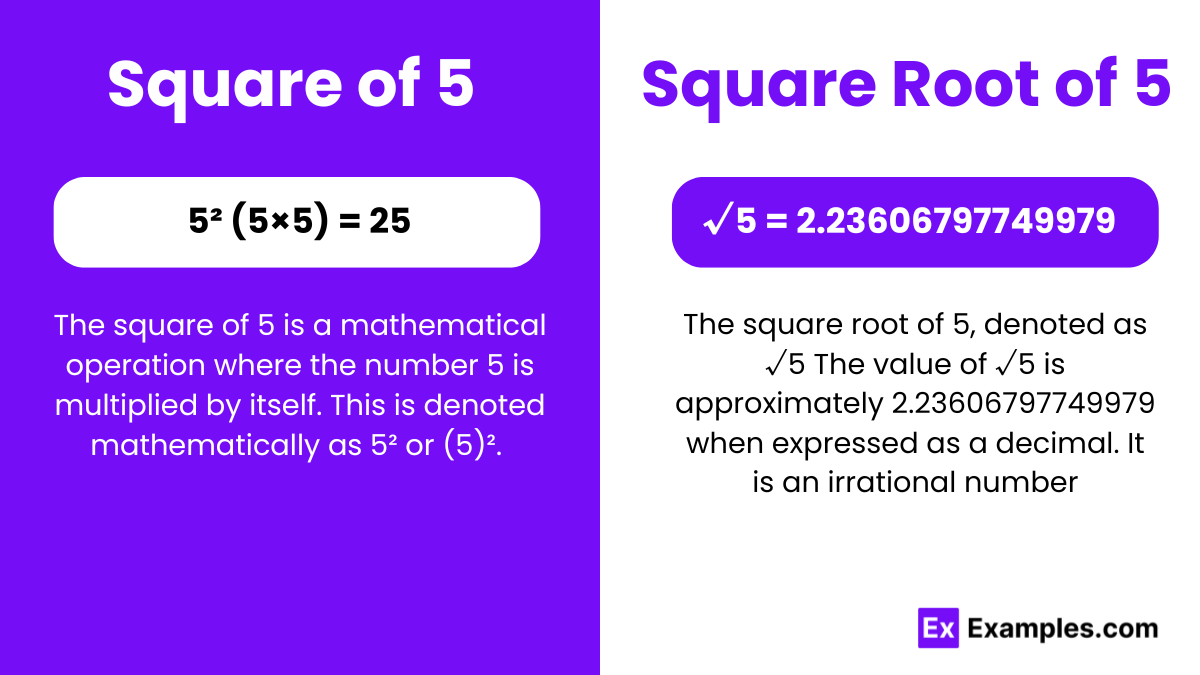
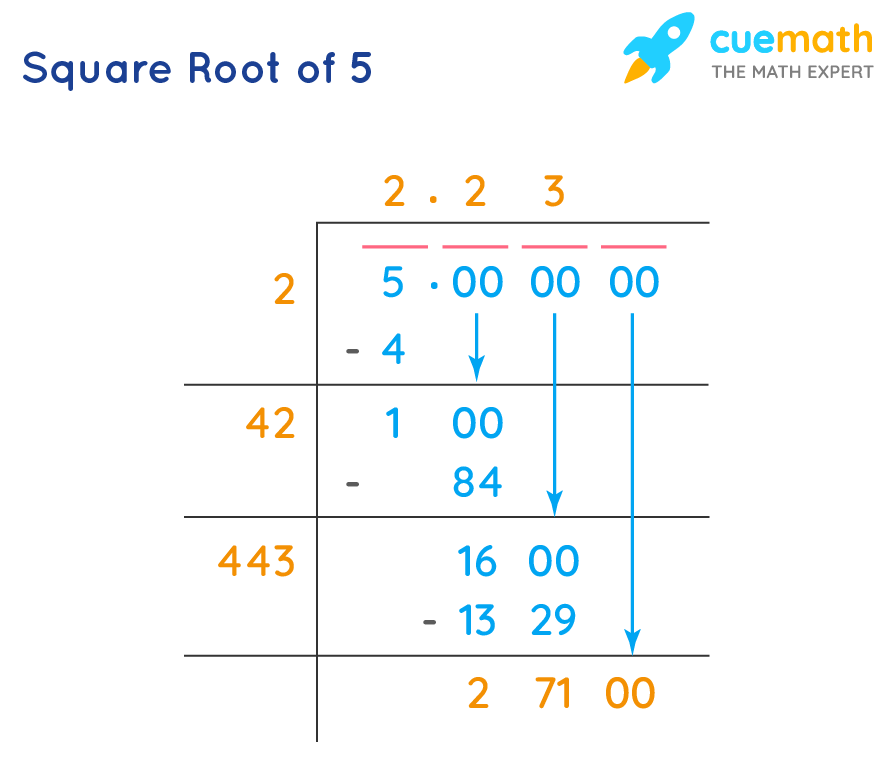
So, where does the square root of 5 fit into all this? The square root of 5 is the number that, when multiplied by itself, equals 5. So, roughly 2.236… But that decimal goes on forever, and it doesn't repeat. This is a big clue!
Imagine trying to divide your pizza into slices that perfectly represent that number. You'd be cutting forever and never get a clean, countable piece. This endless, non-repeating decimal is a sign that we're dealing with something irrational. (Get it? Irrational? Not able to be written as a ratio?)
Why Is It Irrational? (Let’s Prove It!)
Okay, time for a little proof (don’t worry, it's not as scary as it sounds). We’re going to use a method called “proof by contradiction.” Basically, we'll assume that the square root of 5 is rational, and then show that this assumption leads to a logical absurdity.
Let's assume that the square root of 5 can be expressed as a fraction p/q, where p and q are whole numbers and have no common factors (meaning the fraction is in its simplest form).
If √5 = p/q, then squaring both sides gives us 5 = p²/q². Multiplying both sides by q² gives us 5q² = p².
Now, here's where things get interesting. Because 5q² = p², we know that p² must be divisible by 5. And if p² is divisible by 5, then p itself must also be divisible by 5. (This is a key property of prime numbers like 5.)
So, we can write p as 5k, where k is some other whole number. Substituting this back into our equation, we get 5q² = (5k)². This simplifies to 5q² = 25k², and then q² = 5k².
Now look! This means q² is also divisible by 5, which means q itself must also be divisible by 5. BUT! We initially said that p and q have no common factors. If both p and q are divisible by 5, then they do have a common factor! This is a contradiction!
Our initial assumption that the square root of 5 can be written as a fraction p/q has led us to a logical impossibility. Therefore, our assumption must be wrong. The square root of 5 cannot be expressed as a fraction and is therefore irrational.
Why Should We Care?
Okay, so the square root of 5 is irrational. So what? Why is this cool?
Well, it shows us that the world of numbers is much richer and more complex than we might initially think. Not every number plays by the same rules! There's a whole universe of irrational numbers out there, forever stretching into infinity in ways that rational numbers simply can’t. Imagine a map of numbers - the rational numbers are the well-paved roads, and the irrational numbers are the untamed wilderness.
Think of it like this: rational numbers are like using a ruler with precise markings – you can measure things accurately. Irrational numbers are like trying to measure something with a rubber band that’s constantly stretching – you'll get closer and closer, but never perfectly exact.
This also reveals something important about mathematics: that seemingly simple questions can lead to profound and surprising discoveries. It's a reminder that even in the most established fields, there's always more to learn and explore.
So, next time you see √5, remember that it's not just a number. It’s a portal to a deeper understanding of mathematics and the infinite possibilities that lie within.
Isn't that just a little bit mind-blowing?