Ever feel like some numbers are just… aloof? Like they're keeping a secret, guarding a treasure only they know about? That's how it feels with prime numbers. They're the celebrities of the number world, surrounded by mystery and an almost untouchable aura.
The Number 59: A Lone Wolf?
So, is 59 one of these celebrity numbers? Is it a prime number, standing alone and proud, or is it a composite number, hanging out with other numbers, sharing its divisors?
Think of it like this: imagine you're throwing a party for the number 59. A prime number party is, well, a bit of a solo affair. Only 1 and the number itself are invited. But a composite number party? That's a full-blown bash, with lots of divisors swinging by!
To figure out what kind of party 59 throws, we need to check its guest list. Can any number, other than 1 and 59, divide evenly into it? This is where things get a little… exploratory. We start checking the usual suspects: 2, 3, 5, 7… These are the smaller, more common numbers that like to crash number parties.
Does 2 go into 59? Nope. 59 is an odd number, resolutely avoiding any even number shenanigans. Does 3 work? Not quite. 59 divided by 3 leaves a remainder. It's like trying to fit a square peg into a round hole. 5? Nope. 59 doesn't end in a 0 or a 5. And 7? Close, but no cigar. 7 goes into 56 eight times, leaving 3 left over.
Is 59 a prime number? - Calculatio
We could keep going, checking 11, 13, 17, and so on. But here's a little trick: you only need to check prime numbers up to the square root of the number you're testing. The square root of 59 is a little less than 8. So, since we’ve already checked 2, 3, 5, and 7, we’re pretty much done! We've exhausted all the reasonable party crashers.
Think of it like trying to unlock a treasure chest. You try a few keys, and they don't work. You could keep trying keys forever, but eventually, you realize the chest is locked for a reason. It's meant to protect something valuable.
Prime numbers are kind of like that treasure. They're the building blocks of all other numbers. Every composite number can be broken down into a unique set of prime factors. It's like a secret mathematical code!
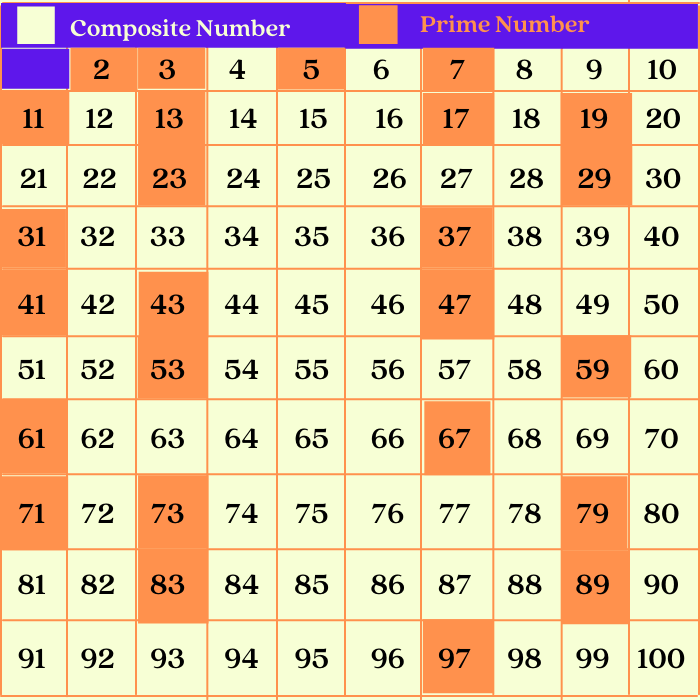
Prime and Composite Number List: Explanation with Examples
So, back to 59. It looks like 59's party guest list is pretty exclusive. Only 1 and 59 are on the list. That means 59 is, indeed, a prime number!
Imagine 59 strolling down the number line, a solitary figure, radiating an air of quiet confidence. It’s not dependent on any other numbers. It stands on its own two digits, a testament to numerical independence. It is a bit like Clark Kent, doing its own thing.
Is 59 a prime number? - Calculatio
Maybe you're thinking, "Okay, so 59 is prime. Big deal." But think about it: hidden within this simple question of prime or composite lies a whole world of mathematical wonder. Prime numbers are the atoms of arithmetic. They are the bedrock upon which so much of mathematics is built.
And the best part? The mystery of prime numbers is far from solved. Scientists are still discovering new and larger prime numbers, and the search continues for patterns and relationships within the seemingly random distribution of these elusive numbers. So, the next time you encounter a number, take a moment to consider its primality. You might just unlock a whole new level of appreciation for the beauty and complexity of mathematics. You might even unlock the next mathematical breakthrough!
Who knew that figuring out whether 59 was prime could be so… heartwarming? Math, surprisingly, can be pretty fun!


![Is 59 a Prime Number or Composite Number [Why & Why not Detailed Guide]](https://images.examples.com/wp-content/uploads/2024/03/Is-59-a-Prime-Number-or-Composite-Number.png)