
Is Ch3br Polar Or Nonpolar
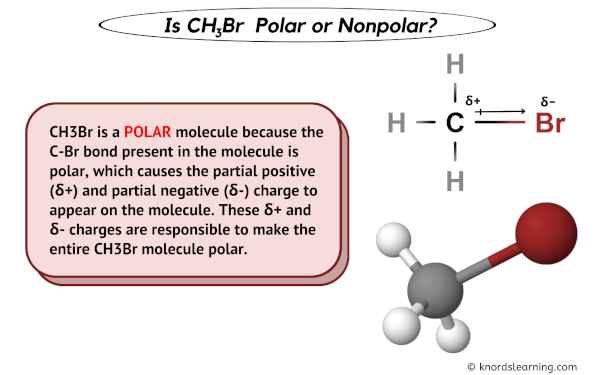
Okay, chemistry buffs and casual knowledge seekers, let’s talk about a molecule that sounds like a futuristic droid but is actually quite grounded (pun intended, for all you Star Wars fans): Ch3Br, or bromomethane. The big question on the periodic table party list is: Is it polar, or is it nonpolar? Grab your matcha latte, and let's dive in!
Understanding Polarity: A Molecular Tug-of-War
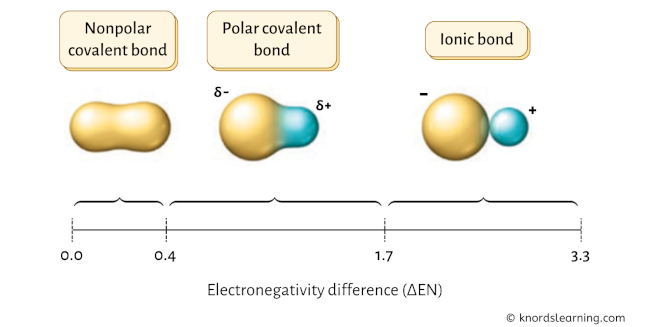
First things first, what even is polarity? Think of it like a microscopic tug-of-war between atoms within a molecule. It all comes down to electronegativity, which is essentially an atom's ability to attract electrons in a chemical bond. The more electronegative an atom, the stronger it pulls those electrons toward itself. This unequal sharing of electrons creates a partial negative charge (δ-) on the more electronegative atom and a partial positive charge (δ+) on the less electronegative atom. Boom! You've got a dipole, and thus, a polar bond.
Imagine two friends trying to share a pizza. One friend is super hungry and grabs most of the slices. That friend is like a highly electronegative atom – hogging all the electron "pizza." The other friend is left with crumbs and a slight feeling of resentment (or in the atomic world, a partial positive charge!).
Must Read
Ch3Br Under the Microscope
Now, let's apply this to bromomethane. We have a central carbon atom (C) bonded to three hydrogen atoms (H) and one bromine atom (Br). Hydrogen and carbon have relatively similar electronegativities. However, bromine is significantly more electronegative than both carbon and hydrogen.
This means bromine is pulling those electrons towards itself like a toddler determined to keep all the toys. The C-Br bond becomes quite polar. The bromine gets a partial negative charge (δ-), and the carbon gets a partial positive charge (δ+). The three C-H bonds are only slightly polar, practically negligible compared to the C-Br bond.

The Molecular Geometry Matters
But hold on! It's not just about the individual bond polarities; we also need to consider the molecule's shape. Bromomethane has a tetrahedral geometry around the central carbon. Ideally, if all four atoms bonded to the carbon were the same (like in methane, CH4), the bond dipoles would cancel each other out, and the molecule would be nonpolar. Think of it like four evenly spaced, equally strong players pulling on a rope in different directions – no one moves.
However, because bromine is so much more electronegative than hydrogen, the C-Br bond creates a significant dipole moment that doesn't get canceled out by the relatively weak C-H bond dipoles. The bromine "pull" is much stronger. This asymmetry results in a net dipole moment for the entire molecule.

The Verdict: Ch3Br is Polar!
Therefore, the answer is: Ch3Br is a polar molecule. It has a net dipole moment due to the presence of the highly electronegative bromine atom and its asymmetrical tetrahedral shape.
Practical Implications and Fun Facts
So, why should you care if bromomethane is polar? Well, polarity affects a molecule's physical properties like its boiling point, solubility, and how it interacts with other molecules. Polar molecules tend to dissolve well in polar solvents (like water) but not in nonpolar solvents (like oil). It's the "like dissolves like" principle.
Here's a fun fact: Halogenated molecules (molecules containing elements like bromine, chlorine, fluorine, and iodine) are often used in organic chemistry as solvents and reactants. Their polarity can be tuned by choosing different halogens to achieve specific reactivity or solubility characteristics. Think of it as a molecular chef using different spices to create the perfect chemical flavor!
Polarity matters in all sorts of applications:
- Drug design: Understanding polarity helps scientists design drugs that can effectively interact with biological targets.
- Material science: Polarity influences how polymers and other materials interact, affecting their strength and durability.
- Environmental science: Polarity affects how pollutants dissolve and disperse in the environment.
Final Thoughts: Polarity in Daily Life
The concept of polarity, whether in chemistry or interpersonal relationships, reminds us that balance and symmetry are essential. Just as a molecule's properties are influenced by the distribution of electrons, our lives are shaped by the balance of give and take, the distribution of responsibilities, and the symmetry of our relationships. Recognizing and understanding these imbalances, just like recognizing a polar molecule, can help us create more stable and fulfilling environments around us. So, the next time you reach for that perfectly balanced cup of coffee, remember the lessons learned from the humble bromomethane. It's all about the pull, the shape, and the overall distribution.
