
Is Ch2f2 Polar Or Nonpolar

Hey there, chemistry enthusiast! Ever looked at a molecule and thought, "Are you polar or are you just putting on an act?" Well, today we're diving headfirst into the fascinating world of molecular polarity, specifically focusing on our friend CH2F2, also known as difluoromethane. Buckle up, it's gonna be a fun ride!
What's the Deal with Polarity Anyway?
Think of polarity like a tiny tug-of-war inside a molecule. It's all about how evenly (or unevenly) the electrons are shared between the atoms. If one atom is a greedy electron hog, it pulls the electrons closer, creating a slightly negative charge on its end and a slightly positive charge on the other end. This creates a dipole moment, and voila, you have a polar molecule!
If the electrons are shared equally (like in a peaceful, harmonious electron commune), then there's no charge difference, no dipole moment, and you have a nonpolar molecule. Simple, right?
Must Read
Now, you might be thinking, "Okay, but how do I know if an atom is a greedy electron hog?" Good question! That's where electronegativity comes in. It's a measure of how strongly an atom attracts electrons in a chemical bond.
CH2F2: Let's Get Down to Business
So, let's take a look at our subject, CH2F2. We have one carbon atom (C) bonded to two hydrogen atoms (H) and two fluorine atoms (F). Remember the tug-of-war analogy? Well, fluorine is a super greedy electron hog! It's one of the most electronegative elements on the periodic table. Hydrogen, on the other hand, is not so greedy.
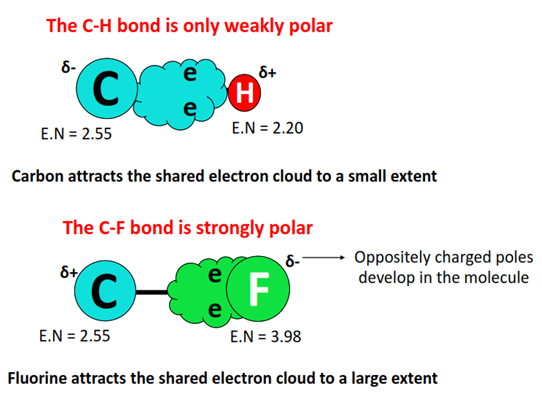
Because fluorine is so much more electronegative than both carbon and hydrogen, it's going to pull the electrons towards itself. This creates a dipole moment pointing from the carbon towards each of the fluorine atoms. So, we have two dipoles pointing in roughly the same direction.
Now, what about the carbon-hydrogen bonds? Well, carbon is slightly more electronegative than hydrogen, so there's a small dipole moment pointing from each hydrogen towards the carbon. However, these dipoles are much smaller than the carbon-fluorine dipoles.
The Big Question: Polar or Nonpolar?
This is where things get a little tricky... or maybe just slightly less straightforward. To determine the overall polarity of the molecule, we need to consider the molecular geometry.
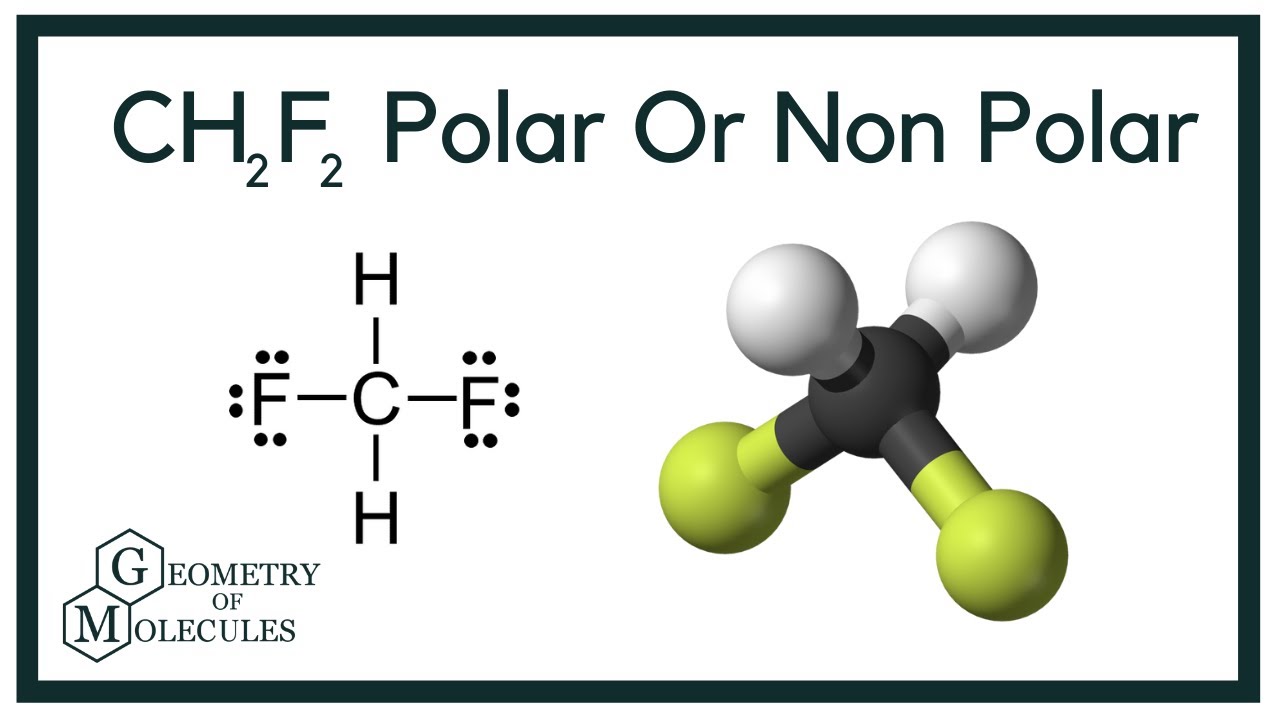
CH2F2 has a tetrahedral geometry. This means that the four atoms bonded to the carbon (two hydrogens and two fluorines) are arranged around the carbon in a three-dimensional tetrahedral shape. Why is this important?
Because of this shape, the individual bond dipoles do not completely cancel each other out. The two strong C-F dipoles dominate, and because they are arranged asymmetrically, their effects don't perfectly negate each other. The smaller C-H dipoles further contribute to the overall dipole moment.

Therefore, drumroll please... CH2F2 is polar!
Imagine trying to perfectly balance two very heavy weights on one side of a seesaw and two very light weights on the other side. You can't, right? The seesaw will tip! That's kind of what's happening with the dipole moments in CH2F2.
Wrapping Things Up (With a Bow!)
So, there you have it! CH2F2, with its greedy fluorines and slightly less greedy carbon, is indeed a polar molecule. It's a classic example of how bond polarity and molecular geometry work together to determine the overall polarity of a molecule.

Understanding polarity is super important in chemistry because it affects all sorts of things, like how molecules interact with each other, how well they dissolve in different solvents, and even how they react with other chemicals.
So next time you encounter a molecule, remember our little chat about CH2F2 and try to determine its polarity. You might just surprise yourself with how much you know!
And hey, even if you get it wrong, don't worry! Chemistry is all about learning and exploring. Keep asking questions, keep experimenting, and most importantly, keep having fun! You're doing great, and the world needs your curiosity and enthusiasm. Go out there and shine, you magnificent molecule maven!