
Is 61 A Prime Number Or A Composite Number
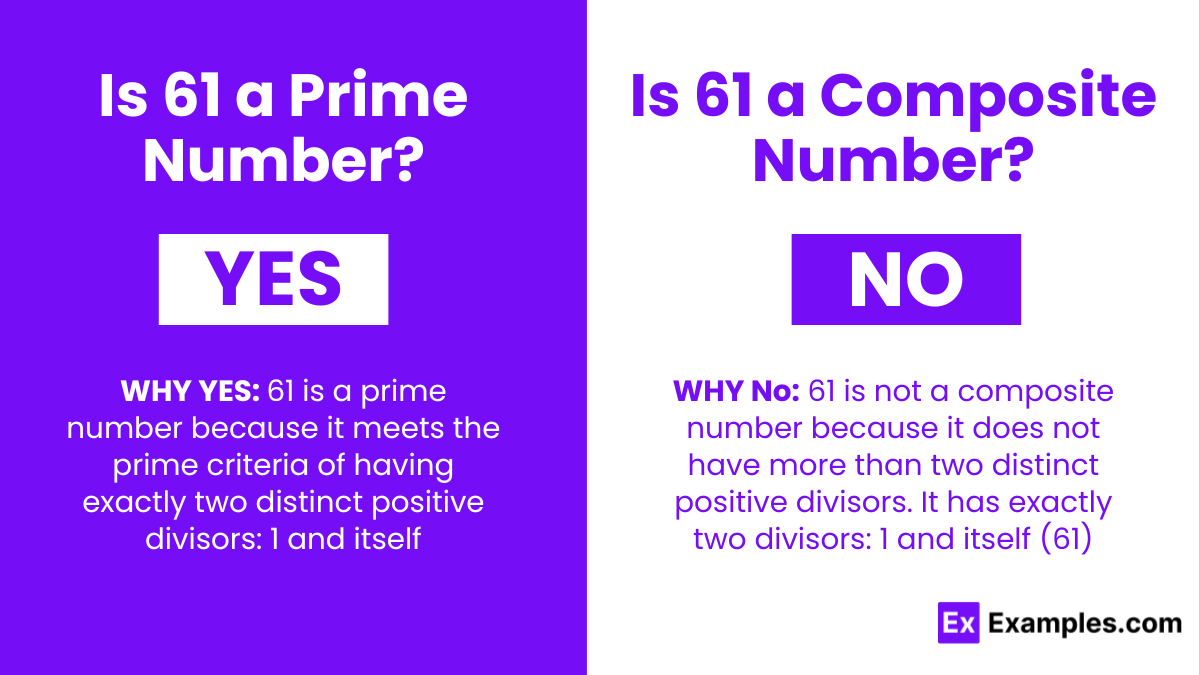
Ever feel like numbers are whispering secrets you just can't understand? Well, today we're cracking the code on one particular number: 61! We're diving into the fascinating world of prime and composite numbers, and trust me, it's way more exciting than it sounds. Why? Because understanding this difference can help you in all sorts of situations, from understanding cryptography (the stuff that keeps your online shopping safe!) to simply impressing your friends at trivia night.
So, what’s the big deal? The goal is simple: to determine whether 61 is a prime number or a composite number. Knowing this helps us understand how numbers are built and related to each other. Think of prime numbers as the LEGO bricks of the number world – you can combine them to build all other whole numbers. Pretty cool, right?
Let's start with the basics. A prime number is a whole number greater than 1 that has only two divisors: 1 and itself. In other words, you can only divide a prime number evenly by 1 and the number itself. For example, 7 is a prime number because you can only divide it evenly by 1 and 7. A composite number, on the other hand, is a whole number greater than 1 that has more than two divisors. For example, 6 is a composite number because you can divide it evenly by 1, 2, 3, and 6.
Must Read
Now, let's put 61 under the microscope. To figure out if 61 is prime or composite, we need to see if it's divisible by any whole number between 2 and the square root of 61 (which is a little less than 8). We only need to check up to the square root because if a number has a divisor larger than its square root, it must also have a divisor smaller than its square root.
Let's test some numbers:
- Is 61 divisible by 2? No, because 61 is an odd number.
- Is 61 divisible by 3? No, because 6 + 1 = 7, and 7 is not divisible by 3.
- Is 61 divisible by 4? No, because it's not divisible by 2.
- Is 61 divisible by 5? No, because it doesn't end in 0 or 5.
- Is 61 divisible by 6? No, because it's not divisible by both 2 and 3.
- Is 61 divisible by 7? No. 61 divided by 7 is 8 with a remainder of 5.
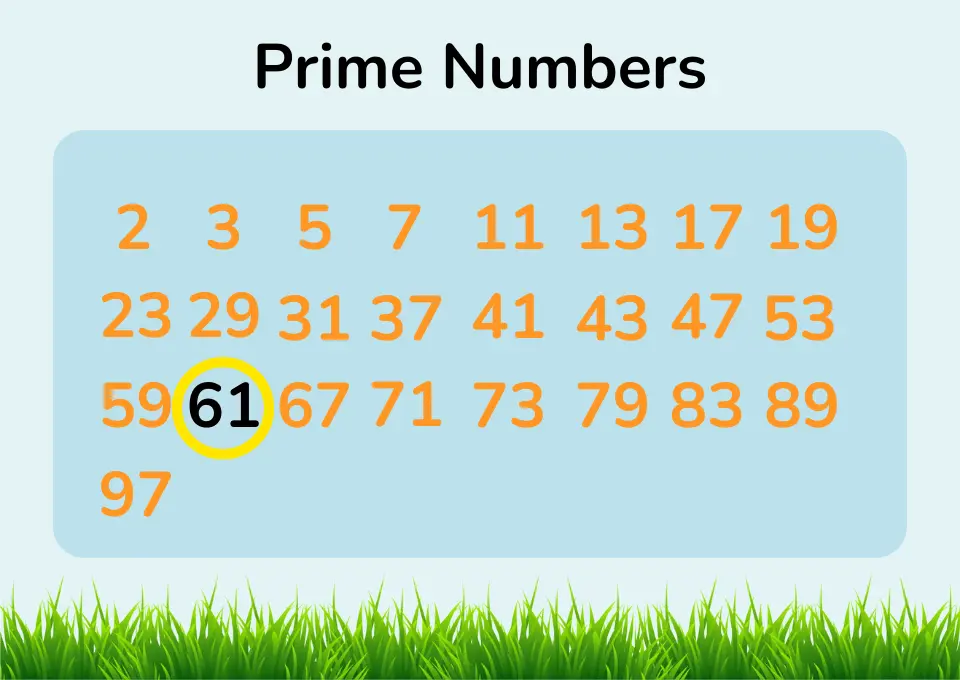
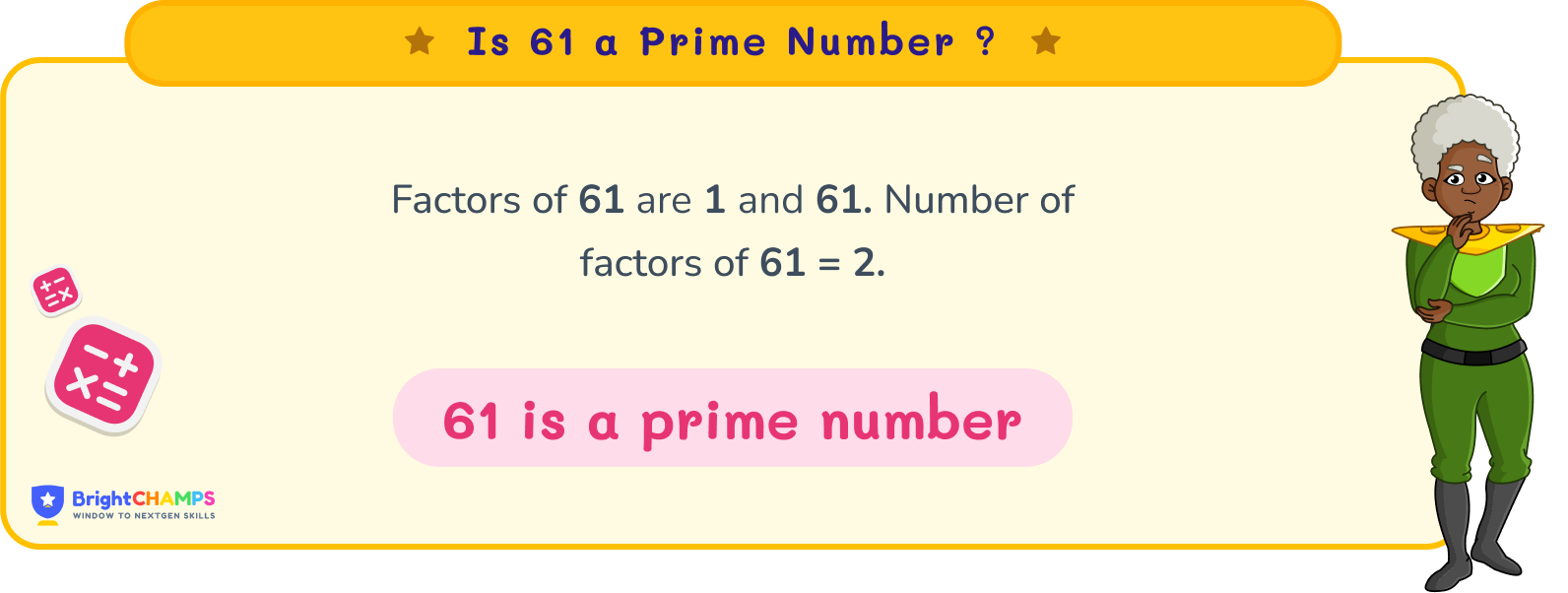
We've checked all the numbers up to 7, which is close to the square root of 61, and none of them divide evenly into 61. Therefore, 61 is only divisible by 1 and 61. That means… drumroll please… 61 is a prime number!
So, there you have it! You've successfully decoded the number 61. Knowing whether a number is prime or composite might seem like a small thing, but it's a fundamental concept in mathematics with real-world applications. Plus, you've now got a fun fact to share at your next party. Impress your friends with your newfound knowledge of prime numbers. Who knows, maybe you'll even inspire someone else to explore the fascinating world of numbers!
![Is 61 a Prime Number or Composite Number [Why & Why not Detailed Guide]](https://images.examples.com/wp-content/uploads/2024/03/Is-61-a-Composite-Number-1.png)