
How To Say Bitch In Spanish
Okay, let's be real. We've all been there. You're watching a telenovela, or maybe just hanging out with Spanish-speaking friends, and you really need a good, juicy insult. You want something with that…bite. But you don’t want to, you know, accidentally call someone a delightful pastry.
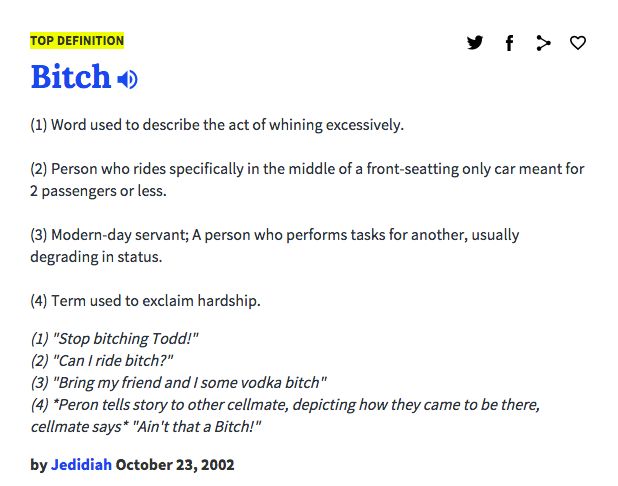
So, how do you say "bitch" in Spanish? Well, it's not as simple as translating "dog." Though, that could work in a pinch, depending on your delivery. But let's get to the good stuff.
The Classics
First, the contender that probably popped into your head: perra. Yes, it literally means female dog. And yes, it can definitely carry that "bitch" energy. But beware! Using it improperly can sound more silly than cutting. It all depends on your tone and the context. Think of it like using "dog" as an insult in English. Sometimes it lands, sometimes it just sounds weird.
Must Read
Then, there's zorra. This translates to "fox." Now, you might be thinking, "Fox? What's so insulting about a fox?" Well, culturally, in some Spanish-speaking regions, it implies slyness and, let's just say, a certain…promiscuity. Think of it as the Spanish equivalent of calling someone a "vixen." It’s got a bit of a sting.
Beyond the Obvious
Now, here’s where things get interesting. Spanish, like any language, thrives on nuance. There are so many ways to express your displeasure without directly translating a four-letter word. And honestly, some of these are way more satisfying.

Consider víbora, meaning viper. Imagine hissing this at someone! It's venomous! It suggests someone is sneaky and backstabbing. Perfect for those passive-aggressive situations.
How about bruja, witch? A classic! It implies someone is not only unpleasant but also potentially meddling and malicious. Plus, witches are cool, so maybe it’s more of a compliment? Just kidding… mostly.
Let’s not forget about the power of a well-placed adjective. Try adding a scathing adjective to a generally neutral noun. For instance, calling someone an idiota pretenciosa (a pretentious idiot) packs a punch without resorting to canine comparisons. It's all about the artistry.
Unpopular Opinion: It's All About the Delivery
Here’s where I get controversial. In my humble opinion, the actual word you use is less important than how you say it. You could call someone "cariño" (darling) in a certain tone and make it sound absolutely devastating. Trust me, I’ve seen it done. It’s all in the eyes, the inflection, the tiny smirk.
A well-timed eye roll accompanied by a drawn-out "Ay, por favor…" can be more effective than any insult you could find in a dictionary. Think of it as verbal judo. Use their own energy against them!

Ultimately, the best way to learn how to deliver a truly cutting insult in Spanish (or any language) is to observe. Watch telenovelas. Listen to how people talk to each other, especially when they're annoyed. Pay attention to the body language and the subtle cues.
And remember, use your newfound knowledge wisely. A well-placed insult can be cathartic, even hilarious. But it can also be hurtful. Choose your battles, and choose your words carefully. Unless you're dealing with a truly deserving persona. Then, unleash the perra within!
Just kidding! (Mostly.)
Unless…?
Okay, I'm done now.