
How To Make Water From Air Without Electricity
Hey there, future water wizards! Ever dreamt of conjuring up a cool glass of H2O seemingly out of thin air? Well, ditch the hocus pocus, because you can actually do it! And the best part? We're talking about making water without plugging anything into a wall socket. Yep, no electricity needed! How cool is that?
Now, I know what you're thinking: "This sounds like something out of a sci-fi movie!" But trust me, it's totally doable with a little know-how and a dash of ingenuity. Ready to dive in? Let's get our hands metaphorically wet!
The Secret's in the Dessicant (Sounds Scary, Isn't!)
Okay, so the real magic ingredient here isn't fairy dust, but something called a dessicant. Sounds kinda like a villain from a superhero movie, doesn’t it? But don't worry, it's actually a super helpful substance that loves to absorb moisture from the air. Think of it like a thirsty sponge for water vapor!
Must Read
You've probably seen dessicants before. Those little silica gel packets that come with new shoes or electronics? Yep, those are dessicants! They keep things dry by sucking up all the moisture in the packaging.
For our water-making adventure, we're going to need something a little more powerful than those tiny packets. Think calcium chloride. It's a salt that's super effective at pulling water out of the air. You can usually find it at hardware stores or online. Just make sure you get the kind that's safe to handle – we're not looking for any explosions here!
The Condensation Dance
Alright, so we've got our dessicant. Now what? This is where the condensation dance begins! (Okay, maybe there's no actual dancing involved, but it sounds more fun that way.)

Here's the basic idea: we're going to expose the calcium chloride to the air, let it absorb all that lovely moisture, and then… extract the water!
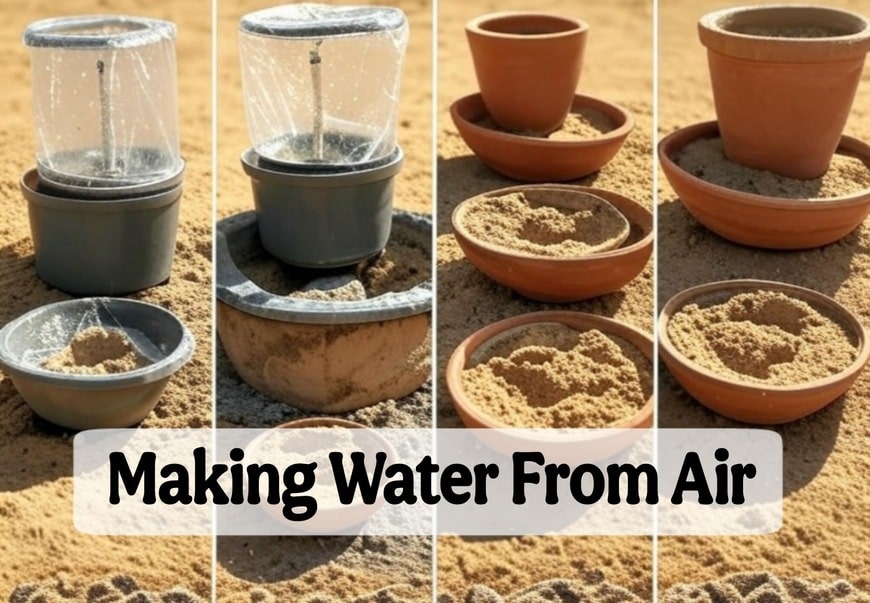
Here's a simple setup you can try:
- Grab two containers. One should be slightly smaller and fit inside the other.
- Place the calcium chloride in the smaller container.
- Put the smaller container inside the larger container. This larger container will catch the water!
- Leave the whole setup in a place with decent humidity. Outside on a slightly humid day is perfect!
Now, patience is key! Over time (it could take several hours or even a day, depending on the humidity), the calcium chloride will absorb water from the air and start to dissolve. You'll see a liquid forming at the bottom of the smaller container.

Separation Anxiety (for the Calcium Chloride, Not You!)
So, we've got a watery mixture of calcium chloride and… well, water. Now we need to separate them! This is where things get a little more involved, but don't worry, we can handle it!
The key here is distillation. We're going to heat the mixture, turning the water into steam. Then, we'll collect the steam and condense it back into pure water!
Now, I know what you’re thinking: “Distillation? That sounds complicated!” And it can be, but we can simplify things. There are lots of DIY distillation setups you can find online using basic kitchen equipment. Think a pot, a lid, and a collection container. A little research will go a long way!

Important Note: Be extremely careful when working with heat. And remember, the water you collect might not be perfectly pure. It's best used for things like watering plants or cleaning. If you want to drink it, you'll need to purify it further.
Scaling Up (Because One Glass Isn’t Enough!)
Okay, so maybe your initial experiment only yields a few drops of water. Don't be discouraged! This is just the beginning. The beauty of this process is that you can scale it up! The more dessicant you use, and the more efficient your collection and distillation methods, the more water you can make. You could even design a passive water collector that works continuously!
Why Bother? (It’s More Than Just Water)
Now, I know what you're really thinking: "Why go through all this trouble when I can just turn on the tap?" And that’s a fair question! But this isn't just about getting a glass of water. It's about understanding how things work, about problem-solving, and about connecting with the natural world. It’s about realizing that even seemingly impossible things are within your reach.

Plus, imagine the bragging rights! You can tell your friends you’re making water from thin air! It’s a guaranteed conversation starter!
Ultimately, learning how to make water from air, even in a small way, can be incredibly empowering. It reminds us that we're not just passive consumers, but active creators, capable of finding innovative solutions to real-world problems. It fosters a spirit of curiosity and encourages us to explore the amazing possibilities that exist all around us.
So, what are you waiting for? Grab some calcium chloride, get your containers ready, and start experimenting! The world of atmospheric water generation awaits! Don't be afraid to tinker, to experiment, and to learn. Who knows? Maybe you'll be the one to invent the next big breakthrough in sustainable water technology. The possibilities are endless, and the adventure is just beginning!