How To Find Direct Materials Cost

Ever baked a cake? Or maybe built a magnificent Lego castle? Then, congratulations! You've already dabbled in the magical world of direct materials cost. Don't let the fancy name scare you. It's simply figuring out how much the actual stuff you used cost.
The Case of the Missing Chocolate Chips
Let's say you're making chocolate chip cookies. Picture this: flour dusting your nose, the whir of the mixer, the intoxicating aroma of vanilla… bliss! But wait, before you devour those golden discs of happiness, a tiny bit of detective work is in order. We need to find our direct materials cost.
What exactly are we looking for? Well, think of all the ingredients that became a real, tangible part of the cookies. The flour, the sugar, the butter, and, of course, the stars of the show: the chocolate chips! These are your direct materials.
Must Read
Now, imagine you bought a five-pound bag of flour for $5, a bag of sugar for $3, a pound of butter for $4, and a bag of chocolate chips for $6. Easy peasy, right?
Hold your horses! You didn't use the entire five-pound bag of flour, did you? Probably not. Maybe you only used two pounds. This is where it gets a little more interesting. We need to figure out how much those two pounds of flour actually cost.
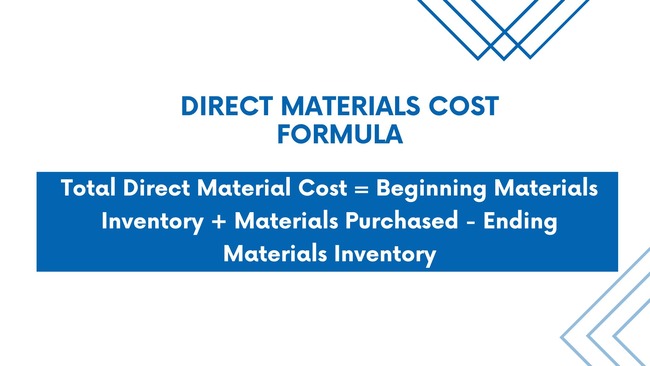
Here's the secret: if the five-pound bag cost $5, then each pound cost $1 (because $5 / 5 pounds = $1 per pound). Since you used two pounds, your flour cost is $2. See? Not so scary!
Let's apply that to everything else. Perhaps you used half the bag of sugar. That means you used $1.50 worth of sugar (because $3 / 2 = $1.50). You used the whole pound of butter, so that's $4. And maybe, just maybe, you were a little generous with the chocolate chips and used three-quarters of the bag. That means your chocolate chip cost is $4.50 (because $6 * 0.75 = $4.50).

Add it all up: $2 (flour) + $1.50 (sugar) + $4 (butter) + $4.50 (chocolate chips) = $12. That, my friends, is your approximate direct materials cost for that batch of cookies!
Beyond the Kitchen: The Lego Master Builder's Dilemma
The same principle applies to building that awe-inspiring Lego castle. Each brick, each tiny character, each little window piece – these are your direct materials. Did you use a whole set? Or did you raid your younger sibling's collection (we won't tell!)? Calculating the direct materials cost helps you understand how much your magnificent creation really cost you. Maybe you even decide to sell it!
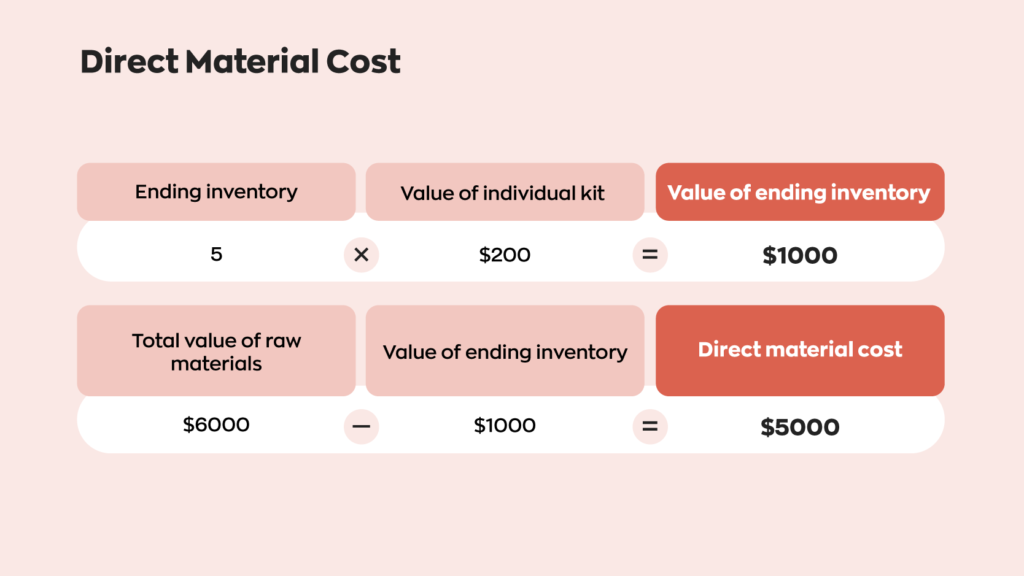
What about that beautiful scarf you knitted for your grandma? The yarn is your direct material. The needles? Not so much. Those are tools you’ll use over and over. We’ll leave that for another article about indirect materials and other exciting accounting adventures!
The Heartwarming Truth
While calculating direct materials cost can seem like a purely financial exercise, it's also a reminder of the effort and resources that go into creating something special. It's about appreciating the value of the ingredients, the bricks, the yarn, and ultimately, the love that goes into every cookie, castle, and scarf.
So, next time you're whipping up a culinary masterpiece or embarking on a creative project, take a moment to appreciate the direct materials that make it all possible. And who knows, maybe you'll even start calculating the cost. Just don't blame us if you suddenly realize how much you're spending on chocolate chips!
“Accounting isn't just counting numbers, it's telling a story.”Remember that direct materials cost is simply a chapter in that story. A delicious chapter, we might add!