
How To Calculate Enteral Feeding Rate

Okay, so you're curious about calculating enteral feeding rates, huh? That's awesome! Maybe you're a student, a caregiver, or just a generally inquisitive human. Whatever your reason, understanding this stuff can be surprisingly interesting. Think of it as culinary math for superheroes – because that's basically what you are when you're helping someone get the nutrition they need. Let's dive in, shall we?
What's Enteral Feeding Anyway?
First things first. What exactly is enteral feeding? Simply put, it's a way to deliver nutrients directly into the stomach or small intestine. Imagine it as a really efficient, targeted delivery system. Think of it like this: If eating a regular meal is like taking a scenic road trip, enteral feeding is like taking a direct flight. Both get you to your destination (nourished!), but one is much faster and more controlled.
Why would someone need enteral feeding? There are tons of reasons! Maybe they have trouble swallowing, can't eat enough on their own, or their digestive system isn't working quite right. Whatever the reason, enteral feeding can be a lifesaver (literally!).
Must Read
The Magic Formula: Calculating the Rate
Alright, now for the main event: calculating the enteral feeding rate. Don't worry; it's not as scary as it sounds. It's really just a bit of simple math. Essentially, we need to figure out how much nutrition the person needs over a certain period of time.
The golden question is: How do we figure this out? It all boils down to a few key pieces of information:
- The total volume of formula needed per day (in mL): This is often prescribed by a doctor or dietitian based on the individual's needs. Think of it like the total gallons of gas you need for your road trip.
- The feeding schedule (in hours): How long will the feeding run each day? Will it be continuous (24 hours) or intermittent (several shorter feedings)? This is like deciding how long you'll be driving each day.
Ready for the formula? Here it is, in all its glory:

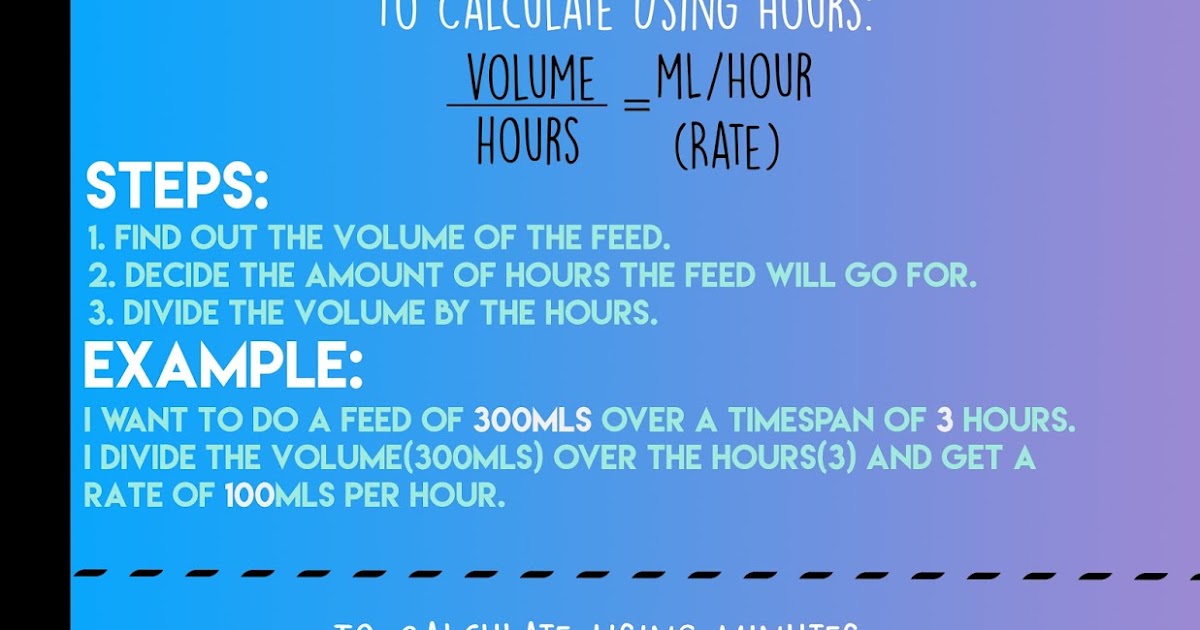
Enteral Feeding Rate (mL/hour) = Total Volume (mL) / Feeding Time (hours)
That's it! Seriously! Let's break it down with an example:
Let's say your doctor prescribes 1500 mL of formula to be given over 24 hours.
Using the formula:

Enteral Feeding Rate = 1500 mL / 24 hours = 62.5 mL/hour
So, the enteral feeding rate would be 62.5 mL per hour. Easy peasy, right?
Let's Do Another One!
Okay, let's say someone needs 1200 mL of formula, but they're only going to be fed for 12 hours each day.

Enteral Feeding Rate = 1200 mL / 12 hours = 100 mL/hour
In this case, the rate would be 100 mL per hour. See? It's just plugging in the numbers!
Why Is This Cool (Besides the Obvious)?
Okay, so maybe you're not completely sold on the coolness factor yet. But think about it: by understanding these calculations, you're gaining the power to understand a critical part of someone's healthcare. You are, in a very real way, contributing to their well-being and quality of life.
Plus, understanding the math behind it all allows you to troubleshoot potential problems. What if the feeding is too fast? Too slow? Knowing the formula allows you to make informed decisions and communicate effectively with the healthcare team.
It's like knowing how your car engine works, even if you're not a mechanic. You can still tell when something sounds off and explain it to the mechanic, right?
Important Considerations (The Fine Print)
Now, before you go off and start calculating rates for everyone you know, there are a few important things to keep in mind:
- Always follow the doctor's or dietitian's orders: They know the individual's needs best. This article is for informational purposes only and should not replace professional medical advice.
- Consider the type of formula: Different formulas have different concentrations and nutrient profiles, which can affect the total volume needed.
- Monitor the person receiving the feeding: Look for signs of intolerance, such as nausea, vomiting, or diarrhea.
- Start slowly and increase gradually: This allows the digestive system to adjust.
Calculating enteral feeding rates might seem a little intimidating at first, but with a little practice and understanding, it becomes second nature. And remember, you're not just crunching numbers; you're playing a vital role in someone's journey to health and well-being. Pretty awesome, right?
So, keep exploring, keep learning, and keep being curious! You never know what fascinating things you'll discover along the way.