Ever wonder why some gadgets feel like energy hogs while others are surprisingly efficient? Or why your super-fast car still needs so much fuel? Get ready, because calculating the efficiency of energy isn't just a boring math problem. Oh no, it's a delightful little puzzle that helps us understand the world around us, save some cash, and even be kinder to our planet!
Think of it like this: every time you use energy, whether it's powering your laptop or brewing a cup of coffee, you're trying to get something useful done. You want a bright screen, or a hot drink. But here's the kicker – not all the energy you put in actually does that one useful thing. Some of it, well, it goes on a little adventure of its own, usually turning into heat or sound. And that, my friends, is where the fun begins!
The Big Idea: Getting More Bang for Your Buck!
At its heart, energy efficiency is about how much of the energy you use actually goes toward your desired outcome. It’s like asking: "How much useful work did I get out of the total energy I supplied?" The higher the percentage, the more efficient your system is. It's truly a game of optimization!
Imagine your old, trusty incandescent light bulb. You turn it on, and it glows brightly, right? But put your hand near it. Hot, isn't it? A lot of the electricity flowing into that bulb isn't making light; it's making heat. That heat is usually considered "wasted" energy because you didn't turn on the light bulb to heat your room (unless it's winter and you're really desperate!).
Now, think about an LED bulb. It still gets warm, but significantly less so. More of the electricity is actually doing its job: making light! This is why LEDs are celebrated for their high efficiency.
Calculating Energy Efficiency - GCSE Physics | kayscience.com - YouTube
The Secret Formula: It's Surprisingly Simple!
Ready for the big reveal? The calculation itself is wonderfully straightforward. You just need two numbers:
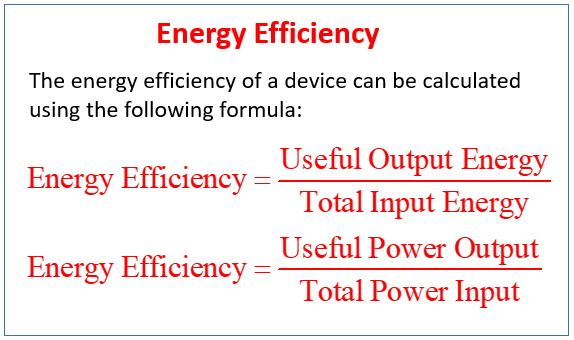
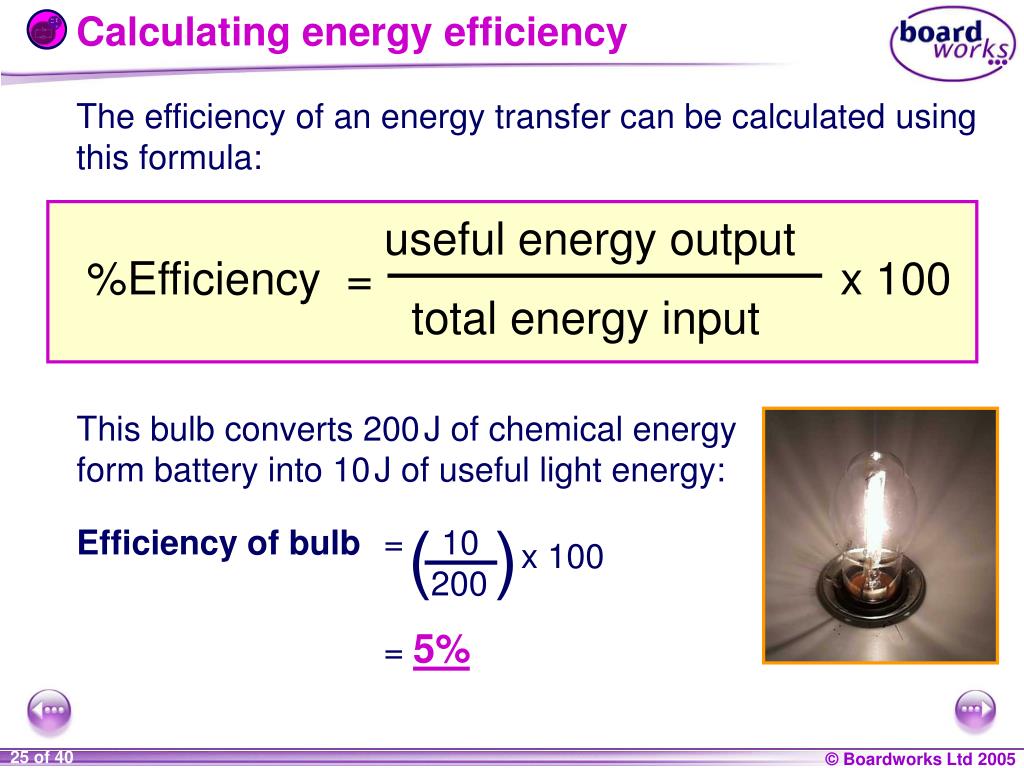
Efficiency = (Useful Energy Out / Total Energy In) * 100%
P1 I) Energy Efficiency – AQA Combined Science Trilogy
That's it! You divide the energy that actually did something useful by all the energy you put into the system. Then, you multiply by 100 to get a nice, easy-to-understand percentage. It’s a bit like figuring out your batting average in a baseball game – how many hits did you get versus how many times you were at bat?
So, for our light bulb example, you'd measure the light energy coming out (the useful energy) and divide it by the total electrical energy you supplied (the total energy in). The result gives you a percentage that tells you just how good that bulb is at its job.
Efficiency Equation
Why Is This So Entertaining?
Well, for starters, it turns you into an instant detective! Suddenly, you start looking at every appliance, every car, every human movement and thinking: "How efficient is that?" You become a connoisseur of cunning energy use.
It's also incredibly satisfying. When you buy an energy-efficient washing machine or switch to a hybrid car, you're not just making a purchase; you're making a smart choice. You're actively reducing the "adventure" energy takes away from your useful goal, which often means saving money on your bills and doing your bit for Mother Earth.
PPT - Measuring current PowerPoint Presentation, free download - ID:5462161
Consider a car engine. You put in gasoline (a lot of energy!), but only a fraction of that energy actually moves the car forward. Much of it escapes as heat from the exhaust or friction. Modern engines are constantly being tweaked to capture more of that energy and turn it into motion, making them more efficient and giving you more miles per gallon. It's a continuous quest for improvement!
Even your own body works this way! When you eat food, your body converts that food energy into things like movement, warmth, and keeping your organs running. If you're running a marathon, your body is being incredibly efficient at converting fuel into forward motion. If you're just sitting on the couch, well, some of that energy might just get stored away for a rainy day!
Understanding energy efficiency is empowering. It gives you the knowledge to make smarter choices, to appreciate the ingenuity behind efficient designs, and to truly see how every bit of energy we use has a story. It's a fundamental concept that connects your toaster to a power plant, your bicycle to a bullet train, and your wallet to the planet's well-being. So, go on, be curious! Start looking at the world through an efficiency lens. It's more fun than you might think!