
How Much Power Does A Nuclear Plant Produce
Ever gazed at the vast, complex machinery of a power plant – maybe on a road trip, or perhaps in a movie – and wondered, "Just how much juice does that thing actually pump out?" If your mind immediately conjures images of glowing green rods à la Mr. Burns' Springfield Nuclear Power Plant, you're not alone. But let's ditch the cartoon villainy for a moment and dive into the fascinating reality of nuclear power. It’s less about a villainous laugh and more about keeping our digital lives humming.
Think about it: from charging your phone to streaming your favorite series, our modern existence runs on electricity. And when it comes to sheer, unadulterated power generation, nuclear plants are in a league of their own. They're the silent, super-efficient workhorses of the energy world, often providing what's known as baseload power – the minimum amount of electricity needed to keep the grid stable 24/7.
The Big Reveal: Power in Numbers
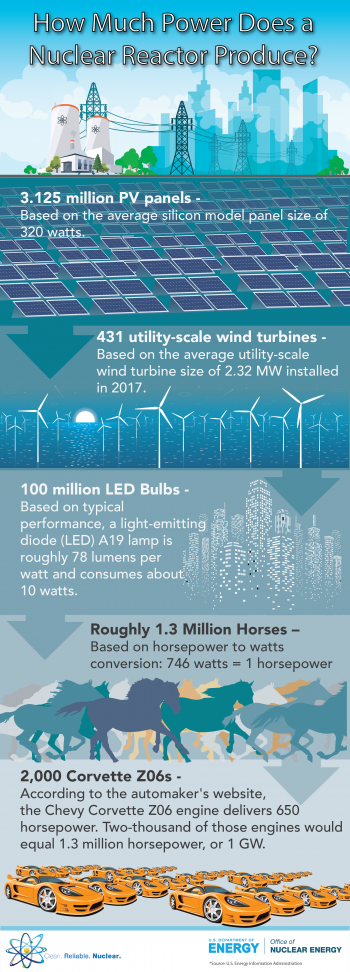
So, let’s get to the nitty-gritty. How much power are we talking? A typical commercial nuclear reactor – and most plants have multiple reactors – can generate anywhere from 1,000 to 1,500 megawatts (MW) of electricity. To put that into perspective, 1,000 MW is equal to 1 gigawatt (GW). Sounds like a lot, right? Because it absolutely is.
Must Read
Consider this: one single 1,000 MW nuclear reactor can power roughly 750,000 to 1 million homes, depending on average household consumption. Imagine a bustling metropolis, its lights twinkling at night, its subways running smoothly, its hospitals fully operational. Much of that underlying energy could very well be supplied by just one or two nuclear units.
To use another analogy, that's enough power to run approximately a billion LED light bulbs, or keep over 100 million laptops charged simultaneously. Suddenly, your phone charger feels a bit humble, doesn't it?
Why So Much Punch?
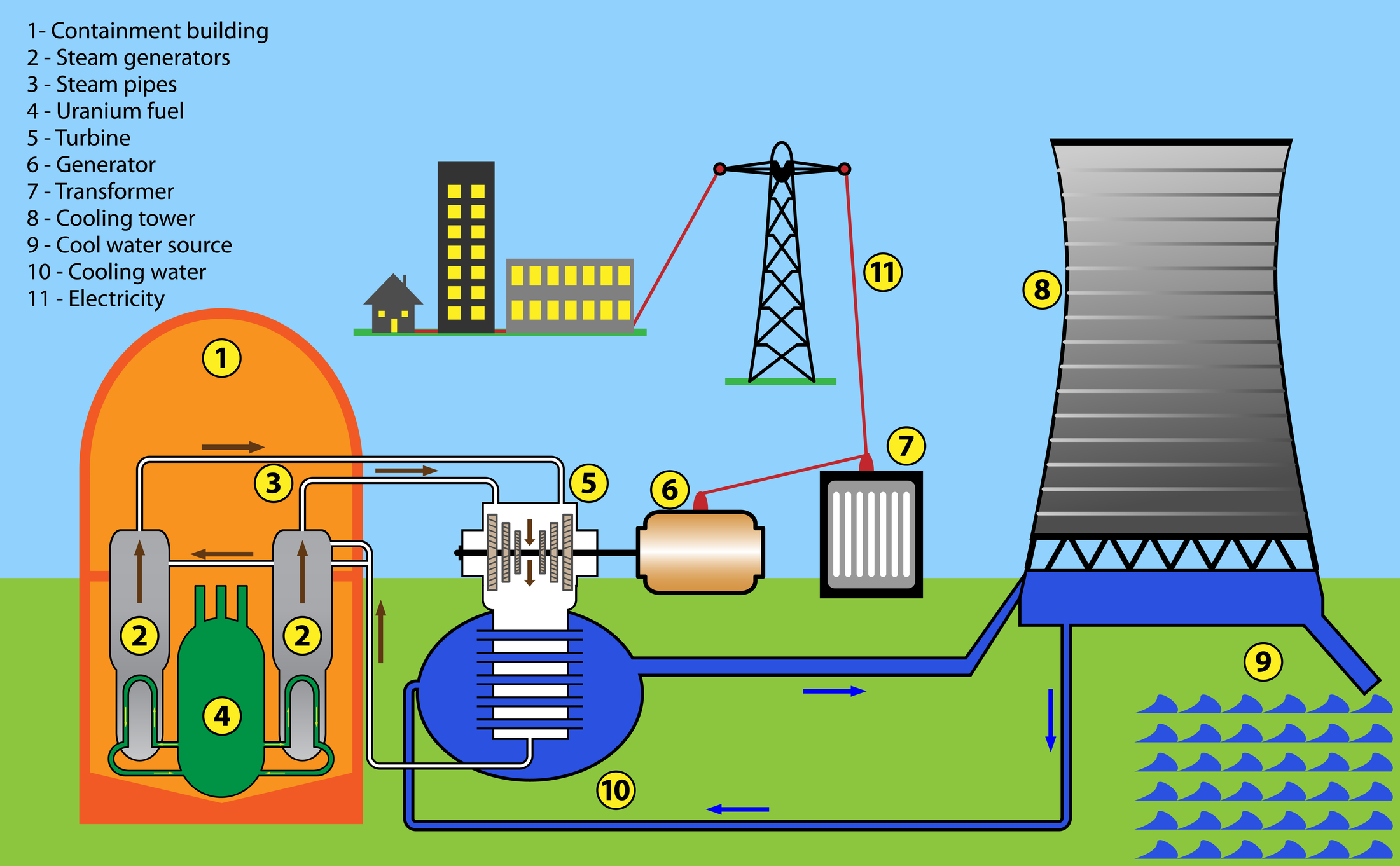
The secret sauce is simple: nuclear fission. A tiny amount of uranium fuel, no bigger than an eraser head, contains as much energy as several barrels of oil or tons of coal. When atoms are split in a controlled chain reaction, they release an incredible amount of heat, which is then used to boil water, create steam, and spin massive turbines connected to generators. It’s a bit like a super-charged, incredibly efficient steam engine.
What makes them truly remarkable is their high capacity factor. Unlike solar panels that only work when the sun shines or wind turbines that need a breeze, nuclear plants can operate almost continuously, running at full power over 90% of the time. This reliability is a huge part of their appeal for stable energy grids.

Fun Facts & Global Glimpses
Did you know the largest nuclear power plant in the world, the Kashiwazaki-Kariwa Nuclear Power Plant in Japan, has a staggering net capacity of 8,212 MW? That's enough to power most of Australia's entire energy grid at peak times! Or how about the fact that France gets about 70% of its electricity from nuclear power? Talk about commitment!
A fun little tidbit: the steam you see rising from those iconic cooling towers? That's just water vapor – essentially a cloud. It's clean, harmless, and proof that a lot of heat is being dissipated efficiently.
Bringing it Home: Your Daily Connection
While you might not have a nuclear power plant in your backyard (and let’s be honest, most of us wouldn’t want one!), the sheer scale of energy they produce has a profound, if often invisible, impact on your daily life. Every time you flip a switch, scroll through Instagram, or enjoy the comfort of air conditioning, you’re tapping into a vast, interconnected energy grid that benefits from these powerful giants.
Understanding where our power comes from can be a powerful thing. It helps us appreciate the engineering marvels that underpin our modern comforts and consider our own energy footprint. So next time you hear about a nuclear plant, remember: it's not just a big building with funny-shaped towers. It's a powerhouse, quietly working to fuel our world, one charged device and illuminated room at a time. It’s all about appreciating the invisible threads of energy that connect us all.
