
How Much Electricity Does A Nuclear Reactor Produce

Alright, settle in, grab your imaginary coffee (or real one, I’m not judging), because we’re about to dive into one of life’s great mysteries: How much electricity does a nuclear reactor actually crank out? It’s a question that probably pops into your head right after, "Where did I leave my keys?" and "Did I remember to feed the cat?"
Most of us picture these things as giant, mysterious concrete bunkers, maybe with a faint green glow if we’ve watched too many cartoons. But what’s happening inside that monumental structure? Is it just making really, really hot water? Yes, but also, so much more!
The Short Answer (for the Impatient)
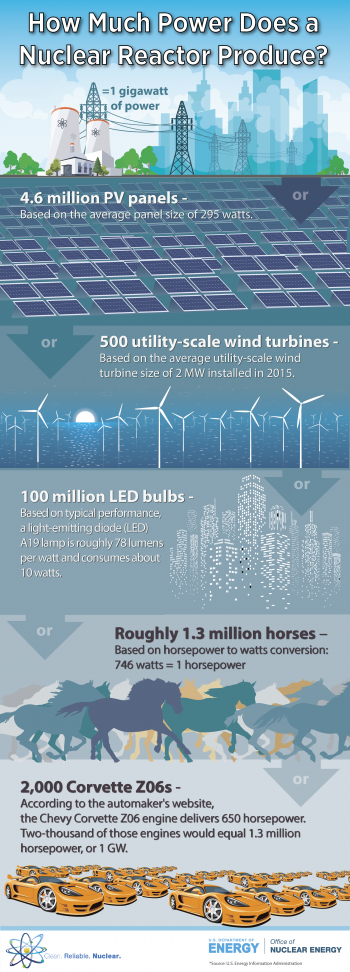
Let’s cut straight to the chase for those of you who have a nuclear reactor to build by lunchtime. A typical modern nuclear power plant unit (usually a single reactor) can produce somewhere in the ballpark of 1,000 to 1,500 megawatts (MW) of electricity. That's a lot of zeros, right? To put that into perspective, that’s enough to continuously power about 750,000 to 1 million homes. Yep, an entire metropolitan area, humming along, all thanks to one colossal, incredibly complex kettle.
Must Read
Imagine, for a second, trying to power a million homes with AA batteries. You’d need so many batteries, they’d probably form their own gravitational pull. Nuclear power just laughs in the face of such puny energy sources.
"But My Solar Panel is Cute!"
And it is! Solar panels are adorable, and wind turbines are majestic spinners of hope. But here’s where nuclear power throws its weight around. While your solar panels are taking a well-deserved nap when the sun goes down (or hides behind a cloud), and wind turbines are standing around looking bored on a calm day, a nuclear reactor is still chugging along, 24/7, 365 days a year. It basically doesn't get sick days, doesn't mind the weather, and it definitely doesn't complain about Monday mornings.

This phenomenal reliability is often called a capacity factor. For nuclear, it's usually around 90% or higher. Solar might hit 25%, wind maybe 35%. Nuclear is basically saying, "Hold my beer, I’m going to do my job, always." It’s the energy world's most dependable workhorse, only this workhorse is powered by splitting atoms.
The Magic Pellet: Uranium!
You might wonder what fuels this beast. It's not giant coal shovels or endless pipes of gas. It's tiny, unassuming pellets of enriched uranium. And when I say tiny, I mean a single uranium pellet, about the size of your fingertip, contains as much energy as a ton of coal, 17,000 cubic feet of natural gas, or 149 gallons of oil. Mind blown, right?

Think about that for a second. That little pellet could keep your TV, fridge, and phone charged for ages, probably outliving your enthusiasm for binge-watching. A full reactor core only needs a few hundred of these pellets to operate for years. Imagine the sheer logistical nightmare of fueling a plant that produced that much power with anything else. We'd need trains stretching to the moon!
How Does It Even Work? (The Extremely Simplified, Humorous Version)
Okay, so it’s not exactly rocket science, but it’s close. Essentially, a nuclear reactor is a very, very fancy way to boil water. Seriously! It creates heat through nuclear fission (fancy word for splitting atoms), which heats water into steam. That steam then spins a massive turbine, which is connected to a generator, and voilà! Electricity is made.
It’s like an incredibly powerful, unbelievably efficient pressure cooker that never runs out of fuel (well, not for a long time). If you had a tea kettle this efficient, you could probably boil the ocean and then some, just for a nice cup of Earl Grey.

The Sheer Scale of It All
Let’s talk scale for a moment. If you were to power a city of a million homes with, say, old-school coal, you'd be looking at literally tons and tons of coal being delivered daily. The carbon emissions would be... well, let's just say the air wouldn't smell like fresh daisies. With nuclear, the fuel requirements are minuscule, and there are zero greenhouse gas emissions during operation. Zip. Nada. Not a peep.
It’s like having a superpower that generates clean, abundant energy without all the messy side effects. Think of it as the quiet, unassuming superhero of the energy world, always working, rarely recognized for its incredible feats of strength.
So, Why Aren't We All Powered by Nuclear?
Ah, that's a whole other coffee conversation, involving things like cost, public perception (thanks, Hollywood and your glowing green slime!), and the challenge of managing waste (which, by the way, is a surprisingly small amount and handled with extreme care). But in terms of sheer, unadulterated, reliable energy output, nuclear is in a league of its own.
Next time you flip a light switch, take a moment. If your power comes from a nuclear plant, know that a monumental feat of engineering is quietly, consistently, and incredibly powerfully keeping your lights on, your Wi-Fi humming, and your coffee maker brewing. It’s not just making electricity; it’s making a lot of it, all the time, with incredible efficiency.
So there you have it. Nuclear reactors: not just for sci-fi movies, but for powering our actual lives with jaw-dropping amounts of clean, reliable energy. Pretty cool, huh?