
How Many Watts To Run Portable Air Conditioner
So, you're thinking about getting a portable air conditioner? Awesome! Staying cool shouldn't be rocket science. But figuring out the watts can feel…well, a little sciency. Let's ditch the jargon and get real about the power it takes to keep your personal ice age humming along.
First things first: Watts. Think of watts like the "food" your AC unit needs to survive. More watts = more power. More power usually = a cooler room. But it also equals a bigger dent in your electricity bill. It’s all about finding that sweet spot, right?
The Wattage Wild West: No Two ACs Are Exactly Alike
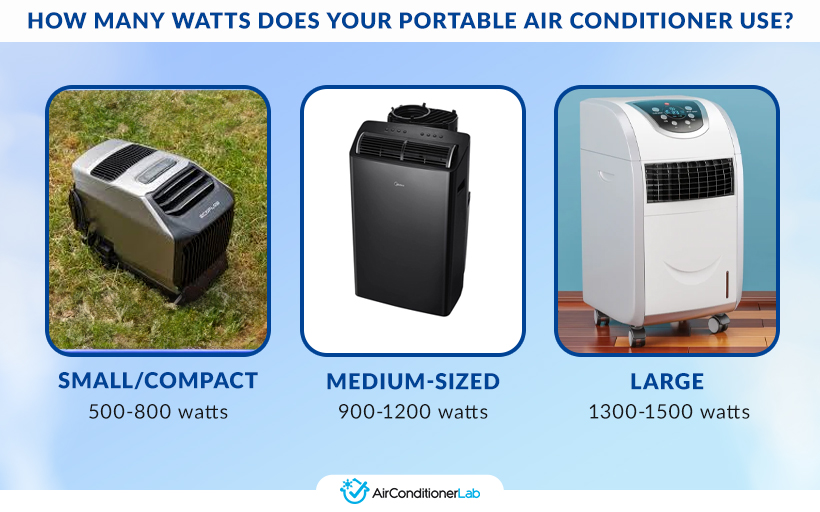
Here’s where things get interesting. Portable ACs come in all shapes and sizes. Some are petite and perfect for a tiny bedroom. Others are beefy beasts meant to conquer a sweltering living room. The wattage reflects this size difference. Generally, expect to see numbers ranging from 700 watts to a whopping 1500 watts. That's a pretty big spread!
Must Read
But why such a difference? It's all about the BTU, baby! BTU stands for British Thermal Units. Think of BTUs as the AC's cooling power. A higher BTU rating means it can cool a larger space. And guess what? Higher BTU usually means higher wattage. Sneaky, huh?
Imagine you’re picking out a puppy. A tiny chihuahua doesn’t eat nearly as much as a giant Great Dane. Same deal with ACs! A smaller unit designed for a small space uses fewer watts.

Decoding the Label: Your Secret Weapon
Okay, so how do you actually find this magical wattage number? Look for a sticker on the back or side of the unit. It’s usually near the other important specs like the model number and voltage. You're hunting for something that says "Watts" or maybe "Power Consumption." It might even be abbreviated as "W."
Don't see it? No sweat! Check the owner's manual. Seriously, crack that thing open. It’s not just for propping up wobbly tables (though it could work in a pinch!). The manual should have all the nitty-gritty details, including the power consumption.
And here's a little secret: sometimes, the wattage is listed in amps. Amps multiplied by voltage (usually 120V in the US) equals watts. So, if you see amps, just do a quick multiplication to get your wattage number. You’re practically an engineer now!
Wattage Woes: Thinking Beyond the Number
Knowing the wattage is just the first step. You also need to think about how long you'll be running the AC. A 1000-watt AC running for one hour uses 1 kilowatt-hour (kWh) of electricity. Your electric bill is based on kWh. So, the more you run it, the more it costs. Obvious, right? But it’s easy to forget when you're basking in that cool, refreshing air.
Also, consider the Energy Efficiency Ratio (EER). This number tells you how efficiently the AC converts electricity into cooling power. A higher EER means more cooling per watt. Think of it like miles per gallon in a car. A higher EER AC will save you money in the long run, even if it has a slightly higher wattage.
It's also a good idea to look for the Energy Star label. Energy Star certified ACs are more efficient than standard models. They've been put through the wringer and proven to save you money on your electricity bill.
Watt's Next? Time to Get Cool!
Armed with your newfound wattage wisdom, you're ready to conquer the world of portable air conditioners! You can confidently choose an AC that’s powerful enough to cool your space without turning your electric bill into a monster.

Remember to consider the BTU rating, check the label for wattage, and think about how long you'll be running the unit. And don't forget to look for that sweet Energy Star label. Staying cool has never been so empowering!
So go forth, brave shopper! Find the perfect portable AC. And remember, a little wattage knowledge goes a long way toward a cool and comfortable summer. You've got this! Now, go make some cold air magic happen!