
How Is Electricity Produced By Nuclear Power Plants
Hey there! Grab a coffee, let's chat. You ever wonder how nuclear power plants actually, you know, make electricity? Because for a lot of us, "nuclear" just sounds… intense. Maybe a bit scary, right? But honestly, once you peek behind the curtain, it's actually pretty darn clever. And it’s not nearly as complicated as it sounds!
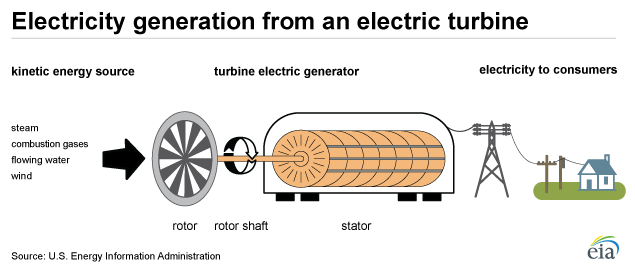
Think of it this way: almost all electricity, no matter if it's coal, gas, or nuclear, boils down to one thing: spinning a giant pinwheel. Seriously! We call that pinwheel a turbine, and when it spins, it powers something called a generator, which is basically a fancy magnet-and-wire contraption that makes electrons zoom around. Ta-da! Electricity!
So, What's Nuclear's Secret Sauce?
Okay, so if the goal is to spin a turbine, we need to generate a whole lot of steam to push it. Most power plants burn stuff – coal, natural gas – to boil water. Nuclear plants, though? They don't burn a thing. Their secret ingredient is a process called nuclear fission. Yeah, I know, fission sounds like a sci-fi movie, but stick with me.
Must Read
Here’s the lowdown: Inside a nuclear power plant, we use a special kind of fuel, usually uranium. This uranium is packed into little pellets, which are then stacked into long rods. These fuel rods are chilling in the heart of the reactor, submerged in water.
Now, here's where the magic (or rather, the physics) happens. We introduce a tiny particle, a neutron, to a uranium atom. When that neutron hits the uranium atom, the uranium atom gets all jiggly and splits apart. This splitting? That's fission!
And when a uranium atom splits, it does two super important things:
- It releases a ton of heat. Like, seriously hot heat.
- It releases more neutrons.
See where this is going? Those newly released neutrons then go off and smash into other uranium atoms, causing them to split, release more heat, and release even more neutrons! This is called a chain reaction. Don't worry, it's not like an uncontrolled explosion; engineers are super clever and have ways to keep it perfectly, safely controlled. We're talking about a very sophisticated balancing act!
Heat, Steam, Spin, Zap!
So, we've got this incredibly hot chain reaction happening in the reactor core. What's next? That intense heat is used to heat up water. But it's not just any water; it's water in a sealed system that's under immense pressure, so it gets super-duper hot but doesn't actually boil.
This superheated water then flows through a device called a steam generator. Think of it like a giant heat exchanger. It transfers its heat to a separate loop of water, which is at a lower pressure. And guess what happens to water at lower pressure when it gets really hot?
Yep! It turns into steam! And not just any steam, we're talking about high-pressure, super-energetic steam. This is the stuff that gets those turbines moving!
Imagine that powerful steam jetting out and hitting the blades of the enormous turbine, making it spin incredibly fast. The turbine is connected by a shaft to the generator. As the turbine spins the generator, it creates an electromagnetic field, which in turn causes those electrons to start flowing. And poof! Electricity is born! Your lights, your phone, your coffee maker – all powered up!
The Grand Finale: Cooling Down
Once the steam has done its job pushing the turbine, it loses a lot of its energy. It then goes into a part called the condenser, where it's cooled back down into liquid water. This cooling usually happens with the help of a separate loop of water, often from a nearby river, lake, or those iconic cooling towers you see. (Fun fact: those big "smokestacks" you see at nuclear plants? That's mostly just water vapor, like a cloud, not smoke or pollution!)
And once it's water again, it gets pumped back to the steam generator to be heated up once more, ready for another round of turning into steam, spinning the turbine, and making more electricity. It's a continuous, beautifully engineered loop!
So, there you have it! From tiny atoms splitting to a massive turbine spinning and finally, to the electricity flowing into your home. It’s pretty ingenious when you break it down, right? Nuclear power plants are essentially just incredibly sophisticated ways to boil water, all thanks to the power of a tiny, splitting atom. Pretty cool, huh? Now, about that refill?