
How Electricity Is Generated In Nuclear Power Plant
Hey there! Grab a mug, settle in. Ever wondered how those giant, often mysterious nuclear power plants actually, you know, make electricity? Sounds a bit like science fiction, right? Like some super secret lab in a movie? Well, it's actually pretty darn clever, and not nearly as scary as it sounds once you break it down. Think of it less as mad science and more as a really, really complicated, but efficient, way to boil water. Seriously!
So, let's chat about it, shall we? You know how most power plants burn stuff like coal or natural gas to heat water and make steam? Or even use wind and water to spin things? Nuclear power plants are in the "boil water" club, but with a super-duper unique heat source. And that heat source, my friend, is where the magic (or rather, the physics!) happens.
The Star of the Show: Uranium!
Our main character here is a metal called uranium. Sounds fancy, doesn't it? It's a naturally occurring element, but a very special kind of it, usually Uranium-235. This particular type is a bit... unstable. It's like that friend who's always on the verge of doing something wild and unpredictable. Uranium-235 is just itching to split apart. And when it does, oh boy, does it release some energy!
Must Read
Splitting Atoms: Fission, Baby!
So, here's the core idea: we take a tiny, invisible particle called a neutron – think of it as a microscopic cannonball – and we fire it at a uranium atom. When that neutron smacks into the uranium atom, the atom gets all excited and, well, it splits! This splitting process is called nuclear fission. Pretty cool name, right?
Now, when a uranium atom fissions, three super important things happen:
- It releases a tiny burst of incredible heat energy. This is our golden ticket!
- It shoots out a couple more neutrons. These are like little radioactive echoes.
- It creates some lighter elements, but let's not get bogged down in the atomic minutiae.
The really clever part? Those newly released neutrons can then go on and hit other uranium atoms, causing them to split, which releases more heat and more neutrons. See where this is going? It's a self-sustaining party! This is called a chain reaction. Imagine knocking over one domino, and it sets off a whole row. But these dominoes are releasing immense amounts of heat!
Keeping it Under Control: The Reactor Core
Okay, so we've got a chain reaction, which is awesome for heat, but we can't just let it run wild. That would be, shall we say, a bit too exciting. So, nuclear power plants have a crucial component called the reactor core. This is where all the fission action happens, safely contained.
Inside the core, we have fuel rods, which are thin tubes packed with little pellets of uranium. And alongside them, we have control rods. These are super important because they're made of materials (like cadmium or boron) that are absolute neutron magnets. They absorb the excess neutrons, slowing down the chain reaction. Think of them as the brakes on our atomic rollercoaster. If things get too hot, they drop down further, absorbing more neutrons and cooling things off. Pretty neat, huh?
All this fission, as you can imagine, generates a phenomenal amount of heat. So, we also have a coolant, usually water, flowing through the core. This water absorbs all that intense heat without boiling because it's kept under extremely high pressure. It's like a super-hot, pressurized sauna that never quite lets out the steam... yet!
From Heat to Steam: The Giant Teapot
The super-hot, pressurized water from the reactor core doesn't actually touch the water that eventually makes steam. Nope, safety first! Instead, it flows through a device called a steam generator. Here, it transfers its insane heat to a separate loop of water that's at lower pressure. And what happens when you heat water at lower pressure? You got it! It boils like crazy, turning into high-pressure, super-hot steam. This is essentially our giant, industrial-scale kettle!
Spinning into Action: The Turbine
Now we have a massive amount of high-pressure steam, and that's exactly what we want. This steam is then directed, with incredible force, towards a set of giant fan-like blades called a turbine. The steam blasts against the blades, making the turbine spin at an incredible speed. Think of it like a pinwheel, but on a scale that could power a small city!
The Grand Finale: The Generator
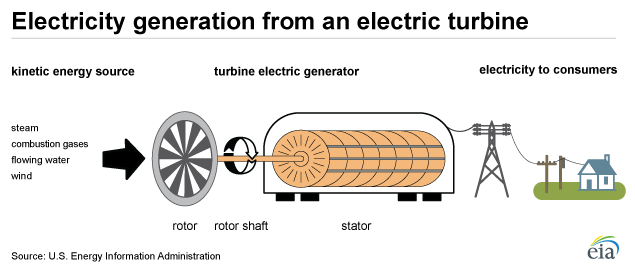
Connected directly to that spinning turbine is a generator. This is where the actual electricity is born! A generator is essentially a fancy device with magnets and coils of wire. When the turbine spins, it rotates these magnets within the coils of wire (or vice-versa), and this movement, thanks to the wonders of electromagnetism, creates an electrical current. And just like that, poof! Electricity! The kind that lights up your house, charges your phone, and keeps your coffee maker brewing.
Cooling Down and Starting Over
After the steam has done its job of spinning the turbine and lost some of its pressure and heat, we don't just let it escape into the atmosphere. That would be wasteful! It goes into a device called a condenser, where it's cooled down by a separate stream of water (often pulled from a nearby river, lake, or from those big, iconic cooling towers you sometimes see). This cooling turns the steam back into liquid water, which is then pumped back to the steam generator to be heated up again. It's a continuous, eco-conscious cycle, minimizing water waste!
So, there you have it! In a nutshell, a nuclear power plant is basically a really, really advanced water boiler that uses the controlled splitting of uranium atoms to create intense heat. That heat then makes steam, which spins a turbine, which then spins a generator, and bam! Electricity for everyone. Pretty clever, right? Who knew tiny atoms could be such hard workers?