History Of Five Mathematician
Ever feel like math is some ancient, mystical language spoken only by people with pocket protectors and an uncanny ability to remember pi to the hundredth digit? Well, hold on to your hats! Because the history of math is actually full of folks just like you and me… okay, maybe a little more dedicated to numbers, but still relatable! Let's meet five of them.
Pythagoras: The OG Geometry Guru
Think of Pythagoras as the ultimate hipster of ancient Greece. Way before skinny jeans and ironic beards, he was all about triangles. Remember the Pythagorean Theorem? (a² + b² = c²). That's him! It's the bedrock of so much architecture and engineering; you can thank him next time you're chilling in a sturdy building. Imagine the guy accidentally bumped into a pyramid once and, bam! Mathematical inspiration struck!
He also had a bit of a cult following, which makes him even more of a hipster icon, right? The Pythagoreans believed everything could be explained through numbers. Seriously. They even had rules about which beans you could eat! (Spoiler alert: most beans were off-limits. Talk about a picky eater!)
Must Read
Euclid: The Organizer Extraordinaire
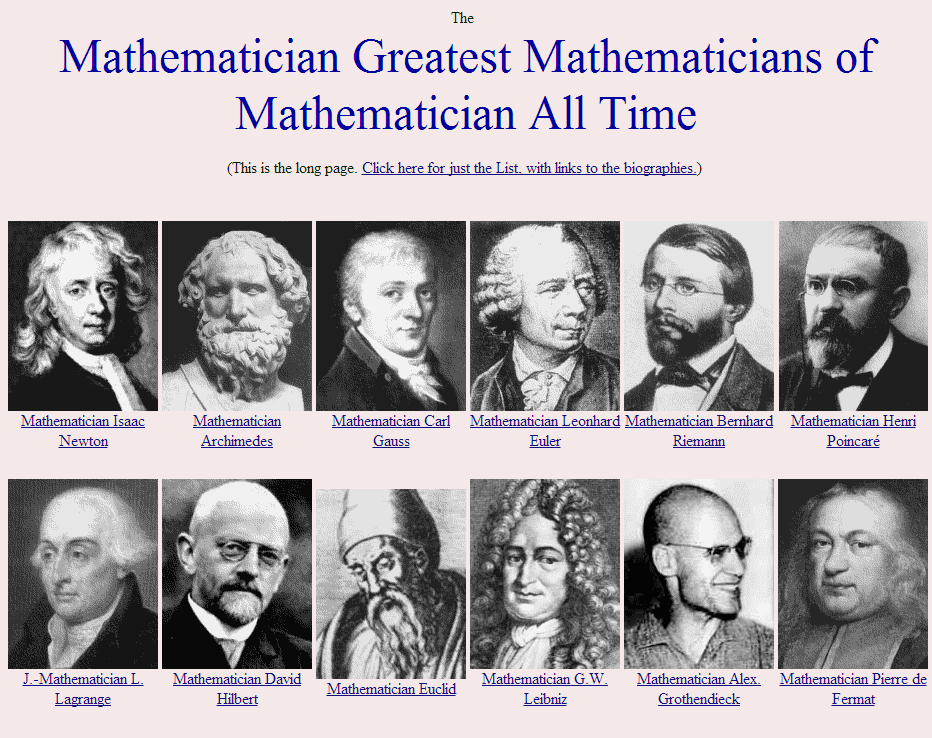
Euclid, the "Father of Geometry," was basically the Marie Kondo of mathematics. He didn't necessarily invent all the geometrical concepts, but he organized them into a neat, logical system in his book Elements. Think of it as the first IKEA instruction manual for geometry. Before Euclid, geometry was like a messy drawer of socks. After Euclid? Perfectly folded and color-coded.
Legend has it that King Ptolemy I once asked Euclid if there was an easier way to learn geometry. Euclid's response? "There is no royal road to geometry." Ouch! Basically, he told the King to put in the work like everyone else. Talk about a mic drop moment!

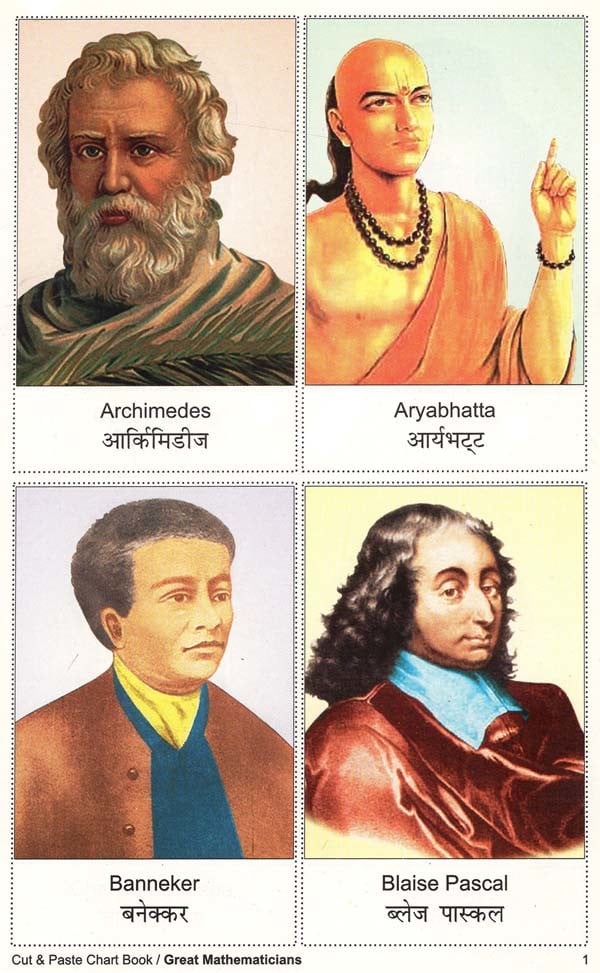
Archimedes: The Mad Scientist of Syracuse
Archimedes was the original "Eureka!" guy. You know, the one who supposedly jumped out of his bathtub, stark naked, shouting that he'd solved a problem. (Though, let's be honest, most of us just get prune-y fingers and realize we forgot shampoo.)
He was an inventor, an engineer, and a mathematician all rolled into one gloriously eccentric package. He invented war machines, calculated the value of pi with impressive accuracy for his time, and even reportedly used mirrors to focus sunlight and set Roman ships on fire. Imagine him at a party. "Oh, this old thing? It's just a death ray... for pirates."
Fibonacci: The Bunny Breeder Who Loved Numbers
Leonardo Pisano, better known as Fibonacci, wasn't some super-serious professor. He was a traveler who picked up mathematical ideas from around the world. He's famous for the Fibonacci sequence (1, 1, 2, 3, 5, 8…), which he used to model…wait for it…rabbit populations. Yep, that's right. Bunny math!
The Fibonacci sequence shows up in nature all over the place – the spiral arrangement of sunflower seeds, the branching of trees, even the proportions of the human face! So next time you're petting a fluffy bunny (or admiring a sunflower), remember Fibonacci, the guy who turned rabbit breeding into a mathematical masterpiece. He's a reminder that math can be found in the most unexpected places.

Alan Turing: The Codebreaker Who Changed the World
Alan Turing was a brilliant mathematician, computer scientist, and codebreaker. During World War II, he played a crucial role in breaking the Enigma code used by the Germans, which is widely believed to have shortened the war by years. Think of him as the ultimate puzzle solver, except the puzzle was stopping a global conflict.
He essentially laid the groundwork for modern computers and artificial intelligence. If you're reading this on your phone or laptop, you owe a debt of gratitude to Alan Turing. His story is also a powerful reminder of the importance of acceptance and tolerance. Despite his incredible contributions, he was persecuted for his sexual orientation and ultimately died tragically. His legacy, however, continues to inspire and shape the world we live in.
So, there you have it! Five mathematicians who prove that numbers aren't just about dry textbooks and complicated equations. They're about curiosity, innovation, and even a little bit of bunny breeding. Who knew math history could be so… human?