
Height Of An Equilateral Triangle

Okay, so picture this: I'm trying to hang a picture, right? And I want it perfectly centered above my couch. Naturally, the couch is pushed right up against the wall. I'm measuring, re-measuring, muttering to myself… and then I realize the wall isn't even straight! It's got this weird, slight angle thing going on. That's when it hit me – sometimes finding the true "height" of something isn't as straightforward as just grabbing a ruler. Geometry, you sneaky devil, you!
Speaking of sneaky geometry, let's talk about the height of an equilateral triangle. Sounds simple, right? It is, once you understand the core concept. But just like my crooked wall, there are a few things to keep in mind.
What Exactly Is The Height, Anyway?
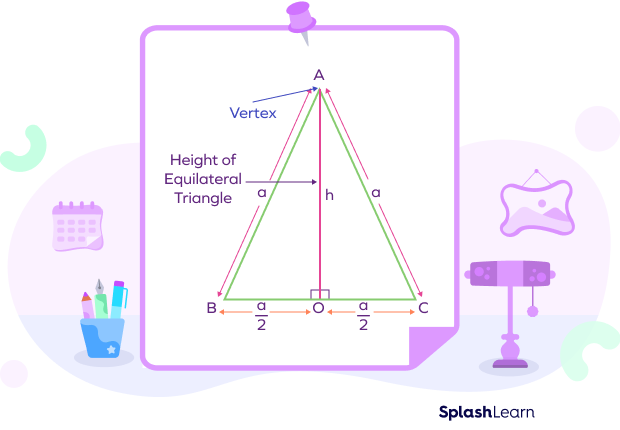
Before we dive into the math, let's define what we mean by "height." It's not just any line you can draw inside the triangle! The height (sometimes called the altitude) is a line segment drawn from one vertex (corner) perpendicular to the opposite side (the base). Think of it as the shortest distance from the top point to the bottom line.
Must Read
Now, because an equilateral triangle is, well, equilateral (all sides are equal and all angles are 60 degrees!), the height also acts as the median (dividing the base in half) and the angle bisector (splitting the top angle into two equal angles). Isn't that neat? All that usefulness wrapped into one little line!
Side note: This makes equilateral triangles super predictable and easy to work with. Unlike, say, scalene triangles… shudders. Don't even get me started on those.
The Pythagorean Theorem to the Rescue!
Alright, let's get to the good stuff: how do we actually calculate the height? This is where our old friend, the Pythagorean Theorem, comes in handy.

Remember that bad boy? a² + b² = c² (where 'c' is the hypotenuse of a right-angled triangle, and 'a' and 'b' are the other two sides).
Here’s the magic: the height of the equilateral triangle neatly divides it into two identical right-angled triangles. The hypotenuse of each of these right triangles is one of the sides of the equilateral triangle (let's call its length 's'), one side is half of the base (s/2), and the other side is the height ('h') that we're trying to find. See how that works?
So, we can rewrite the Pythagorean theorem as:
(s/2)² + h² = s²
Let's solve for 'h'! Ready for some algebra? Don’t worry, I’ll hold your hand (metaphorically, of course. This is the internet).
- Subtract (s/2)² from both sides: h² = s² - (s/2)²
- Simplify: h² = s² - s²/4
- Combine like terms: h² = (3/4)s²
- Take the square root of both sides: h = √(3/4)s²
- Simplify further: h = (√3 / 2) * s
The Formula! (Drumroll Please…)
And there you have it! The height ('h') of an equilateral triangle with side length 's' is:
h = (√3 / 2) * s

Boom! Isn't that a beautiful thing? Memorize it, write it on your hand, tattoo it on your forehead… okay, maybe not the last one. But seriously, it's a handy formula to have in your geometrical toolkit.
Let's try a quick example. If an equilateral triangle has a side length of 10 cm, its height would be (√3 / 2) * 10 cm ≈ 8.66 cm.
Quick Tip: Don’t be afraid of that √3. Your calculator is your friend!

Why Bother? (Real-World Applications)
So, why should you care about the height of an equilateral triangle? Well, beyond impressing your friends at parties (guaranteed to be a hit!), it has practical applications.
Think about architecture, engineering, or even design. Equilateral triangles pop up in structures, patterns, and logos all the time. Knowing how to calculate their height is crucial for ensuring stability, accuracy, and aesthetic appeal.
And who knows, maybe it'll even help you hang a picture straight on a crooked wall someday. Okay, probably not. But hey, knowledge is power, right?
So, there you have it – the height of an equilateral triangle, demystified! Go forth and conquer those geometric challenges! And remember, even if your walls aren't perfectly straight, at least your math skills can be.