
Greatest Common Factor Of 24 And 45
Alright, gather 'round, folks! Let's talk numbers. But not the boring, stuffy kind they teach in school. Oh no, we're diving into the thrilling world of the Greatest Common Factor (GCF)! And today's contenders are the magnificent 24 and the formidable 45. Think of it like a numerical cage match. Only, instead of bloodshed, we get... well, a really cool number.
Now, what is this GCF thingamajig, you ask? Imagine you have a bunch of cookies. Let's say 24 chocolate chip cookies and 45 oatmeal raisin cookies (yes, even oatmeal raisin cookies deserve love... sometimes). You want to divide these cookies into identical goodie bags for your friends. You want to make sure each bag has the same number of chocolate chip cookies and the same number of oatmeal raisin cookies. The biggest number of bags you can make without smashing any cookies (and nobody wants smashed cookies!) is the GCF. See? Practical and delicious.
The Factor Frenzy: Listing 'Em All Out
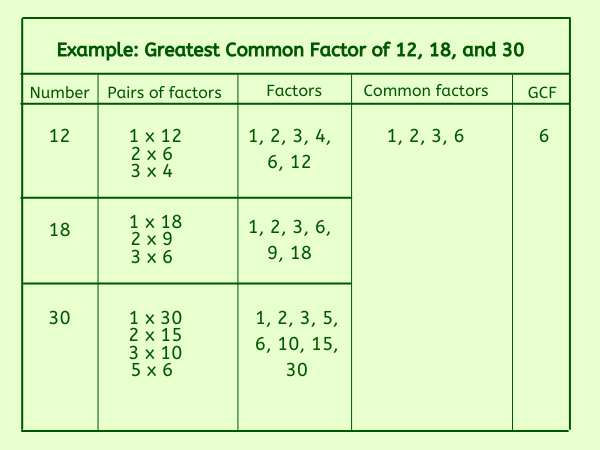
One way to find the GCF is the "list 'em all" method. It's like a family reunion for numbers, where everyone brings their factors. We'll start with 24. A factor is a number that divides evenly into our target number.
Must Read
So, who's invited to the 24 party? Well, obviously 1 is always there, the life of every numerical party. Then comes 2, because 24 is even. 3's on the list, because 3 x 8 = 24. 4 makes an appearance, followed by 6, 8, 12, and finally, the birthday boy himself, 24!
Here's the guest list for 24, just to be clear: 1, 2, 3, 4, 6, 8, 12, 24.
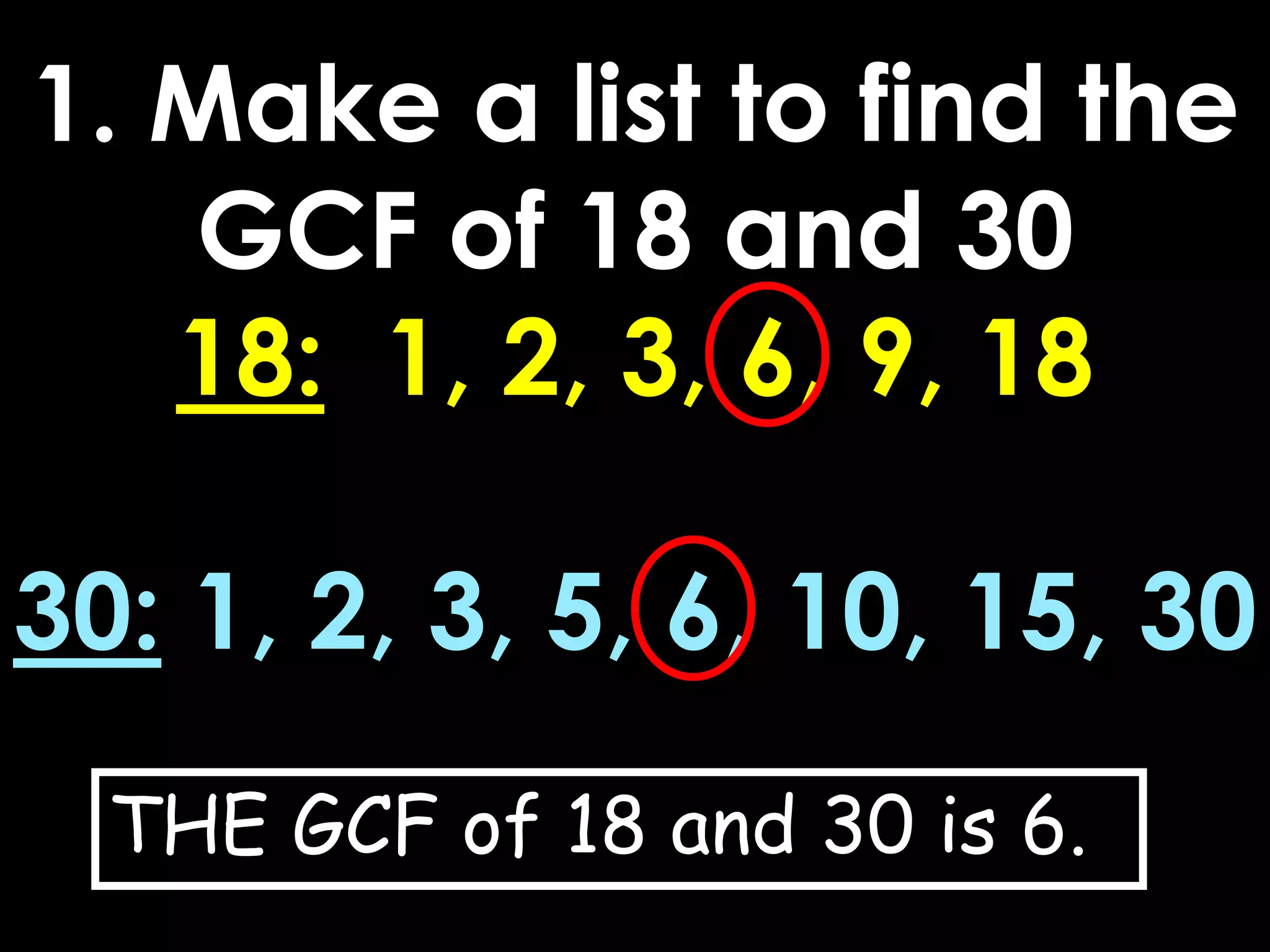
Now, let's see who's crashing the 45 bash. 1 is there (still the party animal). 3 makes an entrance (45 / 3 = 15). 5 pops in (45 / 5 = 9). 9 shows up, followed by 15, and then, you guessed it, 45 itself!
The 45 posse: 1, 3, 5, 9, 15, 45.
Alright, we've got our lists. Now comes the awkward part: the mingling. We need to find the numbers that are on both lists. Those are the "common factors."
Looking at our lists, we see that 1 is a common factor (duh, it's always there), and... 3 is there too! Bingo! Are there any others? Nope! 1 and 3 are the only numbers on both guest lists.
But we're not done yet! We need the greatest common factor. Which is bigger, 1 or 3? 3, obviously! So, the GCF of 24 and 45 is 3! 🎉
The Prime Factorization Power-Up
Okay, so the "list 'em all" method works, but it can get tedious, especially with big numbers. Imagine finding all the factors of 1,234,567! You'd be there all week! That's where prime factorization comes in. It's like giving your numbers a super-powered prime makeover.
A prime number is a number greater than 1 that's only divisible by 1 and itself. Think 2, 3, 5, 7, 11, 13, and so on. They're the building blocks of all other numbers.
Let's break down 24 into its prime factors. 24 can be divided by 2, giving us 12. 12 can be divided by 2, giving us 6. 6 can be divided by 2, giving us 3. And 3 is prime! So, the prime factorization of 24 is 2 x 2 x 2 x 3, or 23 x 3.
Now, let's do 45. 45 can be divided by 3, giving us 15. 15 can be divided by 3, giving us 5. And 5 is prime! So, the prime factorization of 45 is 3 x 3 x 5, or 32 x 5.
Now, the magic happens! To find the GCF, we look for the prime factors that both numbers share, and we take the lowest power of each shared prime. In this case, both 24 and 45 have a 3 as a prime factor. 24 has 31 (which is just 3), and 45 has 32. The lowest power is 31, which is just 3.
Therefore, the GCF of 24 and 45 is 3! BOOM! Same answer, different method. Like ordering pizza – you can call it in, or make it from scratch. Both get you delicious pizza (or, in this case, the GCF).

Why Bother with GCFs Anyway?
Okay, I hear you. "This is all well and good," you say, sipping your latte, "but why should I care about the GCF of 24 and 45?" Well, besides the cookie analogy (which is pretty compelling, if you ask me), GCFs are useful in a surprising number of situations.
For example, they're essential for simplifying fractions. Imagine you have the fraction 24/45. It looks kind of clunky, right? By dividing both the numerator and denominator by their GCF (which we know is 3), we get 8/15. Much cleaner! You can even impress your friends by saying you're "reducing the fraction to its lowest terms." Sounds smart, doesn't it?
They also pop up in algebra, number theory, and even cryptography (the art of secret codes!). While you might not be cracking government secrets anytime soon, knowing how to find the GCF is a valuable skill to have in your numerical toolkit. It's like knowing how to tie your shoes. You might not think about it much, but it's good to know!
So, there you have it! The thrilling, edge-of-your-seat tale of the GCF of 24 and 45. May your future be filled with evenly divided cookies and simplified fractions! And remember, even oatmeal raisin cookies deserve a fair share. Unless there are chocolate chip. Then all bets are off.