
Greatest Common Factor Of 18 And 12

Ever feel like numbers are just...floating around? Like they need a mission? Well, fear not! Because today, we're diving headfirst into the super-spy world of the Greatest Common Factor! Think of it as number matchmaking, but with extra steps and a whole lot of fun.
Our mission, should we choose to accept it, involves two particularly charming numbers: 18 and 12. Sounds simple, right? But trust me, beneath their seemingly ordinary exteriors lies a secret waiting to be unlocked. We're not just adding or subtracting; we're on a quest!
Why Should You Even Care?
Okay, I get it. Math sometimes gets a bad rap. But finding the Greatest Common Factor (GCF) is actually pretty darn useful. Imagine you're baking cookies. You have 18 chocolate chips and 12 sprinkles. You want to divide them equally among your friends. What's the biggest number of friends you can share with, ensuring everyone gets a fair and even distribution of both chips and sprinkles? That's where the GCF swoops in to save the day!
Must Read
Think of it as the ultimate division power! It helps with simplifying fractions, making problem-solving easier, and generally impressing your friends at parties (okay, maybe just impressing yourself, but hey, that's still a win!).
The Hunt Begins!
So, how do we find this elusive GCF of 18 and 12? There are a couple of secret agent techniques we can employ. First up: the trusty "listing factors" method. This is like gathering intel, compiling all the possible allies each number has.
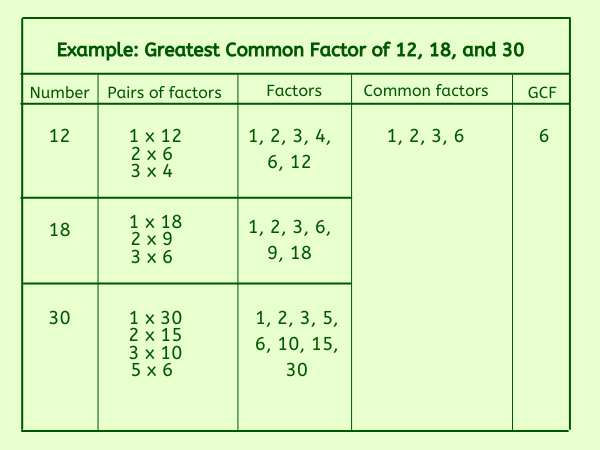
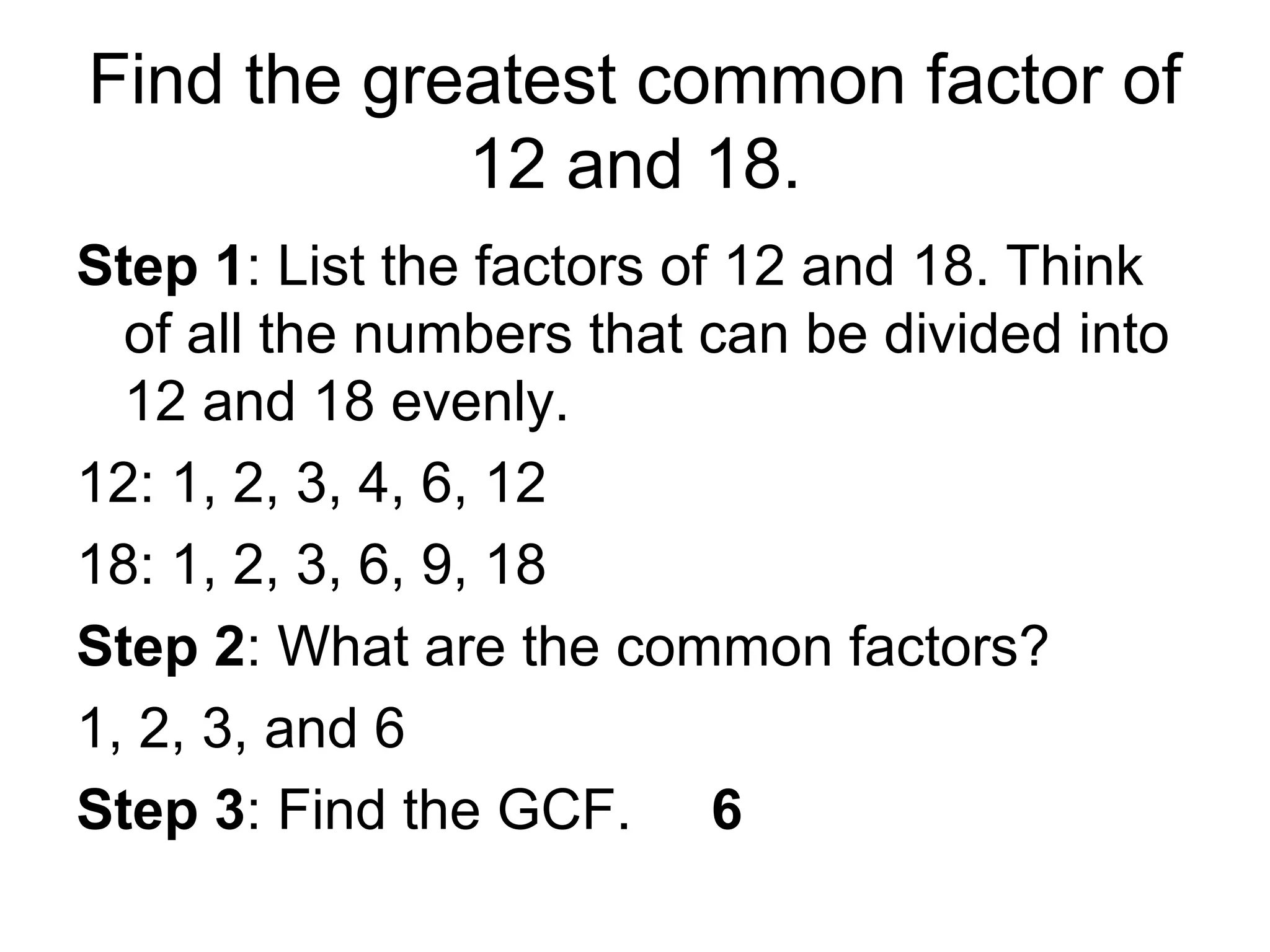
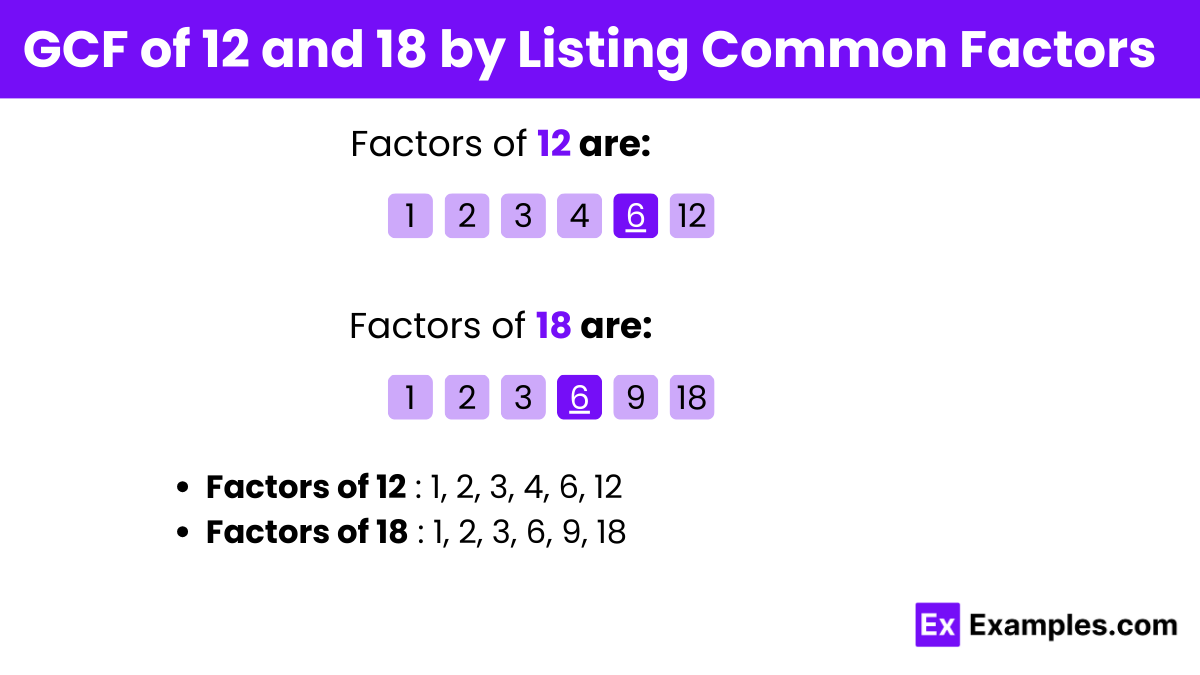
Let's look at 18. What numbers divide evenly into it? We've got 1, 2, 3, 6, 9, and of course, 18 itself. Those are 18's buddies, its factor squad!
Now for 12. Its crew consists of 1, 2, 3, 4, 6, and 12. Notice any familiar faces? This is where the magic happens.
The Big Reveal!
We've gathered our intel, now it's time to compare notes. Look at the factors we listed for both 18 and 12. Which numbers appear on both lists? Those are the "common factors." In this case, we have 1, 2, 3, and 6.
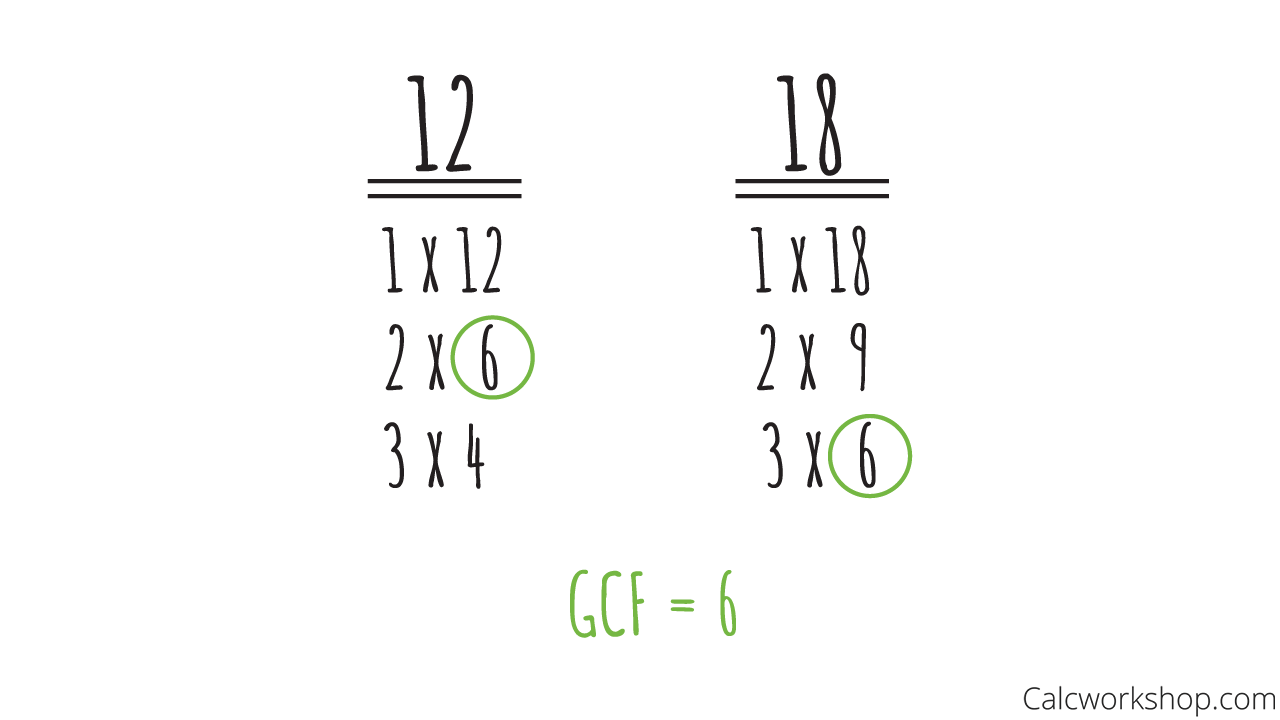
But we're not just looking for any common factor, we want the greatest one. The biggest, the baddest, the most influential factor they share. And the winner is…drumroll please…6!
That's right! The Greatest Common Factor of 18 and 12 is 6. Victory is ours!
Alternate Route: Prime Factorization Power!
Feeling adventurous? There's another way to crack this code, a more sophisticated approach involving something called prime factorization. It might sound intimidating, but it's just breaking down each number into its prime number building blocks.
Think of prime numbers like the atoms of the number world – they can't be broken down further (except by 1 and themselves). Examples include 2, 3, 5, 7, 11, and so on.
Let's decompose 18. It's equal to 2 x 3 x 3 (or 2 x 3²). Now, let's dismantle 12. It's equal to 2 x 2 x 3 (or 2² x 3).
To find the GCF, we look for the common prime factors and take the lowest power of each. Both numbers have a 2 and a 3. 18 has 2¹, and 12 has 2². We take 2¹ (which is just 2). 18 has 3², and 12 has 3¹. We take 3¹ (which is just 3). Multiply those together: 2 x 3 = 6. Ta-da! Same answer, different route. You've leveled up your number skills!
The Thrill of the Chase
So, what makes finding the GCF so entertaining? It's like solving a puzzle, uncovering a hidden relationship between numbers. It's about finding order in chaos, revealing the underlying structure. Plus, it's genuinely useful in real-world situations, from baking to building to who-knows-what-else.
And now you know the secret. So, next time you're faced with two numbers, remember the thrill of the hunt and the satisfaction of discovering their Greatest Common Factor. Who knows, you might even find yourself enjoying math a little more!
Go forth and conquer those numbers! The world needs more GCF detectives!