
Conversion Of Brinell Hardness To Rockwell Hardness
Ever wondered about those mysterious numbers associated with metals? You know, the ones that sound like some secret code? Well, get ready to decode a bit of it!
We're diving into the quirky world of hardness testing. Think of it as a battle royale for materials. Who can withstand the most pressure?
The Tale of Two Tests: Brinell vs. Rockwell
Let's introduce our main contenders. First up, the elder statesman, the granddaddy of hardness tests: Brinell Hardness. Then there's the young upstart, the speed demon: Rockwell Hardness.
Must Read
Each has its own method of measuring a material's resistance. It's like comparing apples and oranges, sort of. But what if you need to compare them?
Brinell: The Indentation Impressionist
Imagine a steel ball, pressed with a hefty force into a material. Brinell leaves a circular indent. The bigger the dent, the softer the material. Simple, right?
Brinell is great for getting an overall picture. It's like taking a wide-angle photo. You see the big picture of the material's hardness.
But what if you need detail? Brinell's not always the best for super-hard materials. The ball can get a bit squished. Think of trying to dent a diamond with a bouncy ball!
Rockwell: The Depth Detective
Rockwell is more refined, a bit more…precise. It uses different indenters and loads. Imagine a tiny, super-strong probe.
Instead of measuring the diameter of an indent, Rockwell measures the depth. It's like checking how far a rock sinks in quicksand. Less sinking equals harder material.
Rockwell offers various scales. Think of them as different magnifying glasses. Each scale focuses on a specific range of hardness. This makes it more versatile than Brinell. It's like having a tool for every job!
Why Bother Converting? The Plot Thickens!
So, why would you want to convert Brinell to Rockwell, or vice-versa? It's not just for kicks and giggles, although it is surprisingly fun.
Sometimes, you might only have Brinell data. Maybe it's an old report, or a standard you're stuck with. But your modern equipment spits out Rockwell numbers. What do you do?
Enter the magical world of conversion charts and equations! These are like translators between the two hardness languages. They help you bridge the gap between different testing methods. Think of it as Rosetta Stone for materials science!
Think about a detective trying to solve a cold case. They might have old witness statements (Brinell). But they need to compare them to new forensic evidence (Rockwell). Conversion is their secret weapon.
Or imagine you're reverse-engineering a product. You only have the material's Brinell hardness. You need to find a suitable replacement. Conversion helps you narrow down your search.
The Challenges of Conversion: A Word of Caution
Now, let's not get too carried away. Converting hardness values isn't a perfect science. It's more like an educated guess. Approximations are involved.
Materials behave differently. Think of comparing playdough to granite. The relationship between indentation size and depth isn't always linear.

Conversion charts are based on empirical data. They're created from testing a bunch of materials. But they're not universally applicable. Each material has its own quirks.
It's like trying to predict the weather based on past trends. You can get a general idea. But you can't guarantee accuracy. Always take conversions with a grain of salt.
Factors like material composition and heat treatment can also affect hardness. These aren't always accounted for in conversion charts. It's like forgetting to factor in humidity when predicting the weather.
So, remember: conversion is a helpful tool. But it's not a substitute for direct testing. If you need precise hardness values, always perform the appropriate test. Think of it as confirming your suspicions with solid evidence.
Conversion Methods: From Charts to Calculators
Okay, so how do you actually convert Brinell to Rockwell? There are a few methods. Let's explore some of the popular choices.
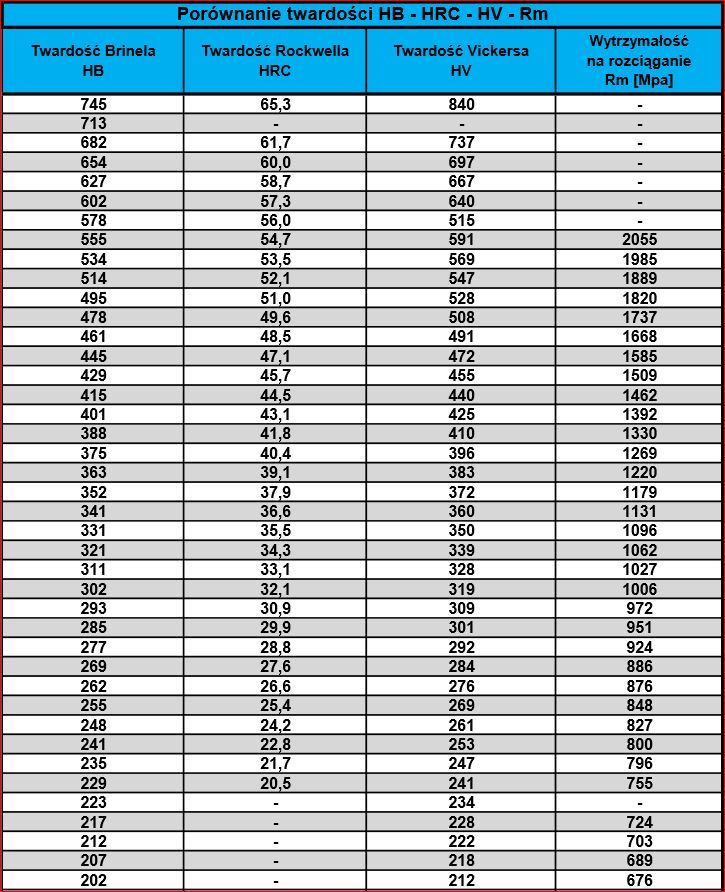
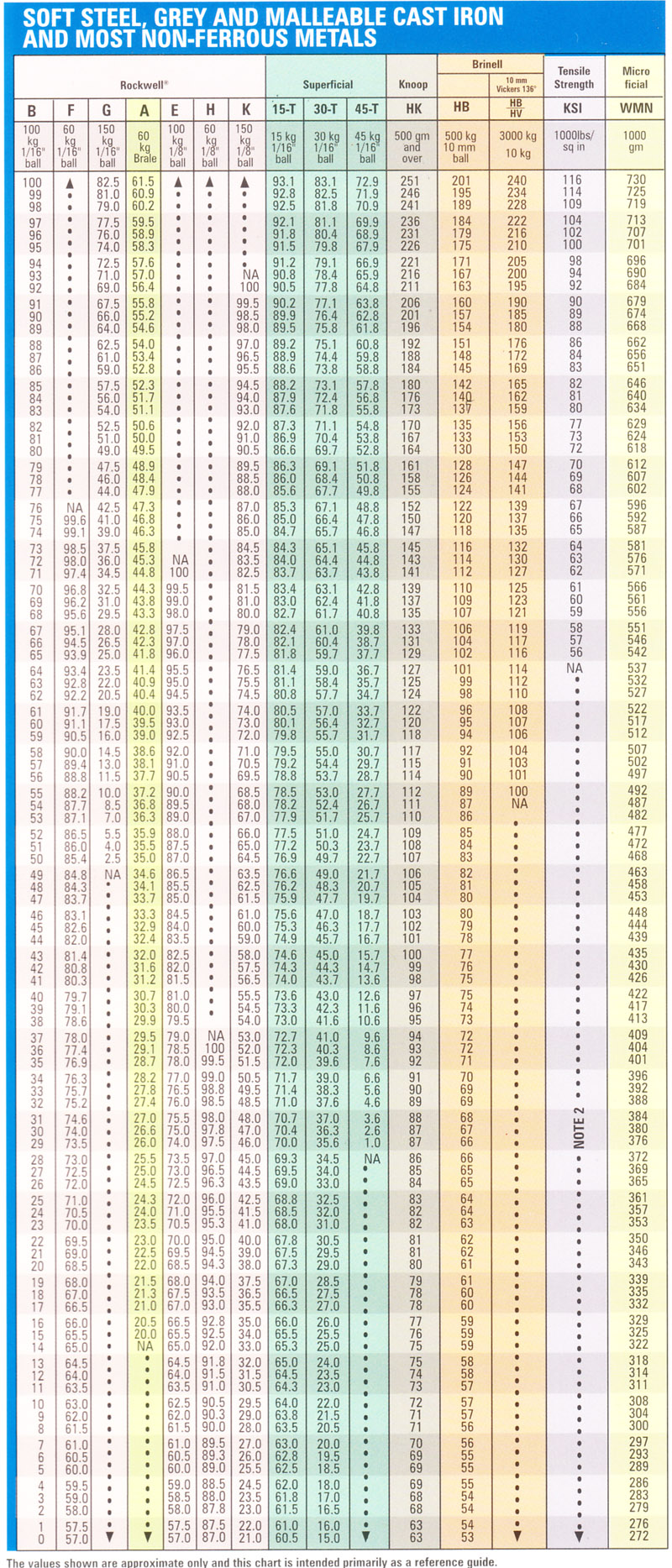
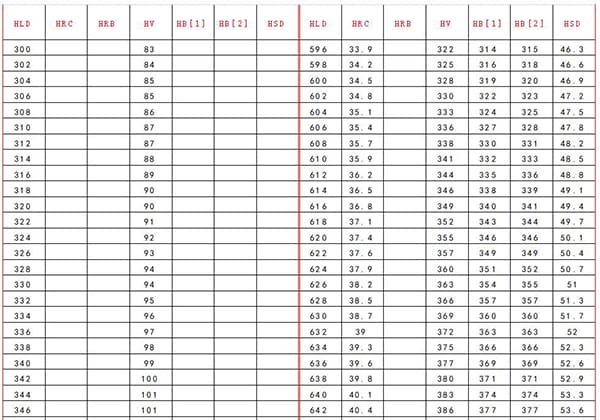
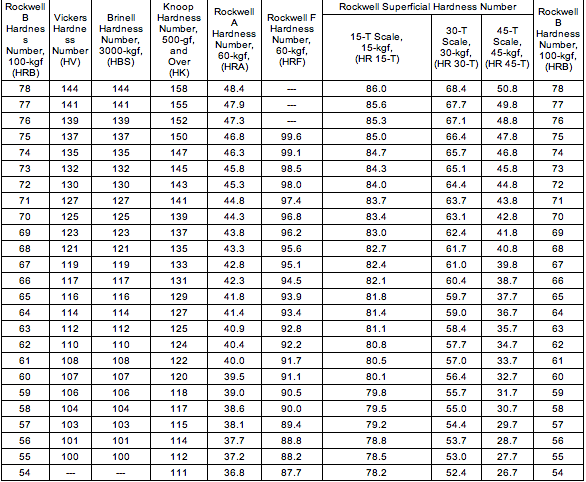
First, there are those handy-dandy conversion charts. These are like cheat sheets for hardness values. Look up your Brinell number. Find the corresponding Rockwell number. Voila!
Charts are great for quick estimations. They're easy to use and readily available. But they're not the most accurate. They're like using a map of the world printed on a napkin.
Then there are the equations. These are more mathematically rigorous. They use formulas to calculate the converted value. Think of them as applying physics to hardness testing.
Equations can provide more accurate results. But they require a bit more effort. You need to plug in the correct values and do the math. It's like solving a puzzle with numbers.
Finally, there are online calculators and software tools. These combine the convenience of charts with the accuracy of equations. They automate the conversion process. Think of them as having a hardness testing robot.
Just enter your Brinell value. Select the desired Rockwell scale. Click a button. Boom! Instant conversion. It's like having a magic wand for hardness testing.
Remember to choose a reputable source for your conversion charts, equations, or calculators. Not all sources are created equal. It's like trusting a fortune teller versus a scientist.
The Fun Factor: Why This Is Actually Interesting
Okay, I know what you're thinking. Hardness testing? Conversion charts? Sounds dry as toast, right? Wrong! This is actually surprisingly fascinating.
Think about it. You're learning about the fundamental properties of materials. You're uncovering the secrets of how things hold up under pressure. It's like being a materials detective.
You're also gaining a deeper appreciation for engineering and manufacturing. You're seeing how precision and accuracy are crucial for creating reliable products. It's like peeking behind the curtain of the modern world.
And let's be honest, there's something inherently satisfying about converting one number to another. It's like solving a riddle or cracking a code. It's a mini-victory for your brain.
So, next time you see a hardness value, don't just glaze over it. Take a moment to appreciate the science and engineering behind it. Maybe even try converting it to another scale. You might just surprise yourself with how much you enjoy it. Trust me, you might get hooked. It is like sudoku for material scientists.
Who knows? Maybe you'll even become the resident hardness conversion expert among your friends. You'll be the life of the party, regaling them with tales of Brinell and Rockwell. Okay, maybe not. But you'll definitely have some interesting knowledge to share.
Beyond the Numbers: The Bigger Picture
Conversion of hardness values is just one small piece of a much larger puzzle. It's part of the broader field of materials science and engineering. It helps us understand and improve the materials that shape our world.
From the skyscrapers that pierce the sky to the tiny microchips that power our devices, materials play a crucial role in everything we do. Understanding their properties is essential for creating safe, reliable, and efficient products.
So, the next time you use a tool, drive a car, or fly in an airplane, remember the materials scientists and engineers who worked tirelessly to ensure its safety and performance. They're the unsung heroes of the modern world. They are working hard to make sure everything stays together. And who knows, maybe one day, you'll join their ranks. It all starts with a little curiosity about hardness testing!
So get out there and explore the world of materials! You might just discover a hidden passion. And remember, even the seemingly dry topics can be surprisingly engaging. You just have to find the fun in the fundamentals.
Happy converting!