
Constitutional Isomer Of Cyclobutane
Hey there, curious minds! Ever stumbled upon something in science that made you go, "Wait, what?" Well, get ready, because we're diving into the fascinating world of constitutional isomers, specifically those of cyclobutane. And trust me, it's way cooler than it sounds.
So, what are constitutional isomers anyway? Think of it like this: you have the same building blocks (atoms!), but you arrange them in different ways to create totally different structures. It's like having the same LEGO bricks but building a car versus a house. Same pieces, different results!
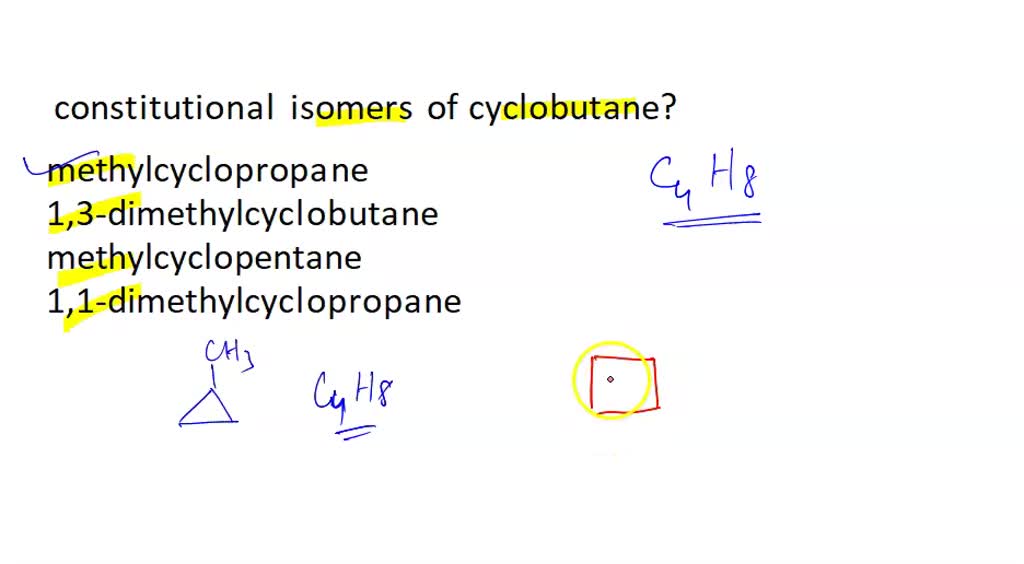
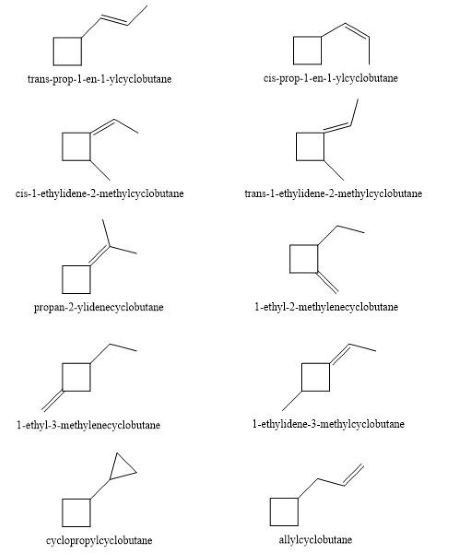
Now, let's talk about cyclobutane. It's a simple little molecule, a ring of four carbon atoms, each bonded to two hydrogen atoms. Pretty basic, right? But this is where the fun starts. Because even with this simple structure, we can play around and create isomers – molecules with the same formula (C4H8) but different arrangements.
Must Read
Simple But Sneaky: Why Cyclobutane Isomers Matter
Okay, so why should you care? Well, these different arrangements, these isomers, have different properties. Different boiling points, different reactivities, different ways they interact with other molecules. It's like having twins; they share the same DNA but have distinct personalities, right?
Consider the most obvious isomer: butane. It's a straight chain of four carbons. Completely different shape to cyclobutane's ring! And that difference in shape? Huge difference in behavior. Butane is a gas at room temperature, used in lighters. Cyclobutane is also a gas, but its ring structure makes it more reactive and it behaves differently.
But that's just the beginning! We can get even more creative by adding things called "substituents" to the cyclobutane ring. Substituents are just other atoms or groups of atoms that hang off the main ring structure. Imagine adding little LEGO attachments to your cyclobutane LEGO ring.
Let's say we add one methyl group (CH3) to the cyclobutane ring. Now we have methylcyclobutane! Easy peasy. But what if we add two methyl groups? Suddenly, things get interesting. Where do we put those methyl groups? Do we put them on the same carbon atom? Do we put them on adjacent carbon atoms? Do we put them on carbon atoms that are opposite each other?
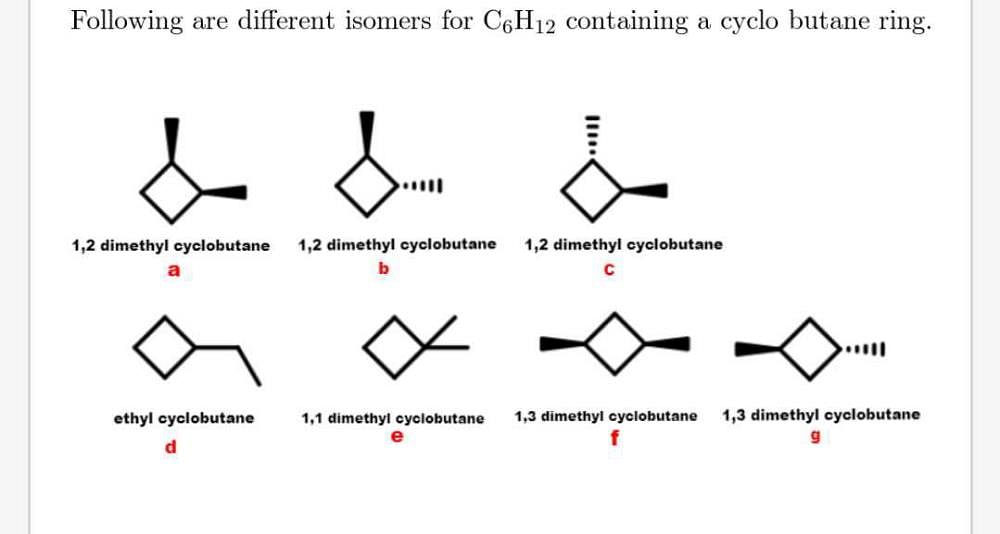
Each of these different arrangements is a different constitutional isomer. And each one has its own unique properties. That's the beauty of isomerism!
From LEGOs to Pharmaceuticals
So, what's the big deal in the real world? Why are chemists so obsessed with these tiny structural variations? Well, think about drugs. Many drugs are designed to interact with specific molecules in our bodies. And the shape of the drug molecule is absolutely critical.
Imagine a lock and key. The lock is a protein in your body, and the key is the drug. If the key doesn't have exactly the right shape, it won't fit the lock, and the drug won't work. Constitutional isomers are like slightly different keys; one might fit the lock perfectly, while the others won't fit at all, or might even jam the lock!
This is why understanding constitutional isomers is so important in drug discovery. Chemists need to be able to synthesize the right isomer, the one that will have the desired effect. Getting the wrong isomer can be useless, or even harmful. Scary, right?
It's not just about pharmaceuticals, either. Constitutional isomers also play a role in materials science, agriculture, and many other fields. Any time the shape of a molecule matters, isomerism becomes a critical factor.
The Takeaway: Shape Matters!
So, next time you hear someone talking about constitutional isomers, don't tune out! Remember the LEGO analogy, remember the lock and key. And remember that even the simplest molecules, like cyclobutane, can have a surprising amount of structural diversity.
Think about it – a simple change in arrangement can lead to a whole new molecule with its own unique properties. That's pretty darn cool, isn't it? It's a reminder that in the world of molecules, shape really does matter. And it's a testament to the power of chemistry to create, understand, and manipulate the building blocks of our universe.
Keep exploring, keep questioning, and keep your mind open to the amazing world of chemistry. You never know what fascinating discoveries you might make!