
Carbon Monoxide Heavier Lighter Than Air

Ever heard about Carbon Monoxide, or CO for short? It’s often called the “silent killer,” and for good reason. It’s odorless, colorless, and super dangerous. But forget the scary stuff for a second, because today we’re diving into something way more curious about CO: its weight. Is it heavier or lighter than the air we breathe?
It sounds like a simple question, right? But the answer, and why that answer matters, is actually pretty fascinating. Let's peel back the layers and get a little nerdy in a chill way.
The Great Gas Weight Debate: CO vs. Air
So, take a moment. What's your gut feeling? Does CO feel like it should be heavy, like a dense fume that sinks to the floor? Or light, like something that just drifts away?
Must Read
Many people assume that because it’s a "fume" or a "gas," it might be heavier. Maybe it settles near the ground, making it more dangerous for pets or small children, right? Or perhaps it's like smoke, rising gently?
Well, here’s the interesting truth: Carbon Monoxide is actually slightly lighter than regular air. Yep, you read that right. Not by a huge amount, mind you, but just a touch.
What Does "Slightly Lighter" Even Mean?
When we say "slightly lighter," we're not talking about helium in a party balloon dramatically soaring to the ceiling. Think less "hot air balloon" and more "a really good feather that barely wants to float."
+Properties:+colorless%2C+odorless%2C+heavier+than+air%2C+%25+of+atmosphere..jpg)
To get a little scientific without getting bogged down: Air isn't just one thing. It's a mix of gases, mostly nitrogen (N₂) and oxygen (O₂). Carbon Monoxide (CO) is made of one carbon atom and one oxygen atom.
When you compare the molecular weight of CO to the average molecular weight of the air around us, CO just squeaks by as being a tad lighter. We're talking about a difference so small, you wouldn't notice it with your bare eyes, even if you could see the gas itself.
Why Is This Little Detail So Cool (and Sneaky)?
This subtle difference in weight is actually a huge part of what makes CO so insidious. If CO were much heavier, like say, carbon dioxide (CO₂), it would tend to sink and collect in lower areas. If it were much lighter, like methane (the main component of natural gas), it would quickly rise and dissipate near the ceiling.
+Properties:+colorless%2C+odorless%2C+heavier+than+air%2C+%25+of+atmosphere..jpg)
But because CO is so close to air in density, what does it do? It doesn't really sink, and it doesn't really float away. Instead, it does something far more dangerous: it mixes. Seamlessly.
Imagine pouring two liquids into a glass that are almost identical in density – like water and slightly diluted water. They wouldn't separate into layers; they'd just blend together perfectly. That's essentially what CO does with the air in your room.
It doesn't form a detectable layer near the floor, nor does it hang out exclusively near the ceiling. Instead, it becomes an invisible, undetectable part of the air you're breathing. No smell, no color, no visible settling or rising. Just... there.

Beyond the Balloon Analogy: Real-World Implications
This blending behavior is precisely why CO is such a problem. You can't just open a window and expect it to magically "float out" or "sink away." While ventilation helps by bringing in fresh air to dilute the CO, the gas itself is happy to hang out wherever the air is.
Think about a crowded room. If someone farts, the smell eventually spreads throughout the entire space, right? It doesn't just stay in one corner, nor does it only rise to the ceiling. It diffuses. CO does something similar, but without the benefit of a tell-tale odor!
This scientific tidbit also explains a lot about carbon monoxide detectors. Ever wondered why you can place them at various heights, not just right on the floor or high up?
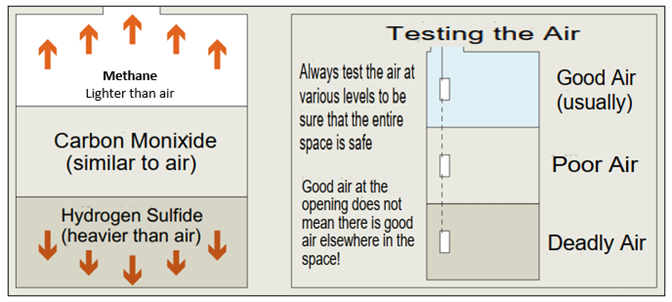
Because CO mixes so uniformly with the air, a detector placed at eye level, near the floor, or higher up can all potentially detect dangerous levels. While recommendations sometimes vary, the key is that it's the concentration in the general breathing space that matters, not its specific layering.
The Coolness of Tiny Differences
Isn't it amazing how such a tiny difference in molecular weight can have such profound implications? It turns an otherwise "just another gas" into a uniquely challenging invisible threat.
So, the next time you hear about Carbon Monoxide, you'll know a little secret. It's not heavy, it's not super light, but its barely-there difference from regular air is what makes it such a masterful blender. It’s a testament to how even the smallest scientific details can reveal the biggest truths about our world and how we stay safe within it. Pretty cool, huh?