
43 Out Of 50 As A Percentage Grade

Alright, gather 'round, folks! Let's talk about something near and dear to all our hearts: grades. Specifically, the age-old question of "What the heck is 43 out of 50 as a percentage?" Because honestly, who actually remembers how to do that stuff after high school? I mean, besides my Aunt Mildred who still calculates the tip down to the exact penny. God bless her.
So, picture this: you're staring at your kid's report card. Or maybe your report card, no judgment here! There it is, staring back at you in bold, judgmental font: 43/50. Panic sets in. Do you need to start selling your prized Beanie Baby collection to pay for tutoring? Is Harvard officially off the table? Hold your horses, Sparky, we're gonna break this down. No tears allowed… unless they’re tears of joy because it's actually a decent grade.
The Dreaded Math Part (Simplified, I Promise!)
Okay, deep breaths everyone. Math. I know, I know. It's like the vegetable of academics. You know it's good for you, but you’d rather have a donut. But trust me, this is easier than parallel parking in San Francisco. The basic formula is this:
Must Read
(Your Score / Total Possible Score) * 100 = Your Percentage
So, in our case, it's (43 / 50) * 100.

Now, if you're anything like me, the sight of fractions makes you want to curl up in a ball and binge-watch cat videos. Luckily, the modern age has bestowed upon us a glorious gift: calculators! (And also cat videos, but let's stay focused). Whip out your phone, your computer, your trusty abacus if you're feeling old-school, and punch in those numbers.
43 divided by 50? That's 0.86. Easy peasy lemon squeezy!
Now, multiply that by 100. Boom! 86.
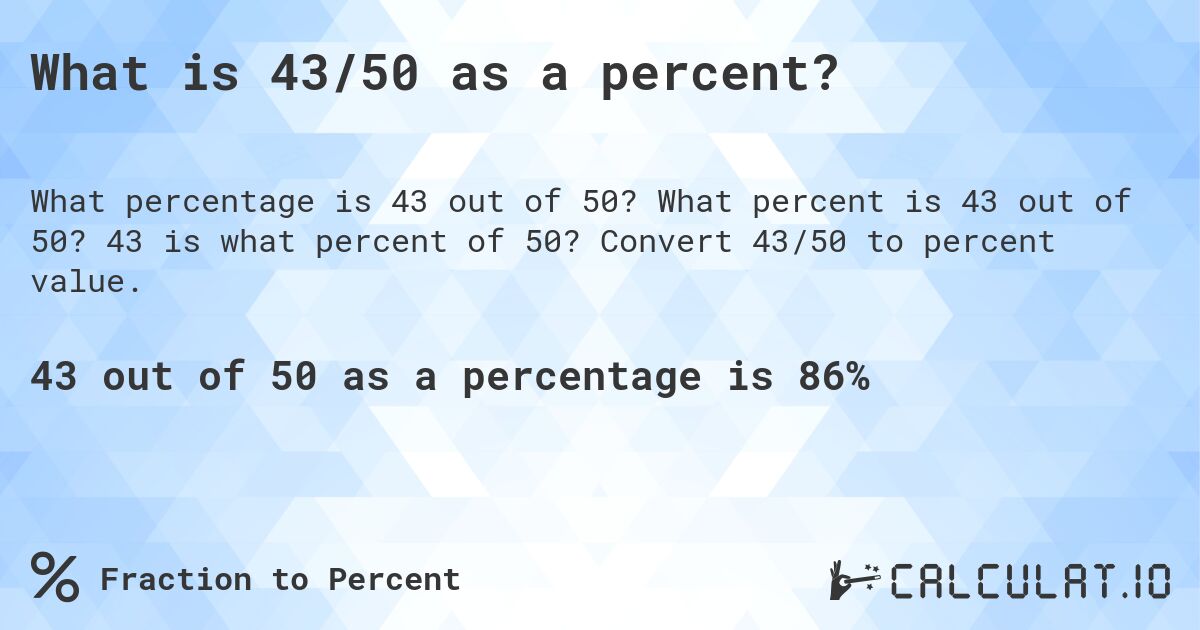
So, 43 out of 50 is 86%. Give yourself a pat on the back. You survived! And you now know more math than… well, probably more than you need to know to order a pizza.
But What Does 86% Really Mean?
Ah, the million-dollar question. Or, more accurately, the slightly above average grade question. An 86% is generally considered a solid B+. Not bad! You're not quite acing the class, but you're definitely not failing. Think of it as the academic equivalent of getting the slightly-too-small free t-shirt at a concert. It's not perfect, but hey, it's free (or, in this case, earned!).
Of course, what a B+ means really depends on the class and the teacher. Some teachers are notoriously tough graders. For them, an 86% might as well be a Nobel Prize. Others hand out A's like candy on Halloween. So, take it with a grain of salt. And maybe bribe the teacher with cookies. Just kidding! (Mostly.)

Here's a shocking fact: Did you know that in some cultures, grades are considered much less important than effort and participation? Imagine that! No more stressing over that one pesky percentage point. Just show up, try your best, and maybe bring a really good pen to class. Okay, I'm exaggerating... slightly.
The "So What?" Factor
Okay, you know it's 86%. You know it's probably a B+. But so what? Is this going to change your life? Probably not. Are you going to suddenly become a rocket scientist? Unlikely (unless you already are one, in which case, congratulations!).
But here’s the thing: understanding percentages is actually pretty useful in everyday life. From calculating discounts at the grocery store (because who doesn't love a good sale?) to figuring out your tax bracket (okay, maybe not love that one), percentages are everywhere. So, congrats! You've leveled up your adulting skills.
Now, go forth and conquer! Armed with your newfound knowledge of percentages, you can confidently tackle any numerical challenge that comes your way. Or, you know, just impress your friends at your next trivia night. The choice is yours.
And if you ever forget how to calculate a percentage again? Just remember Aunt Mildred and her uncanny ability to calculate tips. Or, you know, just Google it. No shame in that game.
Just don't tell Aunt Mildred I said that.