
Which Of The Following Compounds Has The Highest Boiling Point

Alright folks, gather 'round! Pull up a chair, grab a virtual coffee, because we're about to dive headfirst into the wacky world of boiling points. Forget your celebrity gossip, this is the real drama, starring… molecules!
Imagine you're at a molecular party. Some molecules are just chillin', barely interacting. Others are clinging to each other like stage-five clingers. And that, my friends, is the secret to understanding which compound has the highest boiling point.
The Boiling Point: It's Not Just Hot Air
So, what is a boiling point, anyway? Well, it's the temperature at which a liquid turns into a gas. Think of it like this: at the boiling point, the molecules in the liquid have finally had enough of each other and are like, "Peace out, I'm becoming a gas!" They break free from their liquid bonds and zoom off to freedom.
Must Read
The higher the boiling point, the more energy (heat) you need to pump into the liquid to make those molecules break up. It's like trying to separate two best friends who are glued together. You need a lot of convincing… or a very hot poker.
The Culprits: The Usual Suspects for High Boiling Points
Now, let's talk about the factors that influence these boiling points. It's all about the intermolecular forces - the attractions between molecules. Think of them as the molecular equivalent of friendship bracelets… some are strong, some are weak, and some are held together with duct tape and wishful thinking.
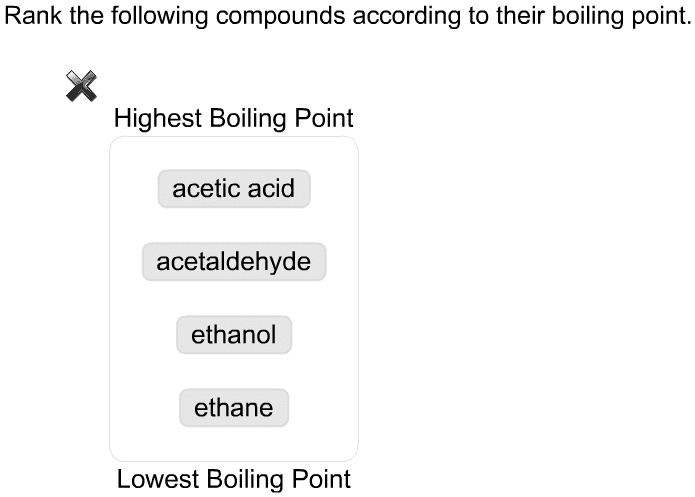
Here's the lowdown on the main players:
- Hydrogen Bonding: This is the strongest of the bunch. Picture two molecules holding hands really, really tightly, and then imagine that handshake being a super glue situation. Water (H2O) is a prime example. That's why it takes so much heat to boil water - those pesky hydrogen bonds are persistent!
- Dipole-Dipole Interactions: These are like weaker handshakes. They happen between polar molecules, which are molecules with a slightly positive end and a slightly negative end. Opposites attract, you know?
- London Dispersion Forces (Van der Waals forces): These are the weakest links, like awkward waves from across the room. Every molecule has them, but they're especially important for nonpolar molecules. The bigger the molecule, the stronger these forces tend to be. Think of it like trying to shake hands with a giant inflatable tube man - more surface area, more force needed!
Molecular Weight: Don't forget about size! Generally, the heavier the molecule, the higher the boiling point. It's like trying to push a sumo wrestler versus pushing a chihuahua. The sumo wrestler requires more effort, right?

Cracking the Case: Which Compound Reigns Supreme?
Okay, let's say we're faced with a lineup: methane (CH4), ethanol (CH3CH2OH), and water (H2O). Which one has the highest boiling point? Let's investigate.
Methane (CH4): This is a small, nonpolar molecule. It only has weak London Dispersion Forces. Poor methane – it's basically the wallflower at the molecular party.
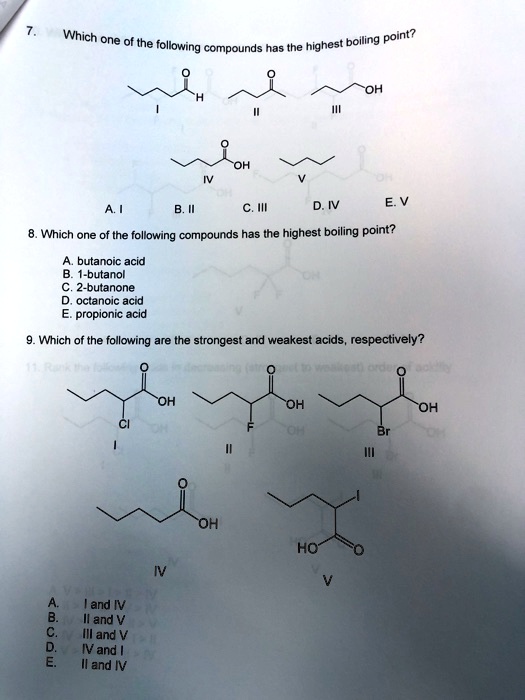
Ethanol (CH3CH2OH): Now we're talking! Ethanol has hydrogen bonding (thanks to that -OH group) and it's bigger than methane. It's like the cool kid at the party who knows everyone and has a bottle of… something.
Water (H2O): Ah, water. It's small, but mighty! It's got strong hydrogen bonding. Two hydrogen atoms bonded to oxygen? That's a hydrogen bonding bonanza! Water is the life of the party, even if it sometimes spills on the carpet.
So, the winner is… (drumroll please)... Water (H2O)! Even though it's smaller than ethanol, its strong hydrogen bonding makes it the champion of boiling points in this scenario.
The Moral of the Story (Besides Science is Cool):
When you're trying to figure out which compound has the highest boiling point, remember these key things:
- Look for hydrogen bonding. It's a game-changer.
- Consider the molecular weight. Bigger is usually better.
- Think about the overall shape and polarity of the molecule. Is it a tightly packed, polar molecule or a sprawling, nonpolar blob?
And remember, chemistry can be fun! It's all about understanding the crazy relationships between tiny particles. Now go forth and impress your friends at your next… molecule-themed party? Okay, maybe just impress them with your newfound knowledge. You’ve earned it!