
Where Was Electricity First Discovered
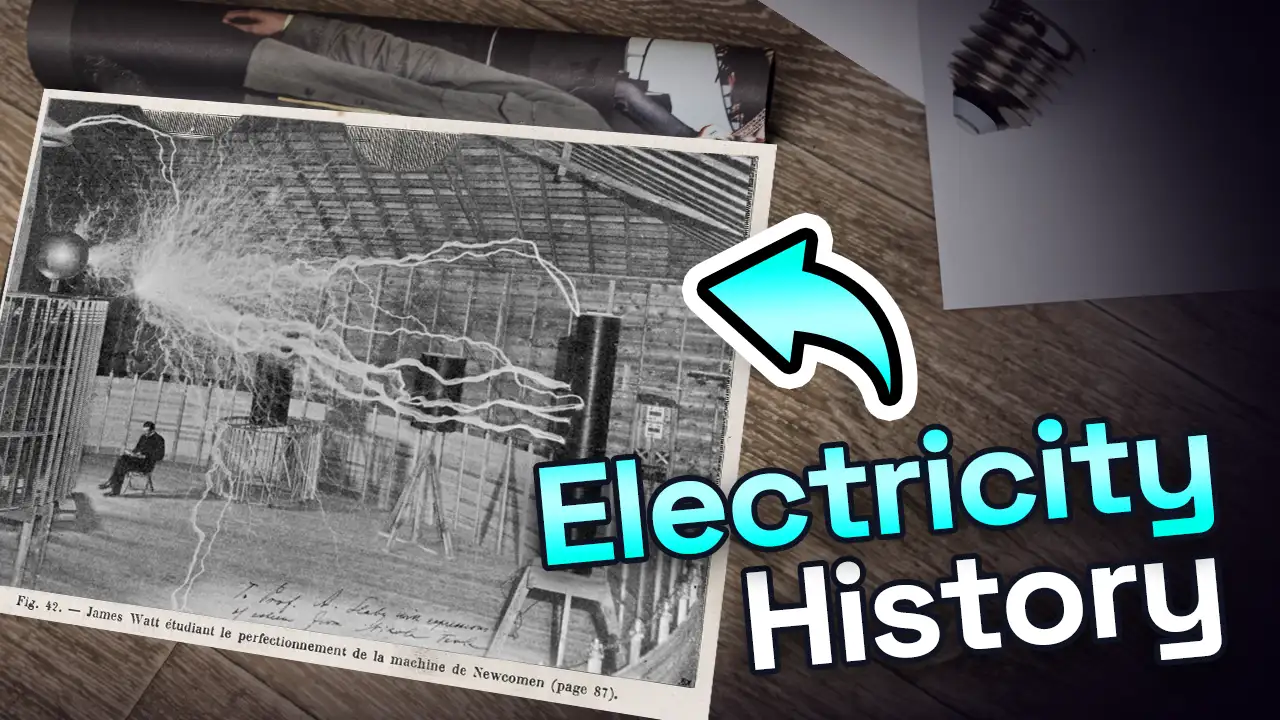
Ever had a power outage? That moment when the lights flicker, the Wi-Fi dies, and your phone starts looking suspiciously like a fancy brick? You suddenly remember what life was like, well, before... everything. We're so utterly dependent on electricity, it's almost funny. But have you ever stopped to wonder, amidst the charging cables and smart lightbulbs, where on earth this magical stuff was first discovered?
It’s not like someone tripped over a giant, glowing "ELECTRICITY HERE" sign in the woods one day, right? Or invented it in a garage like a new kind of toaster. Electricity wasn't so much invented as it was slowly, painstakingly, and sometimes quite shockingly, understood. Think of it less like discovering a new flavor of ice cream and more like realizing the air you've been breathing your whole life actually has ingredients. Mind-blowing, right?
The Ancient Sparks: When Amber Met Wool (or Fur)
Our story kicks off way, way back with the ancient Greeks, around 600 BC. Picture this: a bunch of curious folks, probably bored with philosophy for a minute, messing around with a yellowish fossilized tree resin called amber. They noticed something weird. If you rubbed this amber with a piece of wool or animal fur (think of your fluffy sweater and a cat, but less cute), it would suddenly attract light things – like feathers or little bits of straw. It was basically the world's first, very primitive, and completely accidental static cling experiment.
Must Read
Ever rubbed a balloon on your head and then stuck it to a wall? Same vibe! Only the Greeks didn't have balloons, or walls, probably. They just knew this amber (which, by the way, they called "elektron") had some kind of mysterious attraction. They had no idea why it happened, just that it did. It was like seeing your dog spin in circles before lying down – you know it’s going to happen, but the underlying physics? Nah, just cute.
Naming the Unseen: "Electricus" Enters the Chat
Fast forward a couple of millennia to the 16th century. Enter William Gilbert, an English scientist and physician to Queen Elizabeth I. This guy was a real MVP. He was the first to properly study this "amber effect" methodically. He realized it wasn't just amber that did this; other materials could, too. He's the one who coined the term "electricus" (from the Greek "elektron") to describe these properties. Basically, he gave this mysterious force a name, finally making it sound less like a magical spell and more like a scientific phenomenon.
Gilbert was like that friend who, after years of you mumbling about "that weird feeling," finally says, "Oh, you mean anxiety?" and suddenly it has a label, and you can start to understand it. Big step!
Kites, Keys, and a Dash of Danger: Franklin's Zany Experiment
Now, let's talk about the rock star of early electricity, Benjamin Franklin. Yes, the guy on the hundred-dollar bill, the kite, the key! In the mid-1700s, Franklin, ever the tinkerer, wanted to prove that lightning was, in fact, electricity. This sounds obvious now, but back then, it was a wild theory.

His famous (and incredibly dangerous) kite experiment involved flying a kite with a metal key attached during a thunderstorm. When lightning struck (or rather, when static electricity from the storm clouds traveled down the wet string to the key), he felt a shock. Please, for the love of all that is holy, do NOT try this at home! This was like jumping out of a plane to prove gravity – incredibly risky, but it worked. Franklin's experiment, while often romanticized and a tad oversimplified in cartoons, was a monumental step in understanding that the immense power of a storm was the same stuff that made amber attract feathers.
From Zaps to a Steady Stream: Volta's Battery Breakthrough
While Franklin proved lightning was electrical, it was still all about unpredictable sparks and static zaps. What we needed was a way to make electricity flow continuously. Enter Alessandro Volta, an Italian physicist, at the turn of the 19th century. He built the first true electric battery, the voltaic pile, in 1800.

Imagine stacking alternating discs of copper and zinc, separated by brine-soaked cardboard. Boom! You had a steady flow of electrical current. This was a game-changer! Before Volta, studying electricity was like trying to catch raindrops in a thimble. After Volta, it was like turning on a garden hose. Scientists finally had a reliable source to experiment with, paving the way for everything that followed – motors, generators, light bulbs, and eventually, the phone you're probably holding right now.
So, Where Was It First Discovered?
The answer, then, isn't a single place or moment. It was discovered piecemeal, across continents and centuries. It began with the curiosity of the ancient Greeks, continued with the systematic observations of Gilbert, saw a dramatic (and terrifying) confirmation by Franklin, and finally found its steady supply thanks to Volta's brilliant battery. It was a journey from a curious static cling to a controlled, continuous current.
So, the next time you flip a light switch or charge your device, give a little nod to all those brilliant, brave, and sometimes slightly crazy individuals who slowly unraveled the mystery of electricity. Because without them, we’d still be rubbing amber and wondering why our hair stands on end. And honestly, who has time for that when there's TikTok to scroll?
